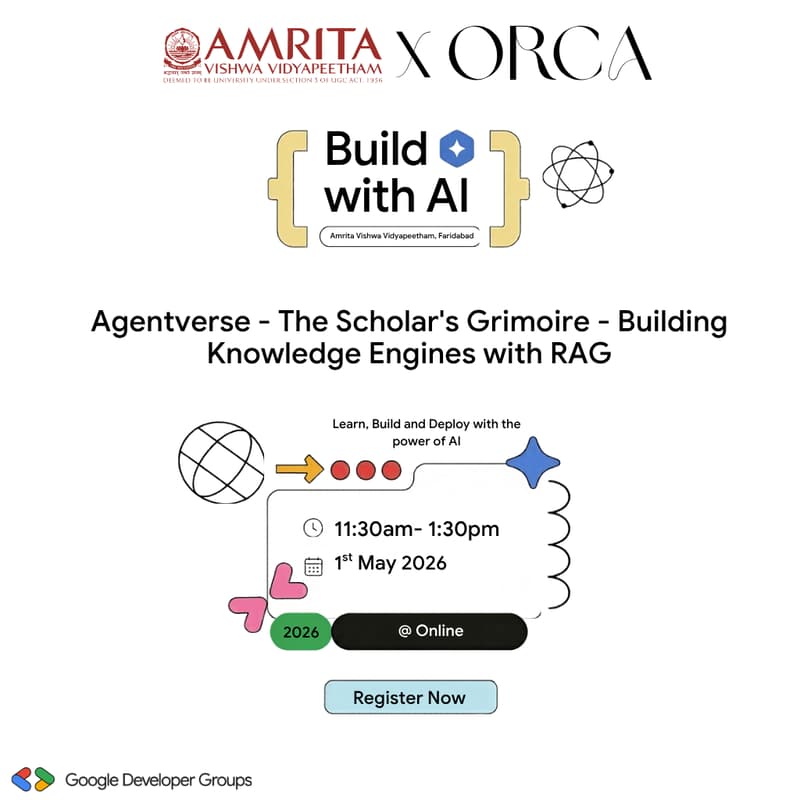
Agentverse - The Scholar's Grimoire - Building Knowledge Engines with RAG
Build a RAG Agent on Google Cloud — The Scholar's Grimoire
Most people learning AI are stuck in tutorial hell. They watch videos, read docs, and still can't answer the one question that actually matters: how does real data become real intelligence?
This session answers that question — by making you build it yourself.
We're going online for a hands-on codelab where you go from raw, unstructured text files sitting in a storage bucket to a fully deployed, production-style RAG agent running on Google Cloud. Not a toy. Not a Jupyter notebook you'll never open again. A live, callable agent — with a vector database, a semantic search engine, and a Gemini brain — deployed on Cloud Run.
Here's what actually happens across the session:
You start with chaos. Messy, unstructured battle logs scattered across Google Cloud Storage — the kind of data that breaks every naive approach. Your first move is to point BigQuery at it without moving a single file, then summon a Gemini model directly from SQL to read those logs and extract structured meaning from them. No Python. No Spark. Just SQL calling an LLM mid-query. It's a genuinely different way to think about data transformation.
Then you go deeper. You take that raw text, chunk it into semantically meaningful pieces, run it through an embedding model, and store the resulting vectors — all inside BigQuery. You write a semantic search query that finds relevant passages not by keyword, but by meaning. You type a question in plain English and the system returns the closest conceptual match from your data. That moment is what RAG actually feels like from the inside.
Then you scale it. You build a Dataflow pipeline — Apache Beam running on Google's serverless infrastructure — that automates the entire read-embed-write loop at scale. This is what separates a working prototype from something that doesn't fall over when the data grows.
And finally, you wire up the agent. You plug a pgvector-backed PostgreSQL database into an ADK agent running Gemini 2.5 Flash, give it a retrieval tool, and deploy the whole thing to Cloud Run. At the end, you have a live URL. You can call it. It uses your data to answer questions.
Why this stack. Why now.
The gap between "I understand RAG conceptually" and "I have built and deployed a RAG system" is enormous. Most content stops at the concept. This session is entirely the second thing.
BigQuery ML doing LLM inference inside SQL queries is genuinely underexplored. pgvector closing the gap between relational databases and vector search is real and production-ready. Dataflow handling batch vectorization at scale is what teams at companies actually use. You're not learning toy versions of these ideas — you're learning the real plumbing.
Who this is for
You don't need to be an ML engineer. You need to be curious, willing to type commands in a terminal, and interested in understanding how AI systems are actually assembled — not just used.
If you've ever wondered what happens between "we have data" and "we have an intelligent agent" — this session is that missing chapter.
What you leave with
A deployed RAG agent. A working mental model of the full data-to-agent pipeline. And the specific, concrete knowledge of how Google Cloud's data and AI services fit together in a system that actually does something.
Come build something real.
Host Community
This event is hosted by Orca AI Club in collaboration with Amrita Vishwa Vidyapeetham, Faridabad, supported by Google Developer Groups.
🎁 Note: Attendees will receive $5 in Google Cloud credits upon joining the session, which can be used to follow along with the hands-on codelab directly on Google Cloud — no setup cost, no barriers.