
Top AI Researchers Roundtable & BBQ Party in Los Altos Hills
Event Overview
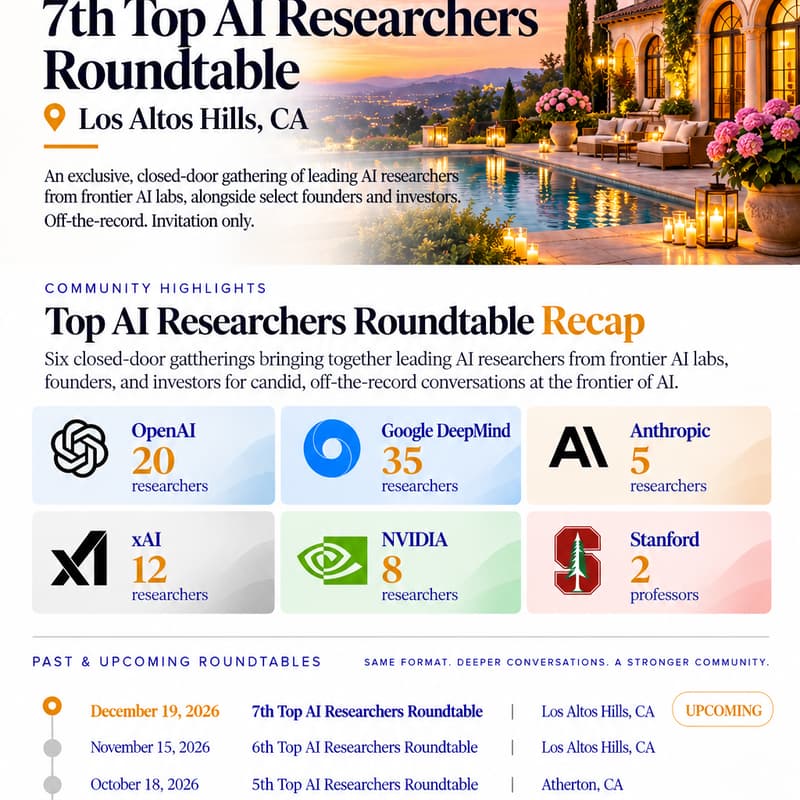
Since launching the series in May 2026, we’ve successfully hosted six exclusive, closed-door Top AI Researchers Roundtables, fostering meaningful connections and in-depth conversations among researchers and leaders from the world’s foremost AI labs and research institutions. Participants have included:
Ed Chi — VP of Research at Google DeepMind
20 researchers from OpenAI
5 researchers from Anthropic
35 researchers from Google DeepMind
12 researchers from xAI
8 researchers from NVIDIA
2 Stanford professors
Xuedong Huang — CTO, Zoom
Yuandong Tian — Co-founder of Recursive (Raising $650M)
We’re excited to continue this tradition with our 7th Top AI Researchers Roundtable, taking place on December 19, from 3:00 PM to 5:00 PM, at a private residence in Los Altos Hills.
This invitation-only gathering will once again bring together leading researchers from OpenAI, Google DeepMind, Anthropic, xAI, and other frontier AI labs and research institutions for an intimate, closed-door discussion exploring some of the most important questions shaping the future of artificial intelligence.
This will be a fully closed-door, off-the-record conversation focused on the future of AI systems—from frontier research breakthroughs and emerging technical challenges to the next wave of opportunities that could shape the industry over the coming years.
Following the roundtable, guests will continue the discussion over a private BBQ reception with fellow researchers, founders, investors, and industry leaders.
Core Discussion Topics
As AI agents move from experimental applications toward everyday use, two fundamental questions are emerging: whether personal AI agents can achieve mass-market adoption, and whether our existing security infrastructure is prepared for increasingly autonomous AI systems.
This roundtable brings together leading AI researchers to explore five critical questions spanning consumer demand, agent architecture, model safety, security infrastructure, and emerging market opportunities.
Rather than formal presentations, the discussion will focus on open questions, technical challenges, differing perspectives, and the opportunities that could shape the next generation of AI.
QUESTION 1 · THE PERSONAL AGENT MARKET
Is the Personal Agent a genuine mass-market opportunity or a Silicon Valley assumption?
Emerging personal agent products raise important questions about the depth of consumer demand, geographic differences in adoption, and willingness to pay. While AI agents promise to automate everyday tasks, it remains unclear whether mainstream consumers have enough recurring needs to sustain a mass-market product.
Follow-up questions
Do mainstream consumers have enough tasks to delegate to AI agents?
Are ordinary people willing to pay for time savings?
Is the current growth bottleneck driven by limited model capabilities, immature product experiences, or fundamentally weak consumer demand?
QUESTION 2 · THE FUTURE OF PERSONAL AGENTS
What is the ultimate form of the Personal Agent?
As AI agents become more capable, their eventual product form remains an open question. Personal agents could evolve into universal, persistent assistants, specialized tools for individual use cases, or capabilities embedded directly into existing digital environments.
Follow-up questions
Will everyone have a universal, persistent personal agent, or will specialized agents dominate different use cases?
Is the primary value proposition time savings, capability augmentation, or emotional companionship?
Will personal agents become standalone super apps or native features of operating systems and existing applications?
What will be the killer use case that drives mass adoption?
QUESTION 3 · THE LIMITS OF MODEL SAFETY
Can Model Safety be fundamentally solved at the model level?
As AI models become more intelligent and autonomous, alignment, prompt injection, deception, and reliable oversight present increasingly important technical challenges. Recent disruptions across digital infrastructure also raise broader questions about the resilience of the systems into which autonomous agents may eventually be integrated.
Follow-up questions
As models become more capable and autonomous, will alignment, prompt injection, and deception become easier or harder to address?
Can less capable AI reliably supervise more intelligent AI?
Can model-level safeguards provide sufficient protection, or are additional architectural safeguards necessary?
Do we need to fundamentally redesign our digital security architecture before autonomous agents become widely integrated into critical infrastructure?
QUESTION 4 · THE EMERGING AI SECURITY MARKET
How big is the AI Security market, and what should the next generation of security products look like?
The emergence of autonomous agents introduces new security challenges across model behavior, identity, authorization, runtime monitoring, and execution control. These challenges raise questions about whether existing cybersecurity products can adapt or whether an entirely new category of security infrastructure will emerge.
Follow-up questions
Will AI security be an incremental expansion of traditional cybersecurity or an entirely new $100B+ market?
Will the winning product be a model-native safety layer, an agent firewall, a runtime monitoring system, or a new infrastructure layer for identity, authorization, and execution control?
Which security needs will translate into independent and sustainable revenue streams?
QUESTION 5 · THE AI SECURITY ECOSYSTEM
Who will capture the most value in the AI Security ecosystem?
Frontier model companies, established cybersecurity providers, technology platforms, and AI-native startups each bring different competitive advantages to the emerging AI security market. The distribution of value may depend on which layer of the technology stack becomes most critical to securing autonomous AI systems.
Follow-up questions
Will frontier model companies like OpenAI and Anthropic dominate through their control of model intelligence?
Will incumbents like Palo Alto Networks and CrowdStrike win through their enterprise distribution and existing security infrastructure?
Will platform companies like Microsoft capture the most value through their control of identity and execution environments?
Is there a structural opportunity for an AI-native security startup to become the next $100B company?
Event Format
30 curated attendees only
Invitation-only
No media / no public recordings
Chatham House Rule-style discussion
Intimate, high-signal conversations among top researchers and operators
Why This Matters
The future of AI will not be shaped solely by public announcements or viral demos.
It will be shaped by small groups of people exchanging ideas, debating technical tradeoffs, and building trusted relationships behind the scenes.
The BFC AI Researcher Inner Circle is designed to create:
Deep technical and strategic dialogue
Cross-organization insight exchange
Authentic relationship-building among frontier researchers
A trusted environment for discussing sensitive ideas and future directions
About the Sponsors
We are where insight and AI shape the future.
Llama Ventures is a Silicon Valley–based early-stage venture firm investing in AI companies from Pre-Seed through Series A. With offices in Sunnyvale and San Francisco, the firm has invested in 60+ companies across AI infrastructure, enterprise software, healthcare, fintech, and deep-tech, and manages $300M+ in direct fund capital alongside a $600M+ fund of funds. Founded by entrepreneurs and technology leaders, Llama Ventures partners closely with founders, providing strategic support and access to a global network of operators, engineers, customers, and investors.
Apera AI | Silicon Valley-Based AI Gateway
One API. 200+ Leading AI Models. 35% Average Cost Savings.
Access the world's leading AI models through a single, reliable, cost-efficient gateway. Simplify AI integration, optimize performance, and reduce inference costs by an average of 35%.
TRUSTED IN PRODUCTION
Powering production AI workloads for 60+ customers.
Want to reduce your AI token costs? Feel free to book a 30-minute consultation with our team:
👉 https://calendly.com/apera-ai-model-review/30min
OrphLux is turning data chaos into training truth, providing the data backbone that helps robotics, world models, and next-generation AI systems learn from the real world. We specialize in three core areas:
•Embodied AI — large-scale, real-world data collection and operation trajectories that teach robots and physical AI systems to perceive, reason, and act in dynamic environments.
•Benchmark Data — rigorous, high-quality evaluation datasets that test and validate generative AI and physical AI systems from development through deployment.
•Expert Ecosystem — a global network of domain specialists and PhD-level experts delivering precision annotation, instruction writing, and preference ranking at scale.
At scale, OrphLux operates 12 global delivery centers across Asia, North America, and South America, with access to more than 100,000 PhD and domain experts.
About Bay Area Founders Club
The Bay Area Founders Club (BFC), founded by Dr. Paul Fang in Silicon Valley in 2022 and managed by a dedicated group of Stanford alumni and students, is a thriving community of over 100,000 members, including more than 5,000 startups and over 1000 venture capital firms. With most startups in our network raising $1-10 million, and some exceeding $20 million, our mission is to empower creators who aspire to make a global impact. We provide the essential resources, support, and connections needed to transform visionary ideas into reality.
Unlock insider access and elevate your founder journey — join BFC NOW.
Learn more: https://www.bayareafoundersclub.com