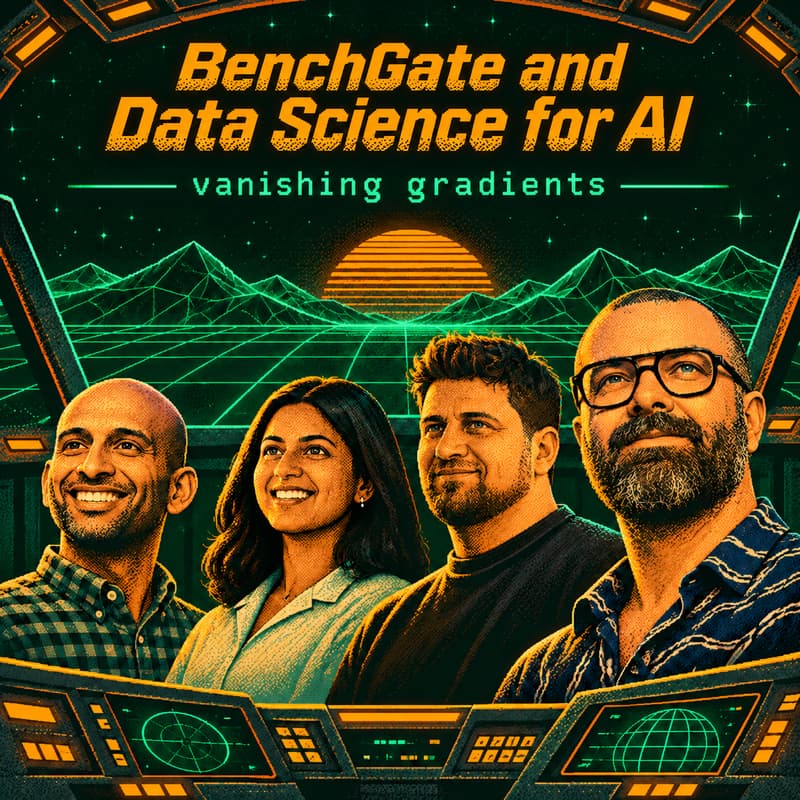

BenchGate and Data Science for AI
Five AI models scored 100% on a public benchmark. On the private version, those same five scored between 53% and 64%. A model that scored 74% both times beat every one of them.
“The industrial-benchmark complex is on thin ice,” as Hamel Husain put it.
Then there’s the benchmark for reading financial documents. Researchers found evidence that models were looking up the answer key on Hugging Face while the grader was marking correct answers wrong.
Welcome to BenchGate! Hugo has invited three of his favourite data people to talk about why data science matters when you’re building AI systems.
Welcome to BenchGate! Hugo has invited three of his favourite data people to talk about why data science matters when you’re building AI systems:
Hamel Husain is the AI evals 🐐, an ML engineer and data scientist at heart, and now works on applied evals at OpenAI.
Shreya Shankar is a computer science researcher, the creator of DocETL (an open-source tool that helps people like public defenders and climate scientists make sense of thousands of documents), an incoming assistant professor at Carnegie Mellon, and Hamel’s co-author on O’Reilly’s new book Evals for AI Engineers.
Chris Albon is an OG data science and ML gangster, wrote O’Reilly’s Machine Learning with Python Cookbook, and leads machine learning and data platform engineering at the Wikimedia Foundation.
Hugo Bowne-Anderson has a silly accent, a face for podcasting, a deep interest in the role of data science in building AI systems, and a knack for asking so many follow-up questions his friends leave the room.
What could possibly go wrong?
In the live recording of Vanishing Gradients, the gang will get into:
The benchmark-industrial complex: Buggy graders, models that have memorised the answers, leaderboards whose rankings reshuffle when you tweak the weights. Why your own evals on your own data beat any leaderboard.
Decision models, a new kind of model built to make cheap, fast yes-or-no calls at huge scale. Shreya has a theory of why they exist, Chris runs them over hundreds of thousands of items a week, and Hamel tested six of them and found that out of the box, some miss most of the failures. Fixing that is classic data science.
Getting answers out of messy text. When AI reads thousands of documents or sales calls for you, how do you know it got them right? As Shreya puts it, you cannot mine diamonds from slop.
Fragile results. Chris has spent 20 years watching analyses fall apart when a few data points are removed, and AI makes it easier than ever to build something that only looks like it works.
Looking at your data: still the most useful advice in AI, and still the thing almost nobody does.
Come with questions. Hugo will bring too many follow-ups. O’Reilly is giving away five ebook copies of Hamel and Shreya’s Evals for AI Engineers to listeners who ask the best questions.
Register to join live or get the recording after.