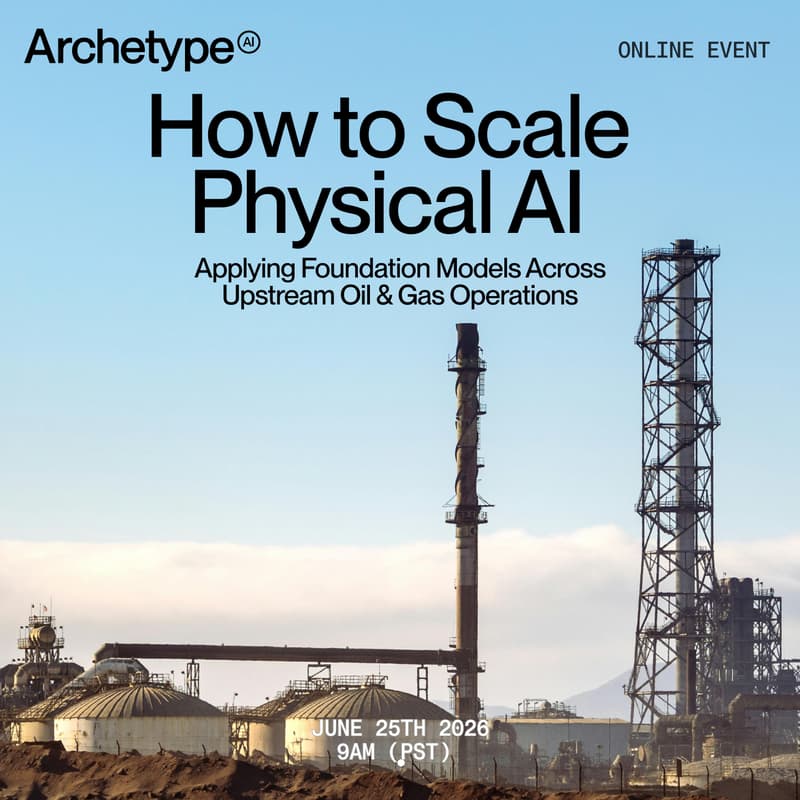
How to Scale Physical AI: Applying Foundation Models Across Upstream Oil & Gas Operations
Upstream oil & gas presents one of the most demanding environments for AI: thousands of distributed wells, changing environmental conditions, heterogeneous sensor data, and operational decisions where the cost of being wrong is measured in lost production, safety incidents, or environmental impact.
Adapting AI systems to the complexity and variability of real-world industrial assets has traditionally required significant model development, customization, and retraining efforts. Foundation models are changing this paradigm. In this session, Archetype AI will explore what it takes to design, adapt, and operationalize Physical AI systems across real upstream use cases — from drilling and production monitoring to pumps, compressors, and other critical equipment.
We’ll cover practical decisions behind these deployments, including preparing industrial sensor data, balancing zero-shot deployment with machine-specific adaptation, and configuring models and agents across fleets of wells and distributed operations.
What you’ll take away:
A practical framework for deploying foundation models across upstream assets and workflows
Guidance on when to use zero-shot deployment, few-shot adaptation, or fine-tuning
Best practices for configuring multimodal sensor inputs and AI agents
Lessons learned from scaling AI systems across equipment fleets