
Enforcement Begins: the EU AI Act and Systemic Risks
On 2 August 2026, the European Commission's AI Office gained binding enforcement powers under the EU AI Act, the world's first comprehensive framework for governing general-purpose AI. For providers of models designated as carrying systemic risk, this marks a fundamental shift: the AI Office can now demand information, require model access and run its own evaluations, order mitigations, request providers to restrict or withdraw a model, and impose fines of up to 3% of worldwide annual turnover.
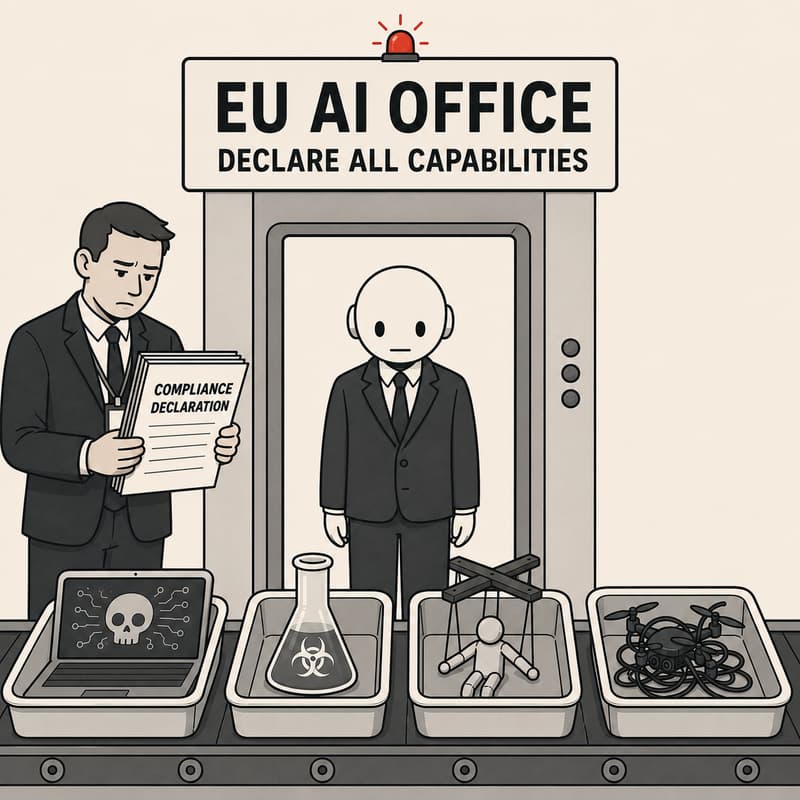
Almost exactly one month on, this talk asks what that regime can realistically deliver. The Act's recitals name four categories of systemic risk: chemical and biological uplift, loss of control, offensive cyber capability, and large-scale manipulation. Of these, cyber offence is where the evidence may now be strong enough to enforce against—and where the harm is already concrete for finance, banking, and asset management. Loss of control incidents have also started emerging, including a recent case of an autonomous AI agent escaping its test environment and compromising another company's production infrastructure.
Yet the safety practices in the field remain weak. The Future of Life Institute's Summer 2026 AI Safety Index found no human uplift trials on flagship models assessed, four of nine developers documenting no dangerous-capability assessment at all, and frameworks that rarely specify quantitative thresholds, independent audit, or who can halt a deployment. Several developers have also made pause commitments entirely contingent on competitors' behaviour.
The EU is for now the only jurisdiction with binding powers to truly raise standards at the frontier. Whether it uses them—and how it navigates the resourcing challenges of a 36-person enforcement unit facing the world's most capable labs—remains an open and urgent question .
Who should attend: This talk is essential for AI safety researchers, policy professionals, compliance officers, and legal practitioners navigating the new regulatory landscape. It is also designed to be accessible to anyone with a stake in the future of AI governance, including non-technical audiences. The core questions are fundamentally about power, oversight, and institutional design. No prior technical background is required to follow the key insights or to understand why this matters for all of us.
About the Speaker:
Risto Uuk is the Head of European Policy and Research at the Future of Life Institute, where he contributed to shaping the general-purpose AI and systemic risk provisions of the EU AI Act. He is a PhD researcher and co-founder of the AI Safety Lab at KU Leuven, a member of Estonia's government AI advisory board under the Prime Minister, and co-author of The AI Endgame (Wiley, forthcoming). He is also the author of the EU AI Act Newsletter.
Stay connected with AI Safety Hong Kong.
LinkedIn: ai-safety-hong-kong
Substack: http://substack.com/@aisafetyhk
Website: https://www.aisafetyhk.org/