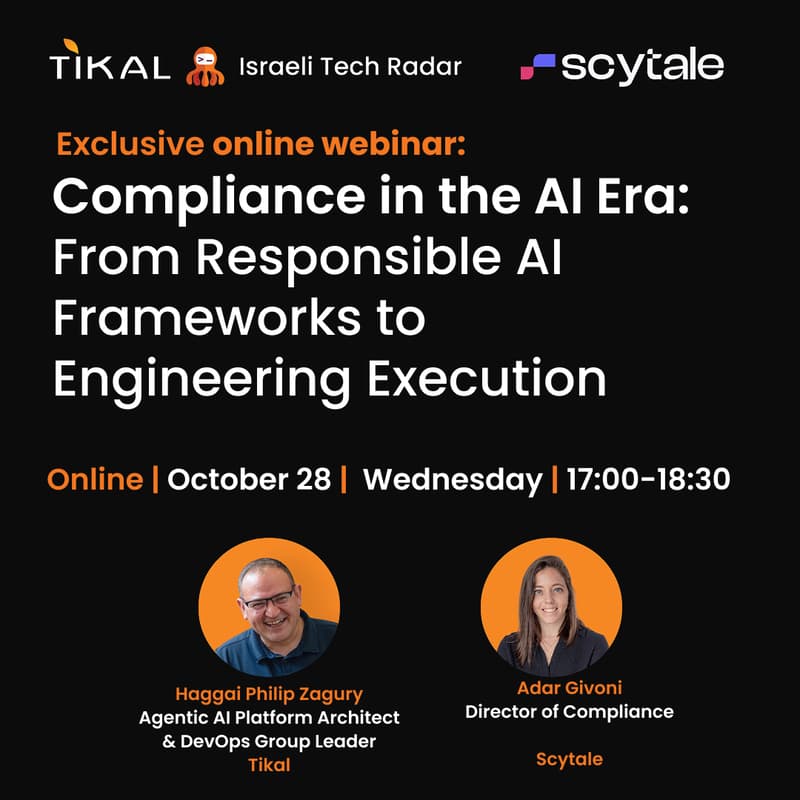

Compliance in the AI Era: From Responsible AI Frameworks to Engineering Execution (Online)
As AI becomes embedded in products, development workflows, and business operations, compliance can no longer remain a separate process handled only before an audit.
Organizations need to understand the regulations, standards, and emerging requirements shaping responsible AI. But knowing what is required is only the first step. The real challenge is translating those requirements into infrastructure, architecture, controls, and engineering practices that work continuously in production.
This webinar will cover both sides of that process, from understanding the changing compliance landscape to implementing its requirements across cloud infrastructure, CI/CD pipelines, agentic architectures, and day to day engineering workflows.
The focus will be on closing the gap between what compliance frameworks require and what engineering teams need to build to support them in practice.
On the Agenda
17:00 to 17:45
The Frameworks Defining Responsible AI in 2026 //Adar Givoni, Director of Compliance, Scytale
Artificial intelligence is rapidly changing how organizations operate, making transparency, accountability, and responsible use increasingly important.
As AI adoption grows, regulators and standards bodies are introducing new requirements. Some are legally binding, while others are voluntary standards that are quickly becoming part of the baseline for responsible AI.
In this session, Adar will review the frameworks shaping responsible AI in 2026, explain how the regulatory landscape is developing, and discuss what organizations should understand as they prepare for broader AI adoption.
17:45 to 18:30
From Framework to Platform: Engineering Compliance into Agentic AI Systems// Haggai Philip Zagury, Agentic AI Platform Architect and DevOps Group Leader, Tikal
Frameworks define what responsible AI requires. Engineering teams still need to turn those requirements into systems that work.
In this session, Haggai will show how platform and DevOps teams can operationalize SOC 2, ISO 27001, and emerging AI specific compliance requirements within agentic systems.
Drawing on real platform architectures, he will explore zero trust multi account cloud design, credential free CI/CD, supply chain hardening, automated evidence collection, and policy as code.
The session will examine where established compliance standards collide with autonomous agents, MCP servers, and LLM driven pipelines, and the patterns teams can use to reconcile them. Haggai will also share lessons from implementation, including what breaks, what scales, and what compliance by design looks like when AI agents are making decisions and taking actions.
Please Note
Registering through this page is an application for approval and will be reviewed by the team before registration is confirmed.
About Scytale
Scytale is a leading AI GRC platform that helps organizations achieve and maintain continuous compliance across 80+ security, privacy, and AI frameworks, including SOC 2, ISO 27001, ISO 42001, GDPR, HIPAA, PCI DSS, and SOX ITGC. The platform combines AI agents with human GRC experts, automating evidence collection, monitoring controls, assessing risk, and identifying compliance gaps, so teams can stay audit ready without the manual overhead. Built-in cross-mapping automatically reuses evidence across multiple frameworks, cutting down duplicate work and simplifying audits.
About Tikal
Tikal is a hands-on tech consultancy living and breathing the Agentic world.
For over 25 years, we have worked alongside engineering organizations to scale their capabilities. Today, we help teams pioneer Agentic Engineering, where developers and AI agents build together.
Our experts integrate directly into engineering teams across AI and ML, Backend, Data, DevOps, Fullstack, and Web, bringing deep expertise and practical experience from real production environments.
As the founders of the Israeli Tech Radar, we share insights from the field and help engineering leaders and teams make informed technology decisions.