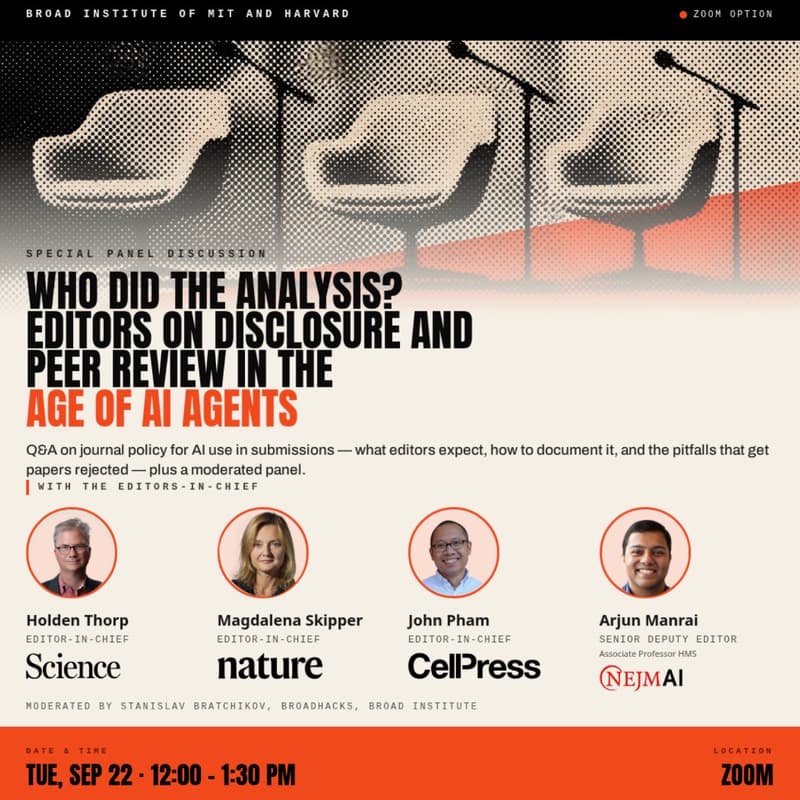
Who Did the Analysis? Editors on Disclosure and Peer Review in the Age of AI Agents
AI agents are now part of how researchers analyze data, write code, and survey the literature. How priority and credit work when an AI system produces the result first? The standards for AI-assisted scientific publishing are still taking shape, and they vary between journals.
This session brings together scientific journals' leaders who set those standards to say what they currently require and where the field is heading:
Holden Thorp, Editor-in-Chief, Science
Magdalena Skipper, Editor-in-Chief, Nature
John Pham, Editor-in-Chief, Cell
Arjun Manrai — Senior Deputy Editor, NEJM AI; Associate Professor, Harvard Medical School
Part 1: What journals expect today (Q&A)
How editors and reviewers evaluate AI-assisted work at submission. Topics include what to disclose and how to document it, where AI use raises questions of originality and reproducibility, and the issues that most often come up in review.
Part 2: Where this is heading (moderated panel)
How peer review, authorship, and reproducibility standards may change as agents take on more of the analytical work, and what that means for how labs should work now.
Who it's for: undergrads, associates, grad students, postdocs, staff scientists, and PIs, both wet-lab and computational, whether you already use AI tools or are still deciding how far to rely on them.
Submit your questions in advance:
Open Google Form
A selection will be shared with the panelists during the event.
Zoom link available upon registration.
📅 Tuesday, September 22 · 12:00–1:30 PM EDT · [Zoom]