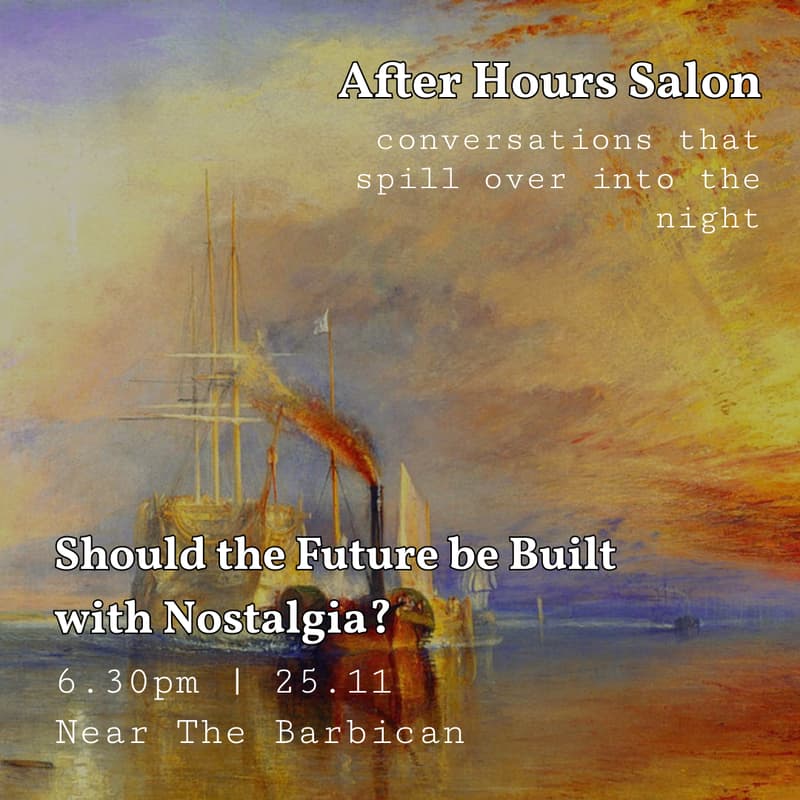

After Hours Salon: Should the Future be Built with Nostalgia?
We look at the present through a rear-view mirror. We march backwards into the future.
Marshall McLuhan
We're back for the next salon in a very exciting location!
Do bring drinks and snacks to share 😍
The Salon:
We’re bringing together techno-optimists and sceptics, deep-thinkers and concerned citizens to discuss the future. Expect drinks, nibbles, a few provocations from people who've thought hard about this.
We’re going to start the discussion amongst a few specialists, bring in the room and then let it propagate into informal chats.
We will kick this off at 7, so please arrive promptly.
We'll be at St Giles without Cripplegate in the Barbican Complex - centuries old masonry amidst the brutalist icon of the Barbican.
The Question
It’s easy to speak of the good old days. To long for a time when optimism was high, energy was cheap and Britain built things. And from Bell Labs to the Sistine Chapel, those building a new future often model their vision on the past.
But is it too much to want to go back there? Reindustrialisation is now government policy. ARIA is modelled on (D)ARPA. We talk of Apollo programmes and Manhattan Projects for AI.
We also see it in how we live, too. From phone free events to rewilding. And in the aesthetics: retrofuturism, the terminal window, a revival of past architecture.
Ideas and designs that survive for centuries usually earn their place, and a nation that remembers it could build is more likely to build again. But nostalgia is selective. The golden ages we invoke weren’t so rosy for everyone. And history cuts both ways. The Arts & Crafts movement, for example, began as a backward-looking revolt against the factory, yet its ideas helped shape the Bauhaus and modernism.
As we build a new world through radical technological and economic upheaval, are these historic roots the foundation we need, or a cage?
We’ll ask:
Is reindustrialisation a strategy, or nostalgia? How would we know the difference?
Which lessons from past golden ages of science and engineering still apply, and which don’t?
Is nostalgia a coping mechanism, a failure of imagination, or a beautiful artefact of the human condition?
We’re bringing together voices from science, policy, technology and culture, including people who’d defend looking back and people who’d challenge it.
The Specialists
Calum Drysdale is an engineer, writer, and co-host of the technology and British revitalization podcast Anglofuturism.
Laura Ryan is Co-Director of Science Works . She was previously Senior Analyst in Science and Technology at the Tony Blair Institute, leading work on metascience, AI for science, and institutional models for R&D.
Arka Serezh is the CEO and founder of Gondor Industries, a company developing robotics and AI manufacturing to cut stone for architecture and sculpture.
As ever we’ll open the conversation up to the whole room so come with opinions!
Reading / Thoughts
Nostalgia and Its Discontents (on origins, etymology and the human condition)
TBI Hard Tech, Hard Power: Rebuilding Britain’s Industrial Base for the Age of AI
Where is my flying car? J. Storrs Hall - a review here.
Why we need Bell-style systems engineers - https://substack.com/home/post/p-115989133