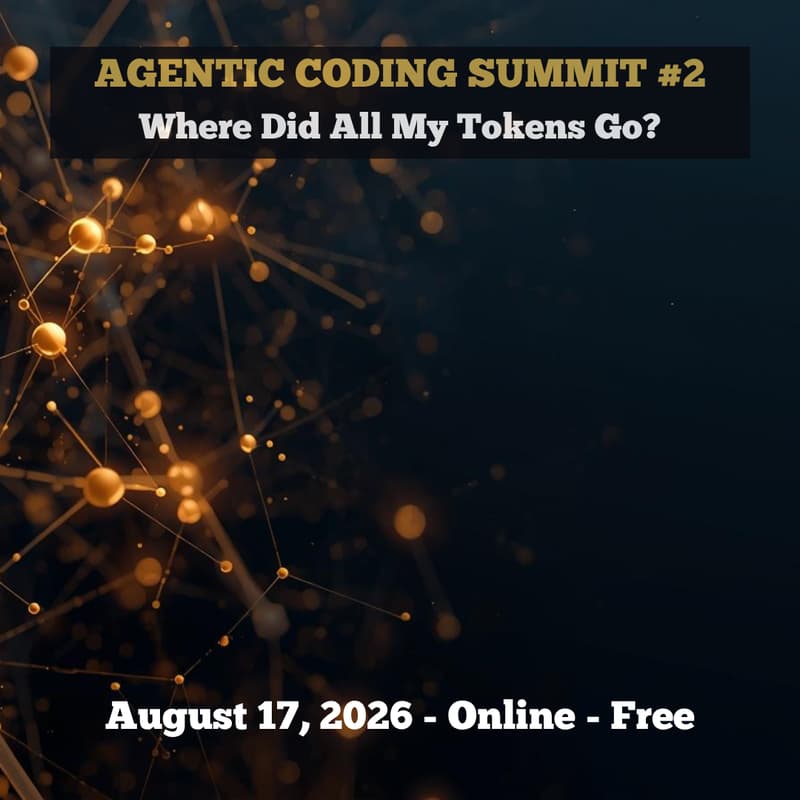
Agentic Coding Summit #2: Where Did All My Tokens Go?
You ask Copilot one question and watch your AI credits melt. Since June 1, GitHub Copilot bills by tokens, and suddenly everyone has the same two questions: where do my credits actually go, and how do I use fewer of them? Some people have started rationing their AI usage. Others just watch the counter and hope.
The second Agentic Coding Summit is about exactly that: understanding and reducing token usage in agentic coding. Practitioners share what actually works in short talks, followed by a roundtable with all speakers. The guiding idea: maximum value per credit, not just fewer tokens.
Topics include how token-based billing actually works (input, output, cached, reasoning), how to measure your own usage, and what popular reduction techniques really deliver — measured on real tasks, not claimed.
This event is for developers and anyone who works with AI coding tools on a daily basis.
🎤 Want to join the roundtable discussion and share your perspective on what changed since token-based billing? Reach out to Matthias on LinkedIn.
Schedule:
12:00 – Welcome & Introduction
12:10 – Talk 1: Dr. Matthias Liebeck: Where Did All My Credits Go? Understanding and Reducing Token Usage in GitHub Copilot
Since June 1, every Copilot interaction is billed by tokens, and the internet is full of tricks that promise 60, 70, even 95 percent savings. But which of them hold up? In this talk, I explain how tokens and AI credits actually work, show how to measure your own usage with tools you already have, and put several popular reduction techniques to the test on real tasks from my own repositories — with honest numbers instead of headline percentages. You'll leave knowing where your credits go and how to check any savings claim yourself.
12:45 – Talk 2: Maxim Salnikov: Copilot, Traced. Your AI pair programmer is a distributed system. Instrument it like one.
Abstract: You have instrumented every service you own — traces, dashboards, alerts, an on-call rota — and then you let the tool that writes your code run as a black box. How many tokens did your last Copilot turn send? What did it cost? Was any of it cached, or did you pay full price to re-send a prompt the model had already seen thirty seconds earlier? Almost nobody can answer, and almost nobody realises that Copilot has been emitting OpenTelemetry this whole time — real OTLP, real GenAI semantic conventions, four settings away from landing in the Grafana or Application Insights you already run. This talk turns Copilot into a service you can actually observe: we read one real turn as a span tree, learn why a single moved byte costs twenty-one thousand tokens, build a telemetry pipeline live and take the generated config with us, and put a number on what a bad prompt prefix costs a forty-person team per month. We also cover the parts the docs get wrong — the cost attribute that is documented under one name and shipped under another, and why "content capture off" is not the same as anonymous. You'll leave able to see your own prompt-cache hit rate in about twenty minutes, on your laptop, without asking anyone's permission.
13:05 – Break
13:15 – Talk 3: Oliver Dzaeck: Copilot already optimizes automatically. What is left for you?
Abstract: Since June 1, Copilot usage has been billed by token consumption in AI Credits. At the same time, the harness already optimizes large parts of the context. This talk shows what happens automatically — and which effective levers remain in your hands.
13:35 – Talk 4: Felix Burkhard Less Token Waste, Same Delivery: A Practical Copilot Workflow Experiment
Abstract: This talk presents a practical approach to reducing GitHub Copilot credit usage in everyday engineering work.
I walk through one task completed in multiple runs with identical model settings and show which workflow changes made the difference. The implementation goal stays the same, while the overall workflow becomes leaner and more cost-aware.
You will leave with a compact playbook you can apply immediately. It covers where token waste typically appears during coding and which lightweight habits reduce it.
13:55 – Roundtable with all speakers: Token-Based Billing: What Actually Changed?
Two and a half months into usage-based billing: what changed in daily work, which savings tricks survived contact with reality, and what do we want GitHub to fix? Bring your questions — there's no per-talk Q&A, all questions from the chat land here.
14:25 – Wrap-up
14:30 – End
This is a free online event via Microsoft Teams. Talks will be in English. The event will be recorded — can't make it live? Register anyway, all registrants get the recording.
Hosted by Dr. Matthias Liebeck, .NET developer and AI speaker, organizer of the Azure Düsseldorf Meetup and the Agentic Coding Summit series, author of the GitHub Copilot newsletter at ghcp.liebeck.io.