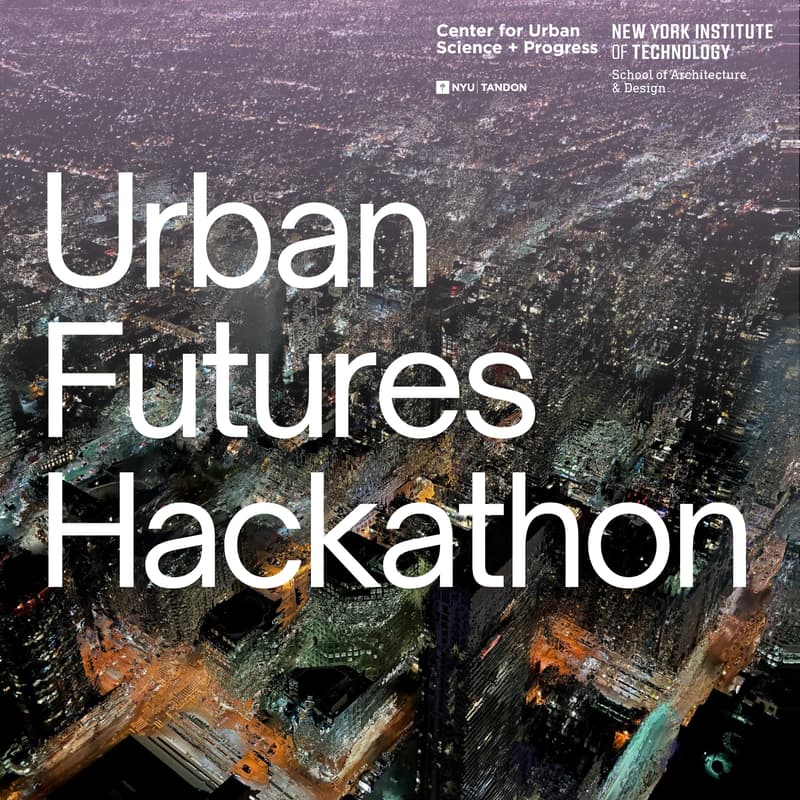

Urban Futures Hackathon
The New York Institute of Technology (NYIT) School of Architecture & Design (NYIT SoAD) — Urban Design Program and the Center for Urban Science + Progress (CUSP) at NYU Tandon School of Engineering are excited to co-host a 48-hour Urban Futures Hackathon on Friday, February 20th, and Saturday, February 21st!
Working alongside designers, urban scientists, data analysts, and policy thinkers from both institutions, participants will co-create rapid, data-informed urban scenarios addressing critical urban challenges in New York City. All projects will be highlighted in a March 2026 presentation and exhibition celebrating participants’ work.
Eligibility
Students currently enrolled at NYIT SoAD (graduate and undergraduate) and in the M.S. in Applied Urban Science and Informatics program or Urban Science Doctoral Track at NYU Tandon's CUSP are eligible to participate.
Overview
The Urban Futures Hackathon aims to bridge spatial design and urban informatics, leveraging the complementary expertise of both programs — design thinking, community engagement, urban systems, and spatial dynamics, combined with data analytics, sensing technologies, and policy modeling, among others.
Work produced by teams combining students from both institutions will connect design inquiry with evidence-based analysis, leveraging the expertise of each program. Their work aims to cultivate innovative and actionable ideas—ranging from speculative design scenarios to real-world policy frameworks—advancing the dialogue on how cities can evolve toward greater equity, resilience, and collective well-being.
Theme — Design + Data + Community
All projects will explore the intersection of design, data, and the human/community experience through a thematic lens. Each team has the flexibility to select a theme from the list below that's most aligned to their assigned site.
Public Space & Behavior: mapping and redesigning the emotional, cultural, and behavioral dynamics of public space to nurture belonging, collective expression, and well-being.
Spatial Justice: ensuring equitable access to resources, opportunities, and public spaces—creating cities that are fair, inclusive, and designed for all.
Equitable Mobility: designing inclusive, data-informed mobility systems that expand access, safety, and connection across communities.
Resiliency: promoting regenerative practices and circular systems that balance human needs with environmental responsibility, resilience, and long-term impact- positioning infrastructure as a catalyst for ecological and social regeneration.
Team Assignment Process
Teams will be assigned and announced in February based on project site preferences to form cross-institutional, multidisciplinary groups.
Deliverables
Each student team has the flexibility to choose a deliverable that best communicates their vision. Possible outcomes may include, but are not limited to:
Data-driven design prototype or visualization developed to test a specific hypothesis or scenario
Brief presentation and policy recommendation that outlines a proposed future scenario
Physical or digital model and dashboard
Sites
Each group will be assigned a site located in New York City. A few sample locations are listed below.
Brooklyn
Brooklyn Navy Yard
South Brooklyn Marine Terminal
Broadway Junction & East New York
Gowanus Rezoning & Canal Waterfront
Bronx
Hunts Point Peninsula
Harlem River Greenway
Queens
Willets Point
Downtown Far Rockaway
NY Harbor
Governors Island – Climate Solutions District
Manhattan
East Side Coastal Resiliency
Essex Crossing / Seward Park
Harlem River Greenway
Contact
If you have any questions, please contact the Hackathon leads:
NYIT students should contact Marcella Del Signore, Associate Professor and Director of the MS. in Urban Design program at the NYIT School of Architecture and Design, at mdelsign@nyit.edu.
NYU Tandon students should contact Anton Rozhkov, Industry Assistant Professor and Director of the M.S. in Applied Urban Science and Informatics Program at NYU Tandon, at ar8843@nyu.edu.
Schedule
View the full schedule here.
The first day of the Urban Futures Hackathon will take place at the Center for Urban Science + Progress at NYU Tandon, located at 370 Jay St. Floor 13, Brooklyn, New York, 11201. Here is a map of NYU’s Brooklyn campus. The second day of the Urban Futures Hackathon will take place at the New York Institute of Technology School of Architecture and Design, located at 1855 Broadway, New York, NY 10023.
March — Final Presentation and Exhibition
The Urban Futures Hackathon will culminate with a final review and exhibition. The presentation and final deliverables will be reviewed by a jury of academics, city agency representatives, and industry experts.