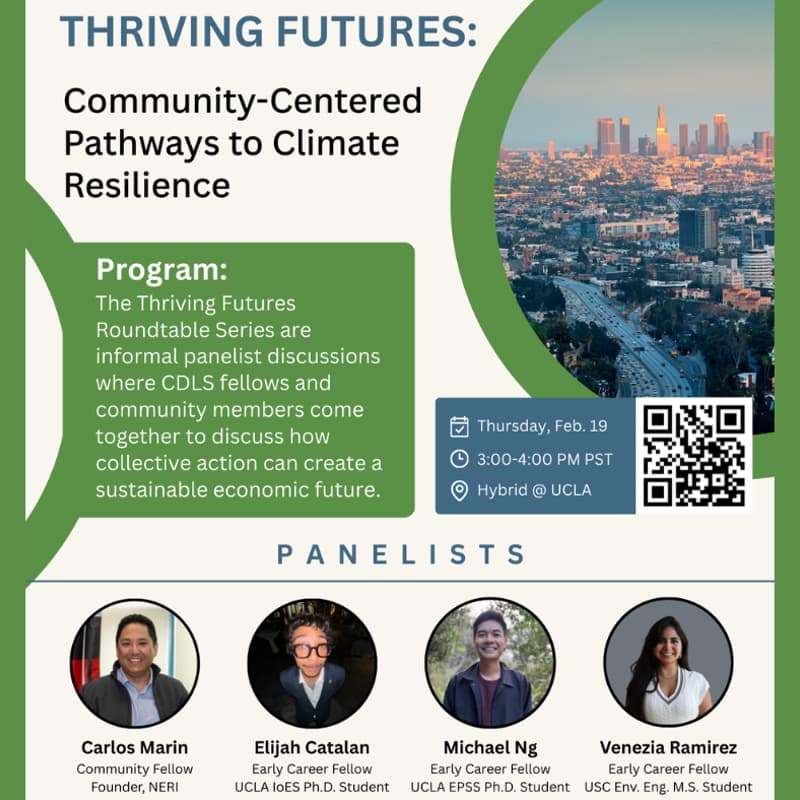
Thriving Futures: Community-Centered Pathways to Climate Resilience
The Thriving Futures Roundtable Series will host informal panelist discussions where CDLS fellows and community members come together to discuss how collective action can create a sustainable economic future.
Our first roundtable series will gather a range of panelists whose work centers community-driven climate resilience.
This event features a 45-minute moderated discussion, followed by open Q&A and a 30 minute (optional) casual networking session.
(Please note: this will be a HYBRID event with limited in-person seating.)
Elijah Catalan is a Ph.D. student at University of California, Los Angeles (UCLA) in the Institute of Environment and Sustainability. He conducts interdisciplinary research utilizing genomic-based biodiversity monitoring and biogeochemistry to examine the impacts of climate and anthropogenic stressors as well as restoration and conservation efforts in coastal systems. Elijah also seeks to decolonize scientific research and advance environmental justice through his work in the CDLS at UCLA. He is a class of 2020 alumnus of Howard University in Washington, D.C. where he was a double major in biology and environmental studies. After finishing his graduate studies, Elijah plans to enter a research-based career where he can help protect and empower those communities disproportionately impacted by environmental conditions and underrepresented in the field of environmental stewardship.
Venezia Ramirez earned her B.S in Environmental Science from UCLA and is currently pursuing the M.S. in Sustainable Engineering at USC with a focused technical emphasis in Energy and Power Systems. It gives her great pride to pursue her master’s degree at the institution where her parents initially met as cleaning/maintenance staff. With roots from Durango, Chihuahua and Guanajuato, Mexico, she brings a passionate devotion that for the past 6 years has fueled her work in researching injustice in urban ecological systems that span from soil remediation, air quality, and now energy justice. She looks forward to completing her degree to increase her capacity to address pressing local and global sustainability challenges through a community driven, engineering systems lens.
Carlos M. Marin is the founder of the New Earth Regeneration Initiative (NERI), a sustainability-driven organization dedicated to developing innovative solutions for soil regeneration and ecosystem restoration. With a unique professional journey that bridges financial services and environmental science, Carlos brings a systems-thinking approach to some of California’s most urgent ecological challenges: soil degradation, water scarcity, and organic waste. After a successful career in banking and finance, Carlos made a bold and purpose-driven transition into the environmental sector. Through NERI, he leads collaborative projects focused on composting, regenerative agriculture, carbon sequestration, and sustainable land management practices. His work has already gained recognition from policymakers and environmental organizations for its real-world applicability and community impact. Carlos holds a B.A. in History from Cal State LA (Magna Cum Laude) and a M.A. in Sustainability at Cal State Northridge. In addition to his academic work, he has consulted with nonprofits, businesses, and local governments on sustainability strategies and environmental education. Passionate about equity and access, Carlos centers historically marginalized communities in NERI’s outreach and implementation strategies. His vision for NERI is rooted in the belief that ecological healing goes hand in hand with social regeneration and that restoring the earth requires restoring our collective relationship to it.
Michael Ng (he/him) is a PhD student in the Department of Earth, Planetary, and Space Sciences at UCLA. As a former educator, he has a passion for science education and environmental advocacy. Michael’s journey began in the classroom, where he witnessed the power of education and its capacity to inspire change. He saw how community-based science drives real-world impact with King/Drew’s Community Inquiry Project. With environmental justice at the core, his current interests include regenerative agriculture, sustainable farming, and bioremediation.