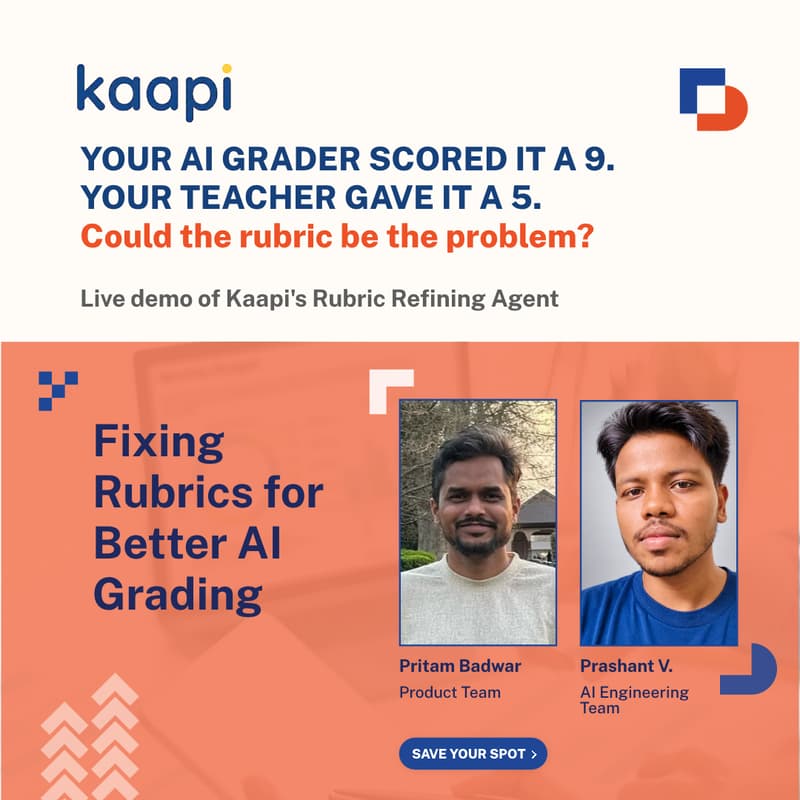
Fixing Rubrics for Better AI Grading
Your AI grader gave an answer a 9. Your teacher gave it a 5. Who’s right?
When education NGOs use AI to assess hundreds or thousands of student submissions, differences between AI-generated scores and teacher assessments can become a significant challenge.
Often, the issue isn't the AI model itself. It's the rubric guiding the assessment.
Criteria such as “moderate creativity” may make sense to a teacher, who brings experience and professional judgment to the task. But AI interprets these instructions literally, leading to scores that don't always align with how teachers assess student work.
What if better rubrics could make AI grading more reliable?
At Kaapi, we're building a Rubric Refining Agent with education NGOs to address this challenge. It identifies where AI-generated scores differ from teacher assessments, suggests clearer rubric wording, and leaves every change for your team to review and approve.
Join this practical webinar to explore how rubric design affects AI grading accuracy and how a structured refinement process can improve agreement between AI and teachers.
What you'll learn
Identify weak rubrics: Spot vague or ambiguous criteria that lead to inconsistent assessments.
Build a gold set: Create a benchmark of teacher-scored answers to evaluate AI grading.
Measure AI-teacher agreement: Understand how closely AI scores match teacher judgments.
Improve grading consistency: Explore ways to make AI assessment more reliable across large volumes of submissions.
See it in action: Watch a live demo of Kaapi's Rubric Refining Agent and its human-approved refinement process.
Who should attend?
This webinar is designed for education NGOs, assessment teams, program leaders, educators, and technology teams exploring or implementing AI-powered assessments.
Whether you're already using AI to grade student work or evaluating its potential for your organisation, you'll leave with a clearer understanding of how better rubrics can support more dependable AI assessments.
Join us to explore how fixing the rubric can help make AI grading more accurate, consistent, and aligned with teacher judgment.