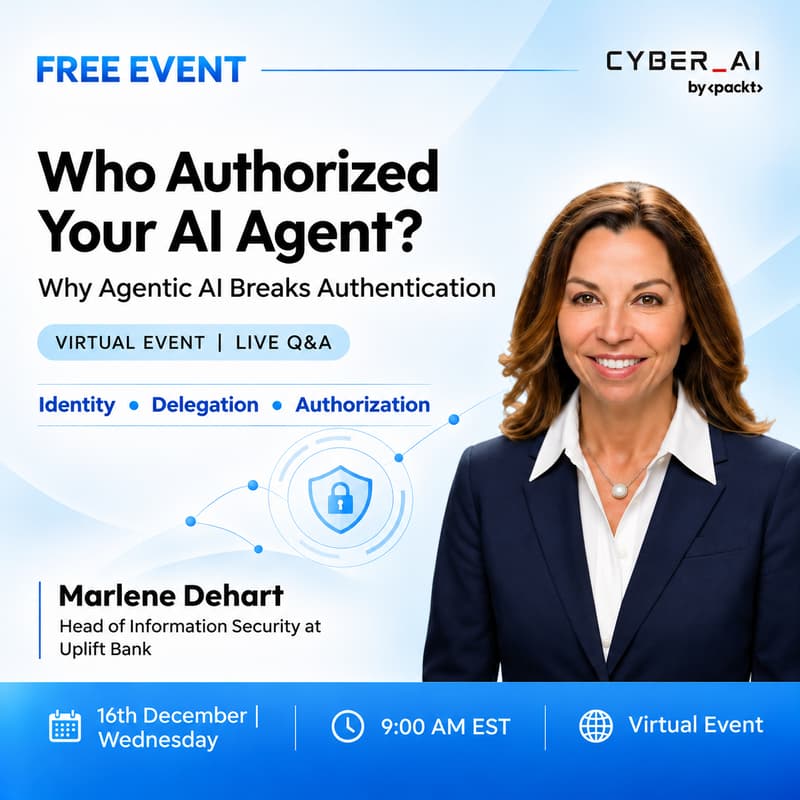

Who Authorized Your AI Agent?
When one AI agent calls another, whose authority is it using? Join Marlene Dehart for a free webinar on agent identity and access.
About the Webinar
You ask an AI agent to book a meeting. It checks your calendar, calls another agent and sends the invite. When you look at the final action, can you tell who requested it, which agent acted and what it had permission to do?
Join Marlene Dehart for a live webinar on authentication, delegation and authorisation in agentic AI. You’ll look at where broad tokens and shared service accounts blur accountability, then explore ways to give each agent only the access its task requires.
Meet the Speaker
Marlene Dehart | Head of Information Security, Southern Bancorp
Marlene Dehart leads information security at Southern Bancorp and previously served as CISO for the Colorado Department of State. She has led identity and access management platform work at Uber and Frontdoor, and brings experience in enterprise risk and security operations.
What Makes This Webinar Different
Follow the request across multiple agents. Trace the original instruction through each handoff to the tool that takes the final action.
Make each access decision explicit. Identify the caller, the person or service that delegated authority, and what the agent is permitted to do.
Take the controls back to your team. Use a readiness checklist to review credential scope, revocation and audit evidence.
What You Will Learn
Map the people, agents, services and tools involved in one workflow.
Recognise where over-privileged tokens, long-lived API keys and shared accounts weaken attribution or leave access in place after a task ends.
Assess how Agent-to-Agent (A2A) agent cards, Model Context Protocol (MCP) authorisation and short-lived credentials can support scoped access.
Webinar Outline
1. Identify the actor and the source of its authority. Map who started the task, which agent is calling, and what each handoff permits.
2. Evaluate agent discovery and trust. Explore what A2A agent cards tell you about an agent and which trust and access decisions your team still needs to make.
3. Limit access to each tool. Use MCP authorisation as a case study in scoping delegated credentials to the intended service, the specific task and the time needed to complete it.
4. Preserve the chain of accountability. Identify the records you need to trace the original request, delegation path, access decision, tool call and outcome.
What You Will Take Away
An agent identity readiness checklist you can apply to your own workflow. It covers who acts, who delegates authority, how to scope and revoke access, and what evidence to keep for an investigation.
Who This Webinar Is For
Identity and access management, privileged access and zero trust teams.
Security architects, AI platform engineers, and cloud, application and API security practitioners.
Technology risk, compliance and AI governance teams evaluating access and accountability.
Product owners, DevSecOps teams and developers building agentic or multi-agent workflows.
Prerequisites and Requirements
No AI development experience is required. Familiarity with authentication, APIs, OAuth or enterprise access control will help you apply the discussion to your own environment.
Why This Webinar Matters Now
Every handoff gives another system a chance to act on the original request. If several agents share a credential, the final log may identify the account while leaving the original requester and delegation path unclear. Those are the details your team needs to investigate an unexpected action.
Reserve Your Place
Register free to join Marlene Dehart live on Wednesday, 16 December 2026 at 9:00 AM EST.