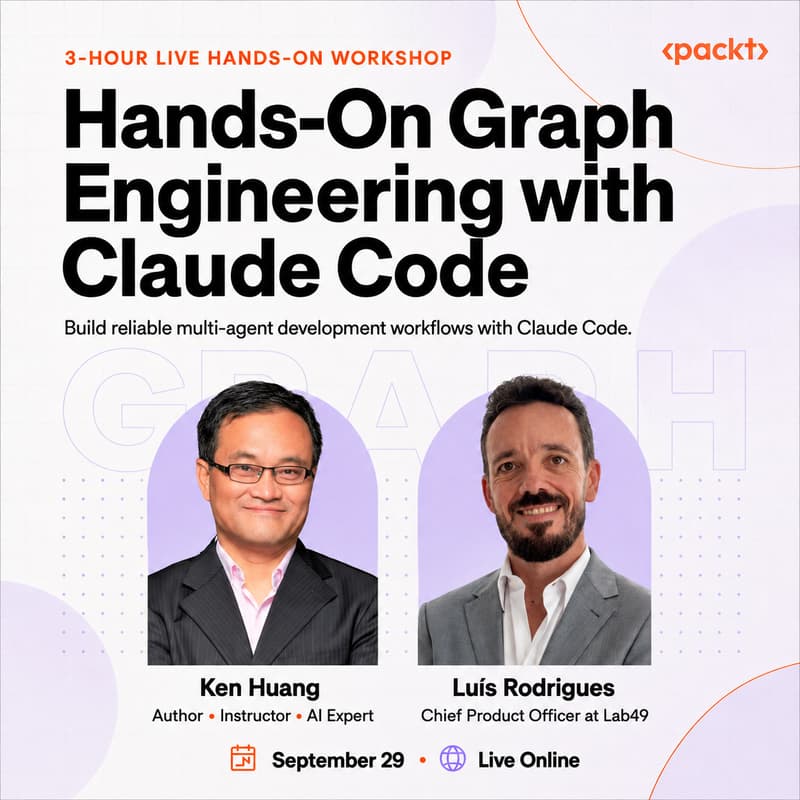

Hands-On Graph Engineering with Claude Code
Overview
Why Attend?
Single-agent coding workflows can break down as tasks become longer, more complex, and more parallel.
The core problems we usually run into are:
Context degradation
Self-grading
Sequential execution
Hidden specification drift
Unbounded retries
This workshop shows you how to solve those problems by designing engineering graphs with clear node boundaries, structured handoffs, parallel execution, independent verification, and controlled recovery.
The goal is simple: move from one agent doing everything to a workflow where each agent has a defined job, clear boundaries, and an independent way to prove the work is correct.
What you’ll be able to do
By the end of the workshop, you’ll be able to:
Recognize when a single-agent workflow is no longer enough
Decide when a graph is justified and when it is not
Break development work into specialized, parallelizable nodes
Define clear completion and failure criteria for each node
Control agent boundaries through tools, models, and worktree isolation
Pass structured artifacts instead of bloated conversation history
Add independent verification and deterministic quality gates
Detect specification drift even when tests pass
Design bounded retry, remediation, and escalation paths
Balance reliability against cost and complexity
Who should attend?
This workshop is designed for:
Developers already using Claude Code
Senior and Staff Engineers
AI Engineers
Technical Leads and Architect
Platform and Developer Productivity Engineers
Teams exploring subagents, agent teams, or multi-agent coding workflows
What you’ll receive
Three-hour live, instructor-led workshop
Guided multi-agent workflow build
Practical frameworks and implementation patterns
Reusable graph-engineering mental model
Complete workshop recording
Workshop slide deck
Live Q&A with the instructor
Certificate of completion
Stop asking one agent to do everything
Move beyond isolated Claude Code sessions and learn how to engineer a realiable, coordinated workflow for planning, implementation, testing, review, and recovery.
Reserve your place now.
Meet your instructors
Luis Rodrigues
CPTO & Entrepreneur
Luis is a Portuguese technologist now based in Dubai, he co-founded QuickCheck, scaling a Nigerian fintech from a weekend experiment to 4M+ downloads and a 150-person team. As Partner & CTO at Seedstars, he helped grow a global organization to 200+ people across emerging markets. Now in the Middle East he moves large financial services and telco organizations from AI pilots to production-grade agentic architectures.
Ken Huang
Author | Instructor | AI Expert
Ken is a prolific author and renowned expert in AI and Web3, with numerous published books spanning business and technical guides as well as cutting-edge research. He is a Research Fellow and Co-Chair of the AI Safety Working Groups at the Cloud Security Alliance, Co-Chair of the OWASP AIVSS project, and Co-Chair of the AI STR Working Group at the World Digital Technology Academy. He is also an Adjunct Professor at the University of San Francisco, where he teaches a graduate course on Generative AI for Data Security.
What you’ll be able to do
By the end of the workshop, you’ll be able to:
Decide whether a task needs one agent or an agent graph
Decompose engineering work into specialised agent responsibilities
Design sequential, parallel, reviewer, and conditional workflows
Configure specialised agents in Claude Code
Define clear contracts for agent inputs and outputs
Coordinate parallel work without unnecessary duplication
Build structured handoffs between agents
Introduce independent testing and review
Detect specification drift and incomplete implementation
Design retry, remediation, and escalation paths
Apply guardrails around tools, permissions, credentials, and iterations
Adapt the workflow to your own repositories and development process
Who should attend?
This workshop is designed for:
Developers already using Claude Code or other AI coding tools
Backend and full-stack developers working in complex repositories
Senior and Staff Engineers exploring agentic development
AI Engineers building developer automation
Technical Leads evaluating multi-agent engineering workflows
Architects designing reliable AI-assisted development systems
Engineering Managers assessing where agent orchestration can add value
You should be comfortable working with software projects and Git repositories. Previous experience using an AI coding assistant is recommended.
You do not need prior experience building multi-agent systems.
What you’ll receive
Two-hour live, instructor-led workshop
Guided multi-agent workflow build
Practical frameworks and implementation patterns
Reusable graph-engineering mental model
Complete workshop recording
Workshop slide deck
Live Q&A with the instructor
Certificate of completion
Stop asking one agent to do everything
Move beyond isolated Claude Code sessions and learn how to engineer a coordinated workflow for planning, implementation, testing, review, and recovery.
Reserve your place now.