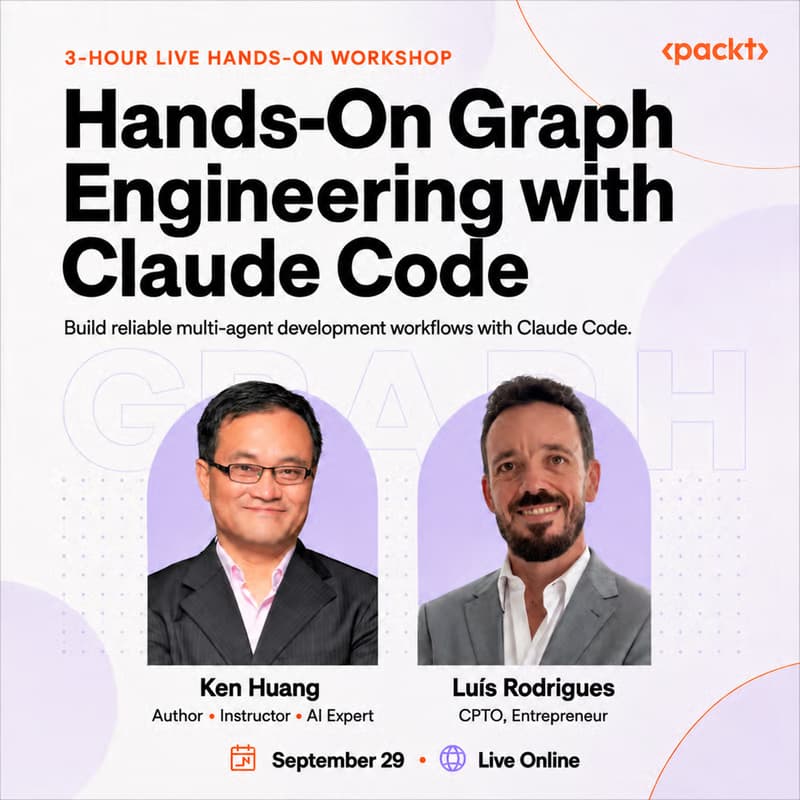

Learn Graph Engineering by Building a Complete Multi-Agent Workflow with Claude Code
Overview
Build reliable multi-agent workflows for complex software development
Why Attend
Agentic coding works well when one agent can handle the task but it starts to break when the work becomes larger, longer, or more parallel.
You run into:
Context degradation
Self-grading
Sequential bottlenecks
Specification drift
Runaway retries
Graph Engineering solves this by connecting specialised agent loops into a coordinated workflow.
Think of it as the difference between a solo developer and an engineering team: each agent has a clear role, focused context, defined handoffs, and an independent way to verify the work.
The outcome: faster, more reliable agentic development with less drift and better control.
This workshop shows you how to move from one capable coding agent to a reliable engineering system.
Meet Your Instructors
Ken Huang brings deep expertise in Graph Engineering, agentic AI architecture, security, and production-grade agent systems. He is also an adjunct professor at the University of San Francisco
Luís Rodrigues is an AI expert who brings the practical engineering perspective on how to make multi-agent workflows actually work with Claude Code in real development environments.
Together, they cover both sides of the problem:
How should the graph be designed?
How do you make it work in practice?
What You’ll Build
A complete multi-agent engineering workflow. You’ll work with:
Specialised agents
Parallel execution
Structured artifacts
Tool boundaries
Worktree isolation
Hooks and quality gates
Failure routing
Human approval
What You’ll Take Away
You’ll learn how to:
How to tell when a single agent loop is enough, and when you need a graph instead
How to break work into specialised, parallel agent roles without losing coherence
How to keep context focused across long running tasks, so quality does not decay the way it does in a single long session
How to design clear handoffs between agents so work does not get lost or reinterpreted in translation
How to add independent verification that does not rely on an agent grading its own homework
How to catch specification drift even when every existing test still passes
How to build bounded retry, remediation, and escalation paths, so a stuck loop stops instead of running unnoticed
How to balance reliability, speed, and cost across the whole system
The goal is simple: stop asking one agent to do everything, and start engineering a workflow where each agent has a defined job, the right context, clear boundaries, and an independent way to prove the work is correct.
Who Should Attend
Built for people already past asking whether agentic coding works, and now running into where it breaks:
Software developers and engineers already using Claude Code
Senior and staff engineers responsible for how AI tooling gets used on their team
AI engineers building agent systems, not just prompting one
Technical leads and architects deciding how multi agent workflows fit their stack
Platform and developer productivity teams supporting agentic tooling at scale
Developers who have tried subagents, hit inconsistent results, and want to understand why
What you’ll receive
Three-hour live, instructor-led workshop
Guided multi-agent workflow build
Practical frameworks and implementation patterns
Reusable graph-engineering mental model
Complete workshop recording
Workshop slide deck
Live Q&A with the instructor
Certificate of completion
Stop asking one agent to do everything
Move beyond isolated Claude Code sessions and learn how to engineer a reliable, coordinated workflow for planning, implementation, testing, review, and recovery.
Reserve your place now.