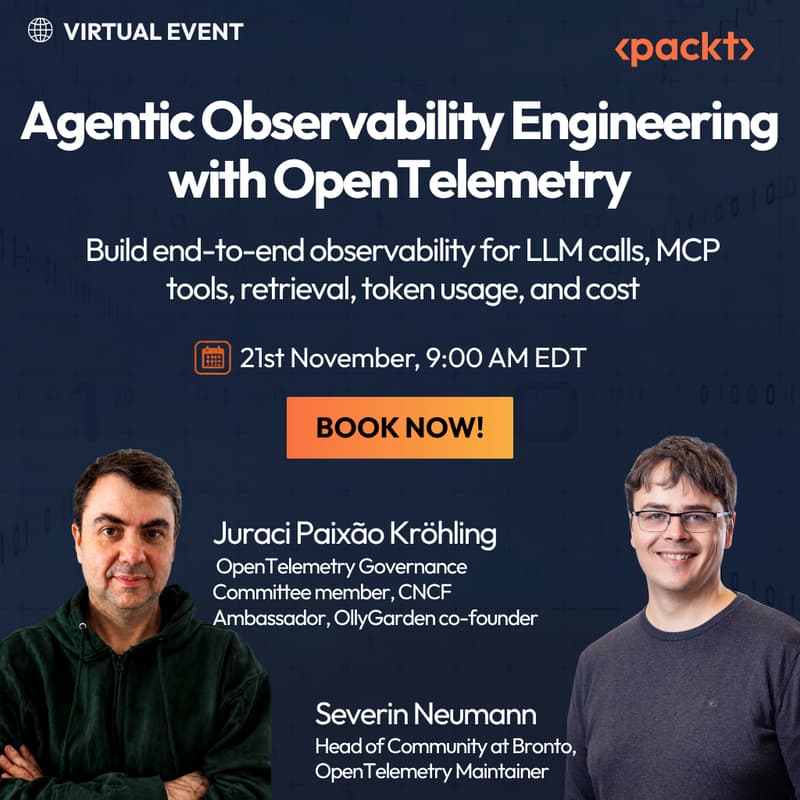

Agentic Observability Engineering with OpenTelemetry
Your agents are in production. Can you see what they're doing?
Agentic AI systems call tools, retrieve context, and chain LLM calls into multi-step workflows. Most teams still observe them through chat logs, if at all. A conventional service either succeeds or throws an error. An agent can fail quietly, through a sequence of steps that each look reasonable on their own. Finding where it went wrong means reading the trace, so the agent needs to produce one.
Agentic Observability Engineering is a live virtual event from Packt. It follows one AI agent from zero instrumentation to a governed, cost-controlled, debuggable production telemetry pipeline. Both sessions are built around live demos on the same agent, so they form one continuous story. Both are led by members of the OpenTelemetry Governance Committee.
This event is about observing agents, not agents doing observability work. You'll learn how to make the agent itself visible.
Agenda
Session 1 (60 min): Instrumenting the Agent: OpenTelemetry for GenAI and Tool-Calling Systems
Speaker: Juraci Paixão Kröhling
Live demo: an uninstrumented agent that calls an LLM, invokes tools through the Model Context Protocol (MCP), and retrieves context, instrumented on stage. The result is one trace with spans for every LLM call, tool call, and retrieval step, plus token usage, latency, and cost.
Why agents need instrumenting: why request counts and error rates miss agent failures, and how traces reveal them.
GenAI semantic conventions: the shared vocabulary that makes traces from different agents and model providers comparable.
Context propagation: keeping a run across an orchestrator, tools, and an external model provider as one coherent trace instead of disconnected fragments.
Q&A: practical first steps for your own agentic workflows.
Session 2 (60 min): From Agent Trace to Production: Governing, Shaping, and Debugging GenAI Telemetry
Speaker: Severin Neumann
Pipeline setup: the instrumented agent from Session 1, connected live to an OpenTelemetry Collector.
Payload governance: making prompt and completion capture an explicit opt-in, and redacting prompts, tool arguments, and personal data with the Collector's redaction, transform, and filter processors.
From traces to operational signals: span-derived metrics and GenAI metric conventions for tracking token usage, latency, and cost per model, tool, and agent, with budgets and alerts that catch runaway agents early.
Controlling volume: why head sampling drops the interesting runs, and tail sampling policies that keep errors, slow runs, expensive runs, and unusual tool usage.
Production debugging, live: four failure modes diagnosed from real telemetry, namely slow retrieval, a token-burning loop, a wrong tool call, and an unexpected execution path.
Q&A: a checklist for taking agent telemetry to production.
Key takeaways
By the end of the event, you will be able to:
Instrument LLM calls, MCP tool calls, and retrieval steps so a full agent run reads as one trace.
Apply OpenTelemetry's GenAI semantic conventions to produce consistent, comparable telemetry across frameworks and providers.
Propagate context across agent, tool, and model-provider boundaries.
Build a vendor-neutral OpenTelemetry Collector pipeline that redacts sensitive prompts, tool arguments, and personal data.
Derive token, latency, and cost metrics from agent spans and alert on runaway agents.
Use tail sampling to retain the agent runs that matter without storing everything.
Diagnose common agent failures by correlating traces, metrics, and logs in the backend you already run.
Treat agent observability as an extension of your existing telemetry stack, not a separate AI tool.
Who should attend
SREs and platform engineers responsible for systems that now include AI agents
DevOps and observability engineers building or running OpenTelemetry pipelines
Engineering teams taking agentic AI from prototype to production
Anyone who needs to answer security, privacy, or cost questions about agent telemetry
Level: Intermediate. Familiarity with traces, metrics, and logs helps. No prior GenAI observability experience is needed.
Meet the speakers
Juraci Paixão Kröhling
Juraci is a member of the OpenTelemetry Governance Committee, a CNCF Ambassador, and co-founder of OllyGarden. He helps shape the direction of OpenTelemetry, the open standard that much of the industry uses for telemetry. In this event, he'll show what well-instrumented AI agents look like from the inside.
Severin Neumann
Severin is a member of the OpenTelemetry Governance Committee, a long-time OpenTelemetry maintainer, and Head of Community at Bronto. He has spent years helping practitioners adopt OpenTelemetry in real environments. In this event, he'll show how to run agent telemetry safely and affordably in production.