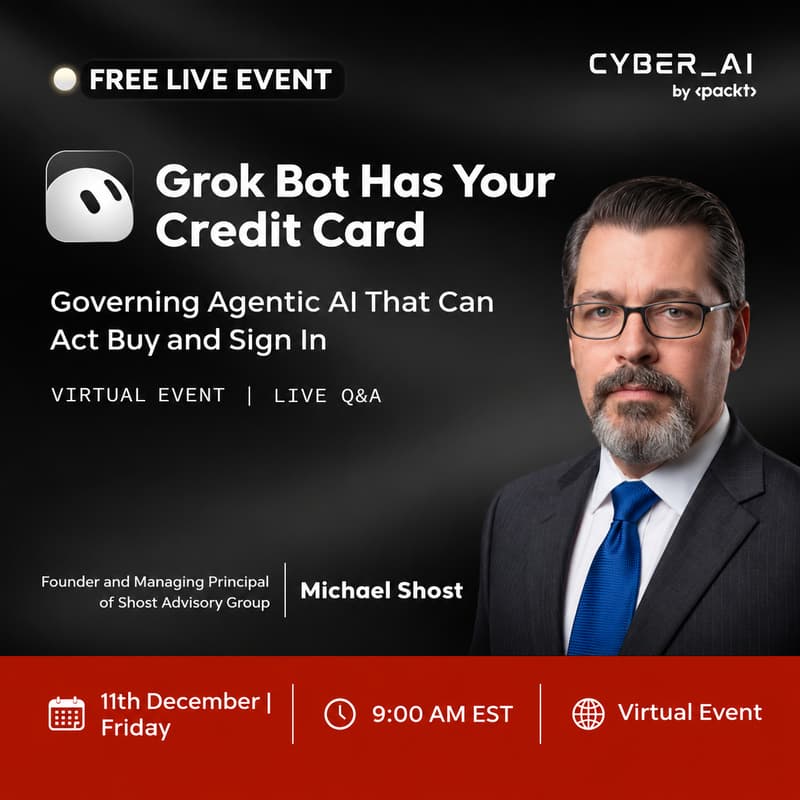

Grok Bot Has Your Credit Card
When AI agents can sign in and spend money, who approves the action? Join Michael Shost for a free webinar on governing agentic AI.
About the Webinar
An AI agent is ready to place an order using a saved card. It’s already signed in, and the person who scheduled the task is offline. Who approved the purchase, and what would you check if it went through?
Join Michael Shost for a live session that uses Grok Bot as a case study in enterprise AI governance. You’ll look at how to set limits on what an agent can do, put human review before consequential actions, and keep a record of what was requested, approved and executed.
Meet the Speaker
Michael Shost | Enterprise AI and Cybersecurity Executive
Michael Shost has more than 25 years of experience leading enterprise technology and transformation initiatives. His work brings together AI adoption, cybersecurity and enterprise governance. He is a Certified Chief Information Security Officer and Certified Ethical Hacker.
What Makes This Webinar Different
A checkout scenario makes the decisions concrete. Decide who can authorise a purchase, when approval is required and what the approver needs to see.
Ownership follows the action. Trace an agent’s access back to the person who delegated the task and the account or session it uses.
The discussion follows the action through to review. Examine what audit logs and action records can each tell you after something goes wrong.
What You Will Learn
Classify agent actions by consequence, from reading and drafting to sending, publishing, purchasing, deleting or changing production systems.
Choose where the workflow should pause for human approval and what context the approver needs.
Identify gaps in permissions, audit coverage and incident response before approving an agent for enterprise use.
Webinar Outline
1. Define the agent’s authority. Identify who can delegate the work and set boundaries for systems, data, actions and operating times.
2. Govern sign-ins, credentials and payments. Connect saved logins, browser sessions, connected apps and payment methods to a named owner and an approved business purpose.
3. Put human review before execution. Use scenarios such as sending an external message, placing an order or changing production data to decide when to pause. Show the approver the target, scope and expected effect.
4. Reconstruct what happened. Use administrative audit logs and action records to review the request, approval decision, execution result, timestamp and responsible user.
What You Will Take Away
A governance checklist you can apply to an agent workflow. It covers ownership, scope, least privilege, approval rules, purchase limits, audit evidence and the ability to pause routines or revoke access.
Who This Webinar Is For
CISOs, security leaders and AI governance leads who approve enterprise AI use.
Security architects, identity and platform security teams, and AppSec, cloud security and DevSecOps practitioners who implement controls.
Technology risk, compliance, legal and privacy teams evaluating accountability and audit evidence.
Product owners and engineering leaders deploying AI agents into business workflows.
Prerequisites and Requirements
No AI development experience is required. Familiarity with enterprise identity, security, risk or governance will help you apply the discussion to your own environment.
Why This Webinar Matters Now
A scheduled agent can act while its owner is away. If it can buy something, send a message or change an account, your team needs to decide in advance who can authorise the action, what limits apply and how to reconstruct the decision later.
Reserve Your Place
Register free to join Michael Shost live on Friday, 11 December 2026 at 9:00 AM EST.