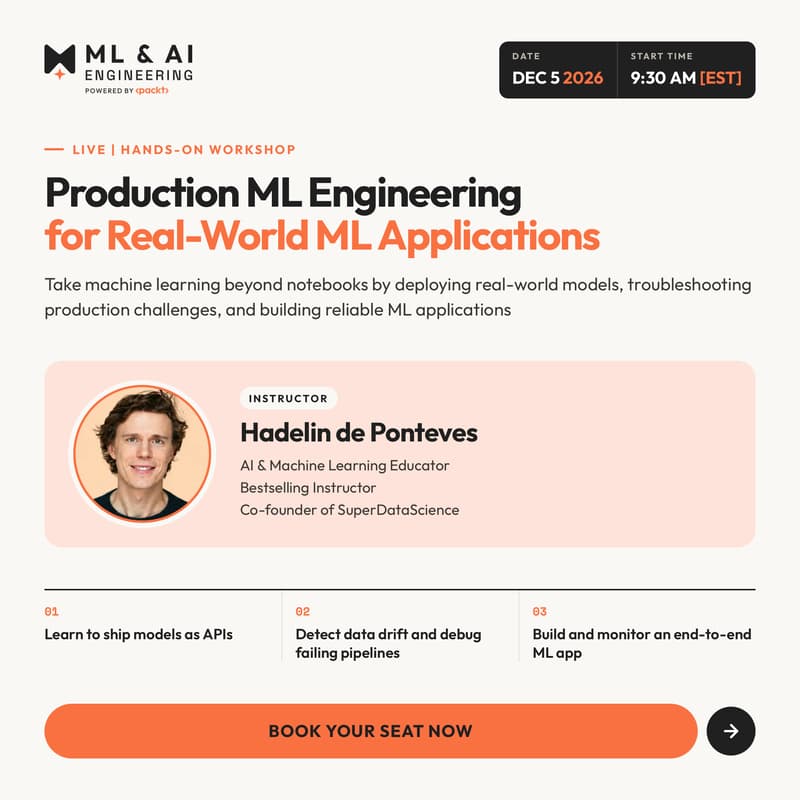

Production ML Engineering for Real-World ML Applications
Take ML beyond notebooks. Learn to deploy, troubleshoot, monitor, and maintain reliable ML applications through hands-on production engineering.
About this workshop
Training a machine learning model is only the beginning. Making it work reliably in production is where the real engineering challenges begin.
In this 4-hour, hands-on workshop, Hadelin will guide you through taking a prepared ML pipeline to a publicly deployed application, using an Alzheimer's Risk Predictor as an educational case study.
You'll tackle real-world engineering challenges, from reproducibility and deployment to validation, monitoring, and troubleshooting.
Build, break, diagnose, fix, and redeploy an ML application through guided production failure scenarios.
What you'll learn
Production readiness: Evaluate model performance, trade-offs, and release criteria beyond accuracy.
Reproducible ML: Track experiments, compare configurations, and evaluate XGBoost, LightGBM, and CatBoost candidates.
Application deployment: Package models into user-facing applications, run smoke tests, and verify public deployments.
Production safeguards: Implement input validation, automated checks, dependency verification, and release gates.
Failure troubleshooting: Investigate logs, resolve configuration issues, handle schema mismatches, and redeploy successfully.
Monitoring and maintenance: Detect data drift and performance degradation, and decide when to retrain, roll back, or redeploy.
What you'll build and take away
Work through an end-to-end ML engineering project featuring three guided production failure scenarios, and leave with:
A publicly deployed ML prediction application
A prepared preprocessing and baseline modeling pipeline
Experiment tracking and input validation templates
CI/CD, deployment, and release-readiness checklists
Monitoring and data-drift checklists
A practical production troubleshooting playbook
Starter code, deployment templates, and supporting resources
Access to the workshop recording
Who should attend?
This workshop is ideal for:
Data Scientists looking to move beyond model experimentation.
Aspiring ML Engineers seeking practical deployment and MLOps skills.
Python Developers building ML-powered applications.
AI Engineers and ML Practitioners interested in production reliability and troubleshooting.
Prerequisites
Basic Python programming skills
Familiarity with pandas, NumPy, and scikit-learn
Foundational knowledge of ML training and evaluation
A laptop with internet access and a local Python or cloud notebook environment
We'll use tools including scikit-learn, XGBoost, LightGBM, CatBoost, and Streamlit (or an equivalent framework).
No prior MLOps or production deployment experience is required. Starter files, setup instructions, and deployment requirements will be shared before the workshop.
Why join?
Most ML tutorials end when a model achieves a good accuracy score. This workshop begins where they end.
Gain hands-on experience building ML applications that are reproducible, testable, deployable, observable, and resilient when things go wrong.
Go beyond building models. Learn to make them work reliably in production.
Important: The Alzheimer's Risk Predictor is an educational engineering case study, not intended for medical diagnosis or clinical decision-making.