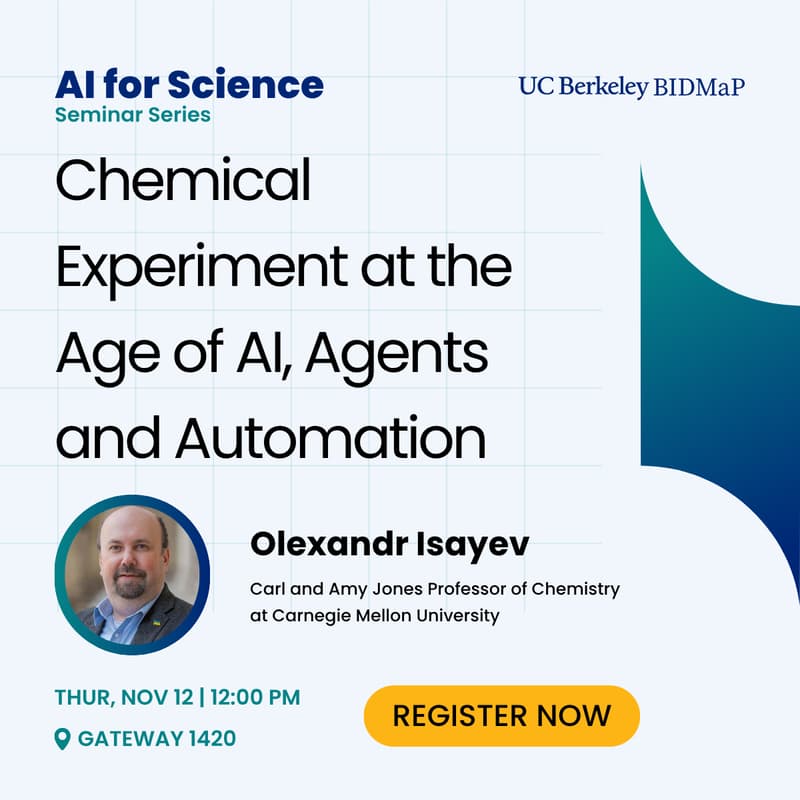

Olexandr Isayev: Chemical Experiment at the Age of AI, Agents and Automation
About this Seminar
Chemical Experiment at the Age of AI, Agents and Automation
The convergence of artificial intelligence, autonomous agents, and laboratory automation is fundamentally reshaping the design, execution, and optimization of chemical experiments. We present an integrated machine learning-guided materials discovery platform that couples automated flow synthesis with automated machine learning to enable rapid experimental and computational cycles. Applied to the design of 19F MRI contrast agents, this platform explored less than 0.9% of a multivariable compositional space, uncovering nonintuitive copolymer formulations that surpassed the performance of existing state-of-the-art materials. Extending this paradigm to multiobjective optimization, a human in the loop reinforcement learning (RLHF) framework was employed to discover polyurethane elastomers exhibiting more than double the average toughness of the initial training set, with select compositions achieving both high tensile strength (>10 MPa) and high extensibility (>200% strain at break) while revealing generalizable structure and property relationships. Central to these efforts are RL agents trained to maximize cumulative rewards aligned with target properties, which learn to propose synthesis protocols, candidate reactants, and experimental conditions as autonomous decision makers within the experimental loop. Looking forward, the integration of large language models (LLMs) and agentic AI architectures stands to substantially advance this paradigm. LLM-powered agents offer the capacity to parse and reason over vast bodies of scientific literature, interpret experimental outcomes through natural language understanding, and orchestrate complex multistep workflows, thereby bridging the divide between high-level scientific reasoning and low-level instrument control. By unifying RL-driven optimization with LLM-based planning and contextual decision-making, we envision fully autonomous experimental platforms in which AI agents formulate hypotheses, design and execute experiments, and iteratively refine their strategies with minimal human oversight. These developments position AI-augmented, agent-driven automation as a rigorous and generalizable strategy for accelerating chemical discovery in data-scarce, multiobjective optimization regimes.
Our Speaker:
Olexandr Isayev
Olexandr Isayev is Carl and Amy Jones Professor of Chemistry at Carnegie Mellon University. In 2008, Olexandr received his Ph.D. in computational chemistry. He was a Postdoctoral Research Fellow at Case Western Reserve University and a scientist at a government research lab. Before CMU, he was a faculty member at the UNC Eshelman School of Pharmacy, the University of North Carolina at Chapel Hill. Olexandr is a 2023 Scialog Fellow and Associate Editor for the ACS Journal of Chemical Information and Modeling. The research in his lab focuses on integrating artificial intelligence (AI) into the chemical sciences.
The Bakar Institute of Digital Materials for the Planet (BIDMaP) accelerates the discovery, development, and deployment of advanced materials to address some of the most urgent challenges facing our planet. By combining cutting-edge chemistry with artificial intelligence, machine learning, and robotics, BIDMaP is reimagining how materials can be designed and optimized for clean energy, clean air, clean water, advanced batteries, and sustainable chemical production.