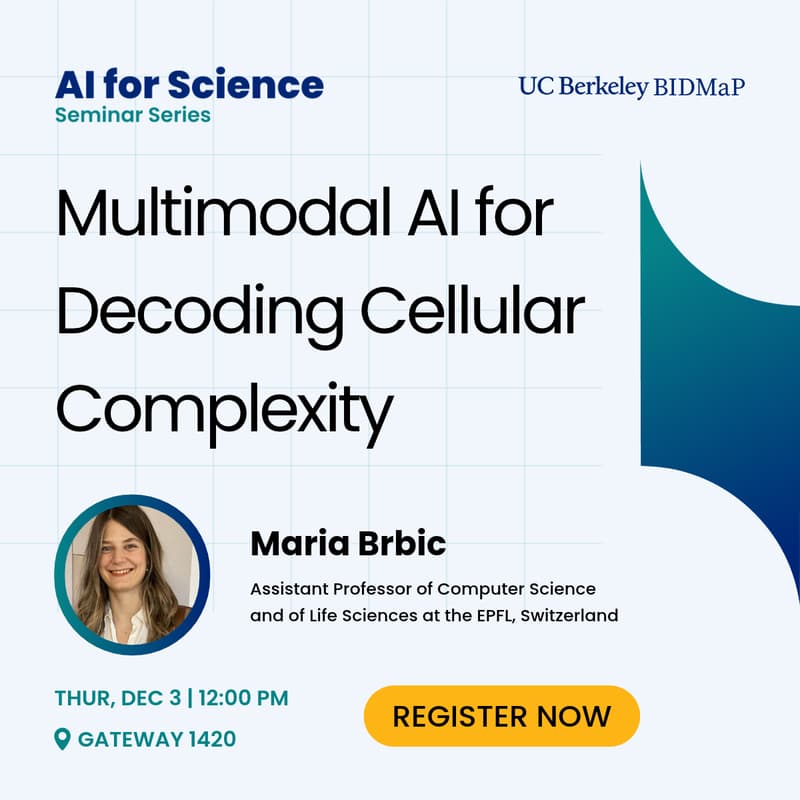

Maria Brbic: Multimodal AI for Decoding Cellular Complexity
About this Seminar
Multimodal AI for Decoding Cellular Complexity
The complexity of biological systems arises from interactions across multiple molecular layers. Understanding these relationships requires models that can integrate high-dimensional, multimodal data and capture how cells behave, interact, and respond to perturbations. In this talk, I will present a suite of generative AI methods we developed to combine information across omics modalities with the aim to uncover principles of cellular organization and bridge molecular and tissue scales. I will demonstrate how these approaches can help to learn the rules governing spatial tissue structure and reveal links between nuclear morphology and molecular state. Finally, I will discuss how these challenges motivate fundamental questions about what AI models learn and share across modalities, and how understanding the structure of their representations can guide more effective and data-efficient multimodal learning.
https://bidmap.berkeley.edu/seminars/maria-brbic-multimodal-ai-decoding-cellular-complexity
Our Speaker:
Maria Brbic
Maria Brbic is an Assistant Professor of Computer Science and of Life Sciences at the EPFL, Switzerland. Her research bridges AI and biology, focusing on developing new AI models that drive advances in biology and biomedicine. Prior to joining EPFL in 2022, she was a postdoctoral fellow at Stanford University. She received her Ph.D. from the University of Zagreb in 2019 and conducted research at Stanford University as a Fulbright Scholar during her doctoral studies. Among other awards and recognitions, she was named a Rising Star in EECS by MIT in 2021, she received the Early Career Bioinformatics Award by SIB in 2023 and she was awarded with the SNSF Starting Grant in 2024. Maria is a CIFAR Fellow in the Multiscale Human Program.
The Bakar Institute of Digital Materials for the Planet (BIDMaP) accelerates the discovery, development, and deployment of advanced materials to address some of the most urgent challenges facing our planet. By combining cutting-edge chemistry with artificial intelligence, machine learning, and robotics, BIDMaP is reimagining how materials can be designed and optimized for clean energy, clean air, clean water, advanced batteries, and sustainable chemical production.