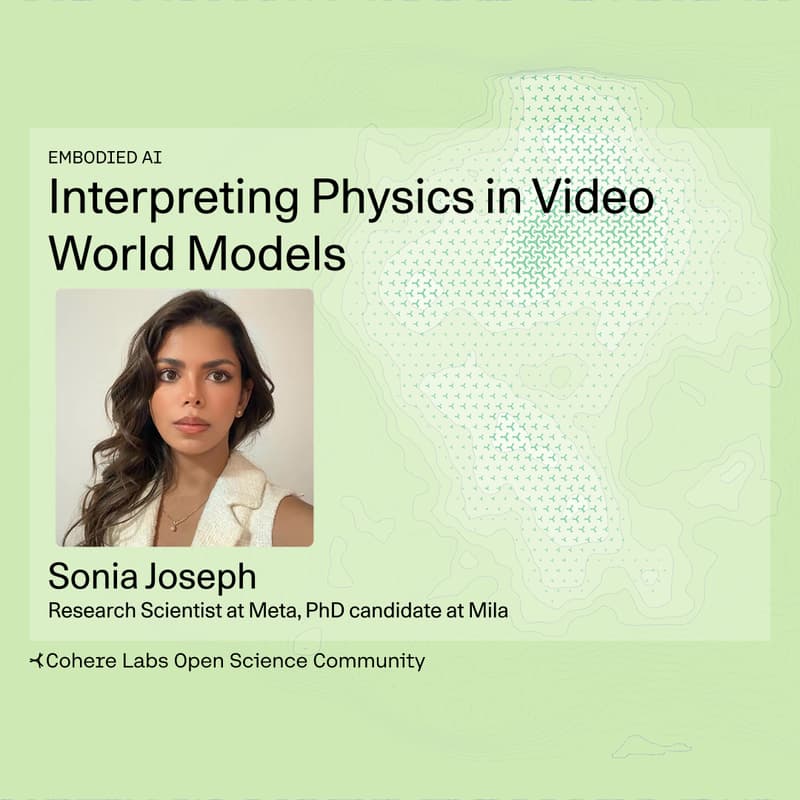

Sonia Joseph - Interpreting Physics in Video World Models
A long-standing question in physical reasoning is whether video models rely on factorized physical state variables, or on task-specific distributed representations. We present the first mechanistic interpretability study of physical variables inside large-scale video encoders, combining layerwise probing, subspace geometry, patch-level decoding, and targeted attention ablations to characterize where and how physical information is orga- nized. Across architectures, we identify a sharp intermediate-depth transition, the Physics Emergence Zone, at which physical variables become linearly accessible. Scalar speed and acceleration are available from early layers, whereas motion direction emerges only at the Physics Emergence Zone, mirroring the V1 to MT motion hierarchy in primate visual cortex. Direction is encoded as a circular high-dimensional population code: dozens of orthogonal probe dimensions must be steered jointly to change the decoded direction, orders of magnitude more than the low-dimensional steering interventions seen in language models. These findings argue against compact physics- engine state variables and support distributed, hierarchically-organized, “brain-like” representations that are nonetheless sufficient for making physical predictions.
Bio: Sonia Joseph is a PhD candidate at Mila/McGill and a researcher at Meta FAIR, where she leads Meta's internal interpretability community and is lead author of "Interpreting Physics in Video World Models," a study of how multimodal systems develop biologically structured "Physics Emergence Zones" where physical concepts become internally decodable.