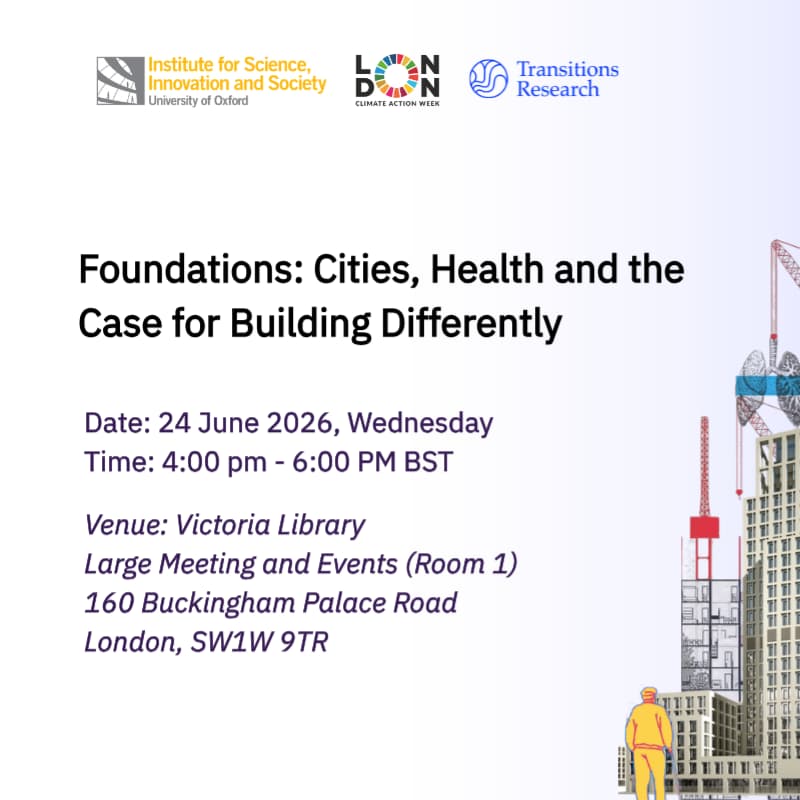

Foundations: Cities, health, and the case for building differently
Event organised by Transitions Research, Institute for Science, Innovation and Society (InSIS), University of Oxford
Foundations: Cities, Health and the Case for Building Differently is a 90-minute session at London Climate Action Week. The session explores how the built environment shapes health outcomes in a warming world, particularly through construction materials, building design, thermal comfort, local knowledge, and the governance of urban infrastructure.
The session will examine the intersection of cities, health, climate adaptation, and low-carbon construction. The session is intended for global health researchers, architects, engineers, built environment practitioners, construction-sector actors, gender and care economy researchers, housing and urban development policymakers, climate adaptation practitioners, and researchers working on cities, infrastructure, and sustainability. It is organised around three linked themes: urban health and the built environment; green construction, local materials and the informal sector; and co-production, equity and governing for healthy cities.
The discussion will consider how poorly ventilated housing, heat-trapping buildings, weak drainage, and toxic materials shape health outcomes, especially in low-income urban settings and rapidly urbanising cities across the Global South. It will also examine how locally adapted, low-carbon materials and construction practices can reduce emissions, improve health, support local economies, and strengthen climate resilience. A core focus will be on the role of community-grounded and co-produced approaches that involve residents, informal-sector actors, care economy actors, researchers, and public institutions in shaping healthier urban futures.
The agenda includes a short opening framing, followed by structured working group discussions across the three themes, and a closing synthesis to identify shared research priorities, policy gaps, and opportunities for collaboration. Headline speakers are currently being confirmed.
The objectives are to establish a shared framing for why cities, construction, health, and sustainability must be addressed together rather than in parallel; generate concrete cross-disciplinary insight through structured discussion; and identify where research gaps, policy failures, and practice opportunities are most acute. Intended outputs include a written synthesis note capturing key insights and areas of convergence, along with a set of identified research priorities and collaboration opportunities.