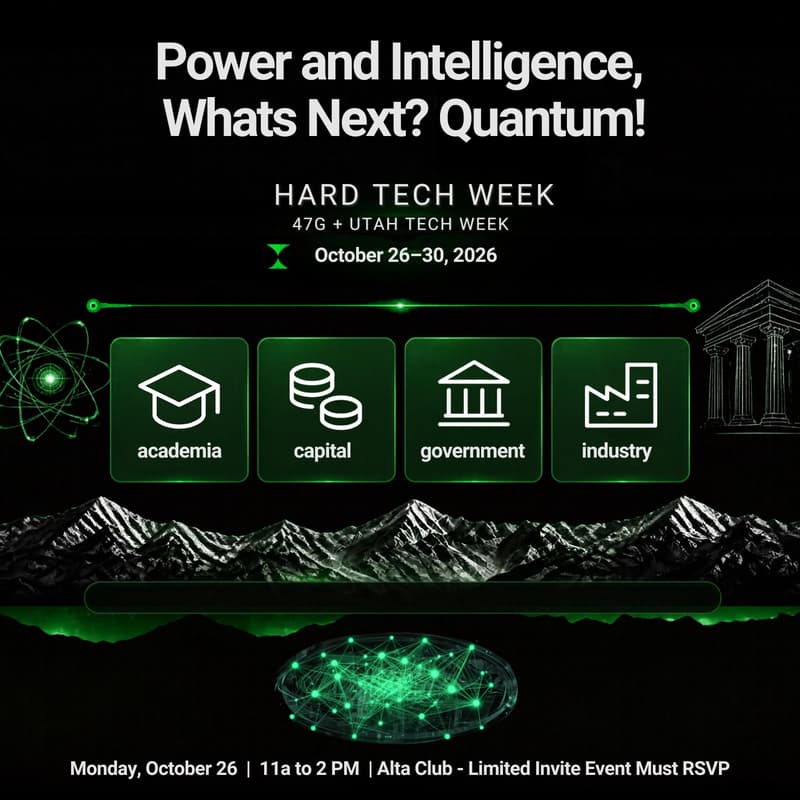
Power and Intelligence: What's Next? Quantum!
We are proud to be hosting one of the first events on the calendar for Utah Tech Week: Hard Tech Track
"Power and Intelligence: What's Next? Quantum!"
Hosts, Sponsors, and Supporters
Hosted by Joel McKay Smith, Heidi Anderson, and Elijah Taylor, with the support of Jeff Hunter from UBS; connectors across Utah's business, rural infrastructure, workforce, and deep tech networks; the convener of Power & Intelligence; and investment and community leaders representing UBS, Black Star Syndicate, Wilson Sonsini, Forbes Partners, Tanner Co., Park City Angels, and jlmstr. Event Brief · jlmstr.me/quantumevent
Logistics:
MUST RSVP AT jlmstr.me/quantum-utah-hard-tech
This event will be full; please don't RSVP unless you plan to attend, and because this is a curated event, only invited guests will be approved.
Doors open at 11; lunch is served at 11:15 a.m. Panel begins close to noon, with networking following til 2.
Parking: the Alta Club lot at 164 E. South Temple, or City Creek with two hours validated.
WHY
Last Year, the "Power and Intelligence" event at UBS resonated with many: The convergence of AI and energy has reshaped how Utah thinks about infrastructure.
Last October, we asked who builds it and who finances
it. In August, the state answered with a different
question entirely.
On August 10, 2026, Governor Cox signed Executive Order 2026-06, establishing the Utah Quantum Initiative and creating a Quantum Coordination Council led by the Governor's Office of Economic Development in partnership with the Nucleus Institute (we welcome Nucleus Institute members to this event).
It followed the June 22 federal order directing the NSF toward quantum facility grants. A federal funding window is open right now, and Utah has an eleven-week plan and a legislative ask arriving in 2027.
Utah's bet is deliberately unusual. The state is not chasing the quantum computer. It is betting on the layer underneath: cryogenic control electronics, advanced packaging, interconnect fabrication, photonics, quantum materials, semiconductor fab, and high-performance computing.
The parts Utah largely already makes. One trade publication called it the smallest quantum plan in America. The ask is $2.5M to $10M near term, against roughly $500M to $700M committed in Illinois and $1B proposed in Maryland.
Small and targeted, or under-reaching? That is a live investment question, and the people writing the plan will be in the room to answer it.
Why Attend
You will leave with a working map of where Utah's quantum money is actually going, which layers of the stack are investable in the next 24 months, and what the post-quantum security deadline means for companies you already own.
Is Utah's small bet the smart bet?
$2.5M to $10M this session against Illinois and Maryland. Deliberate positioning or under-reach?Why components, not computers?
Is "the parts underneath" a durable moat or a consolation prize?The one real deadline.
Post-quantum cryptography is a dated, mandatory migration, and the state plan ties it to Utah's digital identity work. What does a Utah business have to do, and by when?Where does the money go?
A quantum allocation inside the existing Nucleus Fund, with pilots in biotech, logistics, and defense sensing. What is fundable now versus in a decade?The talent leak. The plan names retention as its biggest risk.
No national lab, no problem?
Utah has no DOE lab. Liability, or the strongest argument the delegation has for federal money?
(panelists and more below)
MUST RSVP AT jlmstr.me/quantum-utah-hard-tech
This event will be full; please don't RSVP unless you plan to attend, and because this is a curated event, only invited guests will be approved.
Moderator: Paul Burgon
Partner at KittyHawk focused on energy and infrastructure technology investing, after leading Exit Ventures and co-chairing the Clean Tech Committee at Keiretsu Forum. He has invested over $3 billion across nearly 100 companies and serves on the board of Rocky Mountain University of Health Professions. A Provo-based investor and connector across Utah's tech and energy ecosystem, Paul moderated last year's "Power and Intelligence" event.
Panelist: Heidi Anderson
Executive Partner at Gartner advising CIOs and CTO’s on strategy and AI, following four years as CIO at Prestige Financial Services and the State of Utah Judicial Branch, leading cloud and AI transformation. She serves on the boards of AIM Utah and advises Neumont University. Her deep ties to Utah's tech community make her a key voice on industry readiness for quantum adoption.
Panelist: Glenn Ricart
helped build the early Internet, working on ARPANET since 1969 and creating the first Internet exchange point in 1988. He led OSPF's development at the University of Maryland, ran NSFNet's first backbone routers, and later served as CTO of Novell and CEO of National LambdaRail. Inducted into the Internet Hall of Fame in 2013, he now leads US Ignite's smart-community technology initiatives nationwide.
Panelist: Craig Miller
Senior Staff for Federal Strategy and Operations at IonQ, helping lead the quantum computing company's push into the federal government market. He joined IonQ after a distinguished U.S. Air Force career supporting Special Operations Forces worldwide, most recently commanding the National Security Agency's site in Alaska, and a stint at 47G: Aerospace & Defense. A recurring voice at Utah's Quantum Roundtable series, he has argued the state's proximity to the NSA's Utah Data Center could help it combine classical and quantum computing in one place.
Panelist: AJ Rasmusson
Experimental quantum physicist and Assistant Professor of Physics at BYU. AJ received his Ph.D. in quantum physics from Indiana University, where he performed quantum experiments with trapped-ion qubits. He developed IBM Quantum's Open Quantum educational initiatives from 2021 to 2023. He completed an NRC postdoctoral fellowship at NIST Boulder, CO, in the Ion Storage group, developing novel quantum hardware and quantum error correction-related techniques. In 2025, AJ returned to Utah as an Assistant Professor at BYU, building new trapped-ion quantum experiments. He is a member of the Unitary Fund's open benchmark committee for quantum computing and offers a hardware-level perspective on what quantum can do now and Utah's talent pipeline.
Panelist: Kristin Wihera
Director of Fund Operations at the Nucleus Institute, where she leads day-to-day operations of the Nucleus Fund, a $40M state-backed, evergreen venture fund for early-stage Utah deep tech. A former U.S. Navy officer who led Sailors in ship operations and Naval Nuclear Propulsion, she holds an MBA and an MS in Biotechnology from Harvard and brings the investor's view of what is fundable now.
Panelist: Brigadier General Max Stitzer
Retired Brigadier General with four decades of leadership across military, federal government, and private-sector logistics, including two tours with the Joint Chiefs of Staff and service as Principal Deputy Director for Logistics. He now leads Mentorprise Advisors, connecting private-sector innovators with military and government organizations, and serves as Strategic Advisor for Defense Industry Initiatives at 47G. His expertise in supply chain and defense industrial base strategy informs the event's discussion of quantum's national security applications.
Panelist: Sumit Parashar
Sumit Parashar is the founder and CEO of BODEX, co-founder of UtahQuantum, and Founding Chair of Silicon Slopes Quantum. An electrical engineer since 1990 with more than 30 years in enterprise data architecture, he focuses on practical quantum systems integration and post-quantum cryptography (PQC) remediation. He serves on 47G’s Industry Advisory Board and as Dean’s Executive in Residence at UVU’s Woodbury School of Business. An active educator, he hosts The Entangled Show and created the Quantonomy framework to accelerate enterprise quantum adoption.
Event Brief · jlmstr.me/quantumevent
MUST RSVP AT jlmstr.me/quantum-utah-hard-tech
This event will likely fill up; please don't RSVP unless you plan to attend, and because this is a curated event, only invited guests will be approved.