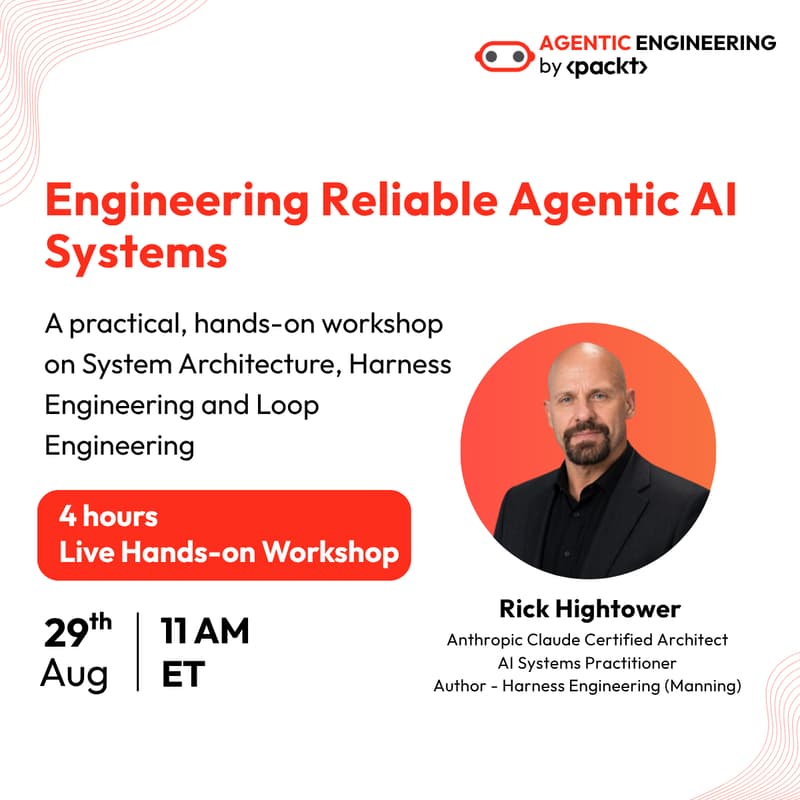

Engineering Reliable Agentic AI Systems
A practical, hands-on workshop on System Architecture, Harness Engineering and Loop Engineering
Building an AI agent is easy. Building one that works reliably in production is not.
Many AI systems can complete simple tasks, but they often struggle with longer workflows. They lose context, make unnecessary model calls, fail to verify their output, retry indefinitely, and become increasingly expensive to operate. As AI agents take on more responsibility, prompt engineering alone is no longer enough.
Reliable agentic systems require thoughtful architecture, structured execution, robust evaluation, and observability. They need clear goals, memory, verification, cost-aware decision making, and safe stopping conditions to perform consistently in real-world environments.
This workshop teaches the engineering patterns behind production-ready agentic systems.
Over four hands-on hours, you'll learn how System Architecture provides the foundation, Harness Engineering ensures quality and reliability, and Loop Engineering orchestrates intelligent execution. Through practical examples and guided exercises, you'll explore how these disciplines work together to build AI systems that are scalable, observable, cost-efficient, and trustworthy.
By the End of This Workshop, You'll Be Able To
Design the architecture for reliable agentic AI systems.
Structure autonomous agent workflows using modern Loop Engineering principles.
Write machine-readable specifications using Spec-Driven Development (SDD).
Build evaluation, testing, and execution harnesses to validate AI agent behaviour.
Implement deterministic verification, LLM-as-Judge, and Agent-as-Judge evaluation strategies.
Design agents that make efficient use of context windows and minimize unnecessary token usage.
Integrate external tools safely using the Model Context Protocol (MCP).
Build autonomous research workflows that validate sources and synthesize reliable results.
Design memory, observability, retry strategies, and human-in-the-loop workflows for production systems.
Apply reusable architectural patterns to real engineering tasks such as PR reviews, CI maintenance, dependency updates, issue routing, and changelog generation.
Who Is This Workshop For?
This workshop is ideal for:
Software Engineers building AI-powered development workflows
AI and LLM Engineers designing autonomous agent systems
Platform and DevOps Engineers automating engineering operations
Technical Architects building production AI platforms
Engineering Managers and Tech Leads evaluating agentic AI adoption
Developers using Claude Code, Codex, Cursor, Gemini, or similar AI coding assistants who want to build reliable, production-ready AI systems
Prerequisites
Basic familiarity with Claude Code or another AI coding tool
GitHub account with Actions enabled
Python 3.11+ for labs
Claude API key (free tier works for labs 1-3)
What You'll Receive
4 hours of live, hands-on instruction with Rick Hightower
Guided labs and practical exercises you can follow along with
Workshop recording to revisit the material after the session (if included)
Downloadable workshop resources (slides, code, lab materials, if included)
Live Q&A with Rick throughout the workshop
Certificate of Completion from Packt