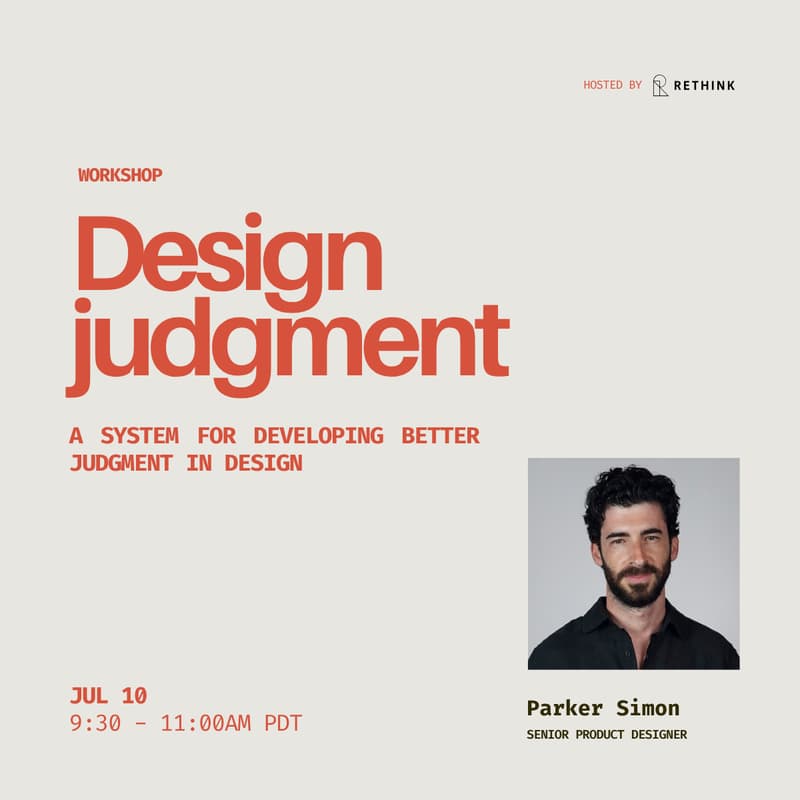

Sharpen Your Design Judgment with Behavioral Science
Most designers or solo founders want to learn how to develop “taste” and “judgment” but few are given a system to build this skillset.
This workshop gives you a framework for how to use behavioral science to build better products using Claude Skills.
What’s in it for you:
You’ll learn a repeatable system for how to
Use Claude skill files (Scanner, Auditor, and Advisor) installed and working on your machine
Translate abstract values (like trust or confidence) into tangible design decisions
Spot inconsistencies between what a product claims and what it expresses
Defend your work with clear reasoning executives and stakeholders understand
Instead of saying “it felt right,” you’ll be able to clearly explain why a choice supports user values like confidence, trust, or belonging.
You’ll leave with:
A practical framework you can use immediately on real projects
An audit of a live product with concrete, defensible recommendations
A structured way to turn research and values into specific design moves
This isn’t a visual design workshop. This isn't theory. You’ll apply the model to a real product and walk away with a framework and a skillset to apply right away at work.
Target audience:
Senior product designers who've sat in a review and said "because it felt right" when asked why they made a choice, and knew that wasn't good enough
Solo founders who are building a product and need it to connect with their audience
Format:
90 minutes workshop
problem framing and live demo
hands-on where everyone installs the tools and runs them on a real product
group debrief and discussion
About the speaker:
Parker Simon is a product designer and systems thinker focused on the intersection of human behavior and complex product systems.
Over the past decade, he has led design across startups and platforms, repeatedly helping teams uncover hidden assumptions and reorganize products around what people actually value. His work draws from product design, values research, behavioral psychology, and human development. He is the creator of the Value Activation Model (VAM), a framework for making design reasoning more explicit, traceable, and grounded in what matters to people.