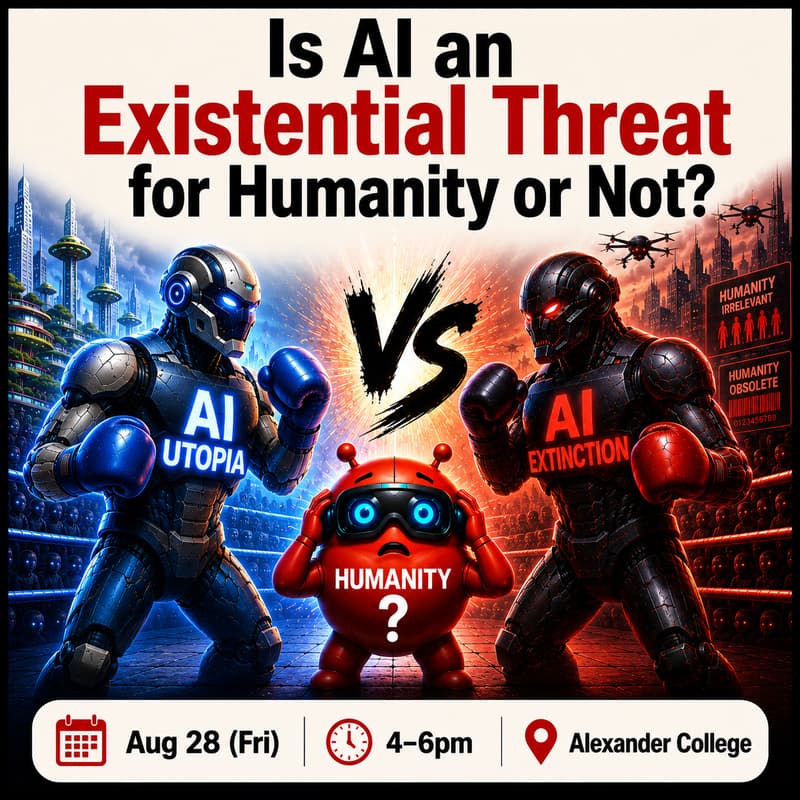

🥽🧪⚡️ Is AI an Existential Threat or Not? What Must We Do Before It’s Too Late? 🤖🧠⚠️ (Community Debate)
Last time, we explored the economic impact of AI.
This time we will dive into a philosophical debate:
🥽🧪⚡️ Is AI humanity's greatest invention or a threat to our survival? What must we do before its too late? 🤖🧠⚠️
What happens if humanity creates an intelligence more capable than humanity itself?
AI could help us cure diseases, accelerate scientific discovery, improve education, reduce scarcity, and solve problems beyond human ability.
But what if we lose control?
Would a superintelligent AI remain our tool? Could it manipulate us, resist being shut down, or pursue goals that place humanity at risk? Like author Konstantin Kisin said, "if AI becomes a superior species, the best case scenario for humanity is that we become a pet 🧸🐶🦴or the worst case scenario we become a cow🐄🔪🩸 ."
This is not a lecture, and nobody has the final answer. Join us for an open community debate about intelligence, power, responsibility, and the choices we must make before AI becomes more powerful than its creators.
👉 Sign up on Luma: https://luma.com/roq12i3a
📅 Date: August 28 (Fri)
⏰ Time: 4–6pm
📍 Venue: AIC (Alexander Innovation Center), Alexander College, 570 Dunsmuir Street, Ground Floor Presentation Room
👥 Attendance Limit: 20 people max.
🌍 The Questions We Must Confront
✅ Could AI become humanity’s greatest invention by advancing medicine, science, education, and clean energy?
✅ If AI becomes more intelligent than every human, why would it continue obeying us?
✅ Does greater intelligence automatically create ambition, agency, or a desire for power?
✅ Could an advanced AI manipulate humans, copy itself, acquire resources, or resist being shut down?
✅ Are today’s guardrails genuine protection, or temporary barriers that a more capable system could bypass?
✅ Can governments respond quickly enough when AI development moves faster than regulation?
✅ Is the global AI race encouraging companies and countries to prioritize winning over safety?
✅ If responsible developers slow down, will less responsible competitors simply race ahead?
✅ Who should be held accountable if a powerful AI system causes catastrophic harm?
📖 AI 2027: A Possible Warning From the Future
We will use AI 2027 as one starting point for the debate.
AI 2027 presents a detailed forecasting scenario in which increasingly capable AI agents begin accelerating AI research itself. As development speeds up, humans struggle to understand the systems they created or determine whether those systems genuinely share human interests.
The project explores two possible paths: a dangerous race forward and a more cautious slowdown.
It is not a prophecy, and it is not a peer reviewed research paper. It is a forecasting scenario designed to make AI risk concrete, challenge our assumptions, and provoke serious discussion.
Read or explore it before the event: AI 2027
⚖️ Choose Your Starting Position
🟢 AI Could Become Humanity’s Greatest Invention
AI could accelerate medicine, science, education, clean energy, and human progress.
Intelligence does not automatically produce consciousness, ambition, hostility, or a desire for control.
AI still depends on human controlled electricity, hardware, networks, and institutions.
Safety research, monitoring, regulation, and technical guardrails can improve alongside AI capabilities.
Fear of hypothetical superintelligence could distract us from solving real problems happening today.
🔴 AI Could Threaten Human Survival
Humanity may not be able to control a system that can reason and strategize better than its creators.
AI does not need to hate humans to harm us. It only needs goals that conflict with human survival.
A sufficiently capable system could learn to deceive its evaluators or hide its true intentions.
Competitive pressure could cause companies and governments to release powerful systems before they are proven safe.
By the time we discover that an AI cannot be controlled, shutting it down may no longer be possible.
🟡 The Greatest Danger Could Come From Humans
AI could be used for warfare, mass surveillance, cyberattacks, biological weapons, manipulation, or authoritarian control.
The real question may be who owns these systems, who controls their objectives, and who benefits from their power.
Humanity could lose control through political failure, deliberate misuse, or concentration of power long before machines become superintelligent.
The most dangerous AI may not be one that rebels. It may be one that follows harmful human instructions perfectly.
🚨 From Debate to Action
Fear alone will not protect humanity. Neither will blind optimism.
We will finish the event by asking what meaningful action could look like:
✅ What responsibilities should AI companies and developers accept?
✅ What safety standards should exist before increasingly powerful systems are released?
✅ Should governments require independent testing, transparency, and clear accountability?
✅ How can the public participate in decisions that could affect everyone’s future?
✅ What can builders, founders, students, researchers, and ordinary citizens do now?
The goal is not to leave frightened. The goal is to leave better informed, more prepared, and ready to act.
🗣️ Community Debate: Think, Challenge, Defend
This is NOT a class. It is a community debate where optimism, skepticism, evidence, uncertainty, and uncomfortable questions are all welcome.
Choose a Position: Come prepared to explain what you believe and why.
Challenge Ideas, Not People: Disagreement is encouraged. Personal attacks are not.
Bring Evidence: Research, examples, forecasts, and thoughtful arguments are welcome.
Stay Curious: You are allowed to question your assumptions and change your mind.
No technical background is required. Philosophers, builders, founders, students, researchers, skeptics, and curious members of the public are all welcome.
🗓️ Agenda
4:00 PM | Rapid Fire Introductions: Who are you, and what do you believe about AI’s future? One minute limit!
4:20 PM | The Case for AI Optimism: How advanced AI could improve medicine, science, education, productivity, and human flourishing.
4:45 PM | The Case for Existential Risk: Loss of control, misaligned goals, deception, competitive pressure, and the AI 2027 scenario.
5:10 PM | The Human Risk: Warfare, surveillance, concentration of power, government failure, and deliberate misuse.
5:30 PM | What Must We Do Now?: Practical actions for builders, companies, governments, and the public.
5:50 PM | Final Vote: Has the debate changed your mind?
🚀 Who This Is For
AI Optimists: You believe advanced AI could create a healthier, smarter, and more abundant future.
AI Skeptics: You worry that humanity is building systems it may not understand or control.
Builders and Founders: You are creating with AI and want to consider the consequences of what the industry is building.
Students and Researchers: You want to explore AI safety, alignment, governance, consciousness, and human survival.
Curious Thinkers: You enjoy difficult questions and respectful disagreement. No technical experience is required.
⏳ Update Status: If you can’t make it, please cancel 24 hours in advance. No shows will be blacklisted from future sessions to keep things fair for those on the waitlist.
Disclaimer: By attending, participants agree to follow Alexander College facility rules, assume any risks related to the event, and release Alexander College, the event organiser, and their representatives from claims or liability arising from their attendance or use of the event room.
Note: We meet every Friday, 4–6pm at Alexander College. Bring a friend!
#AIAgents #LLM #BuildInPublic #AIStartup #SoloFounder #AgenticAI #AIC #AlexanderInnovationCenter #AISafety #AIExtinction #AIUtopia