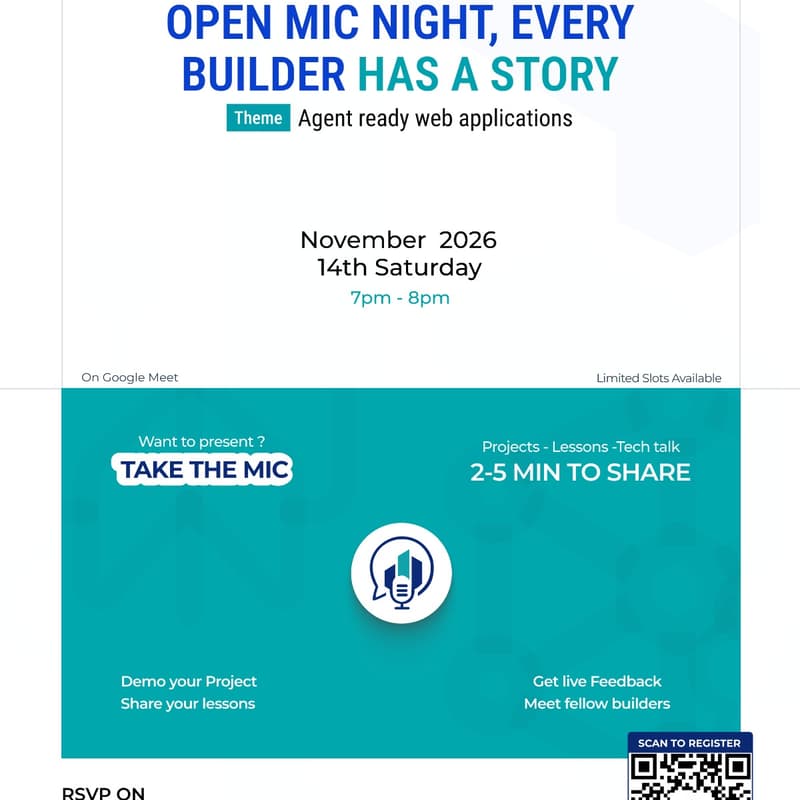

Open Mic: Agent Ready Web Applications
For decades, websites have primarily been designed for humans.
We build interfaces with buttons, navigation menus, search bars, forms, tables, and dashboards. A human visits a website, understands what is available, decides what to do, and interacts with the interface to accomplish a task.
But what happens when the person interacting with your website is no longer the one clicking the buttons?
Imagine asking an AI assistant:
Find me a flight from Nairobi to Lagos next Friday.
Search this store for a laptop under $1,000.
Check my order status and tell me when it will arrive.
Find a suitable insurance package and prepare an application.
An AI agent might attempt to accomplish these tasks by opening a website, reading its contents, identifying buttons, filling out forms, and clicking through different pages.
This approach works, but it is not particularly reliable.
Buttons can be difficult to identify. Forms may have complicated validation rules. Page layouts change. Important functionality may be hidden behind menus or dynamic interactions.
The agent is essentially trying to understand and operate an interface that was designed for humans.
What if websites could explicitly describe the actions they make available to AI agents?