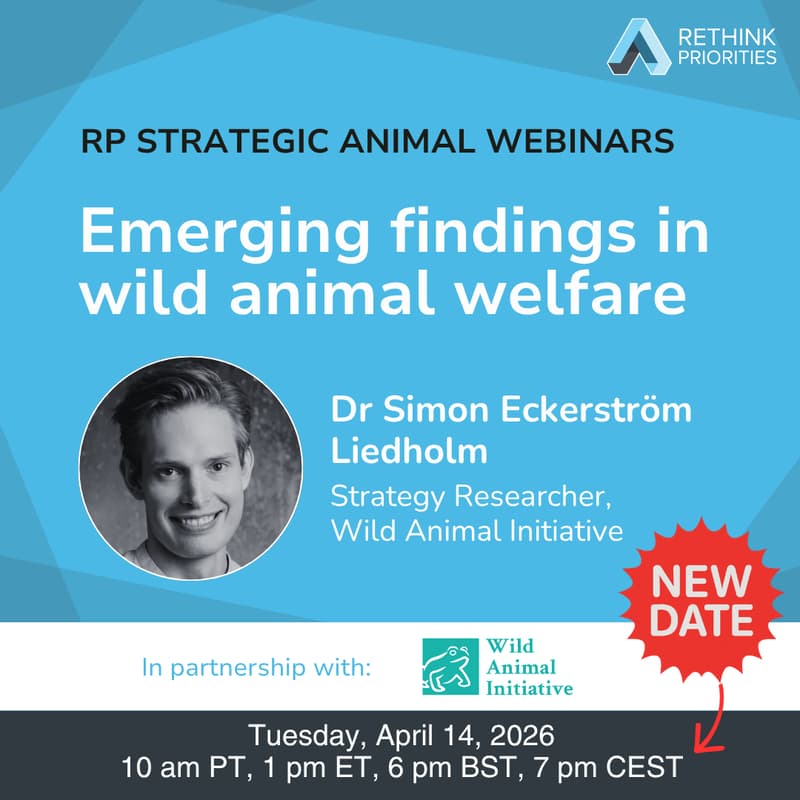

Emerging findings in wild animal welfare
Welcome to the RP Strategic Animal Webinars and the talk and Q&A session: “Emerging findings in wild animal welfare.”
New Date: Tuesday, April 14 (10 am PT, 1 pm ET, 6 pm BST, 7 pm CEST)
About: There are around 1 quadrillion vertebrates, and very roughly 100 quintillion arthropods, both land and marine, living in the wild at any given moment. Due to the recency of wild animal welfare as a research field (less than 10 years), the limited knowledge of these animals' needs, and the complexity of evaluating second-order effects of interventions in the wild, advocates often face a lack of data on promising ways to help wild animals.
In this webinar, Dr. Simon Eckerström Liedholm, Strategy Researcher at Wild Animal Initiative, will explore some key emerging findings in wild animal welfare and their implications for interventions for these animals.
In particular, he will discuss:
The importance of population dynamics for wild animal welfare, and contraception as a promising solution
How repurposing and expanding existing tools help us quantify wild animal welfare
Cause of death and disease mitigation as promising levers of change
Whether you are a researcher, an advocate, or a funder interested in making progress for wild animals, this session will equip you with a better understanding of the cutting-edge of wild animal welfare knowledge relevant to strategy in this area.
Speaker: Dr. Simon Eckerström Liedholm is a Strategy Researcher at Wild Animal Initiative (WAI). Before joining Wild Animal Initiative, he earned his PhD in Zoology at Stockholm University, focusing on behavioral ecology, evolutionary biology, and brain size evolution in fish. Dr. Liedholm’s research at WAI focuses on many different topics, both relating to organizational strategy and object-level questions such as population dynamics, wild animal welfare interventions like wildlife contraception and disease prevention, and the welfare effects of injuries. His current work includes a joint project with Luke Hecht (Science Director at WAI), modeling the effects of contraception, a project on the welfare effects of diseases like the New World on wild animals, and a project on the welfare effects of injuries in wild fish.
Format: We’ll start with a focused 20-30-minute presentation, followed by an extended Q&A session.