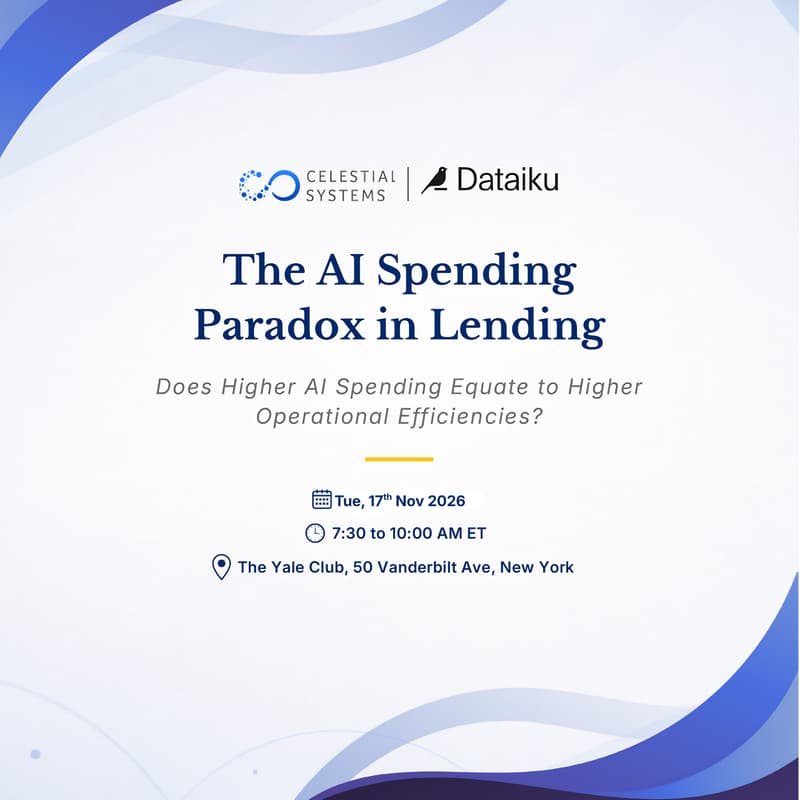

The AI Spending Paradox in Lending
The AI race in lending is real. The returns are not — at least not yet, and not for most.
The numbers tell a consistent story. KPMG's 2026 Banking Technology Survey found that 80% of banking executives expect AI to significantly disrupt their business within three to five years, and their Q2 2026 AI Pulse survey put average projected AI investment for banking organizations at roughly $170 million over the next 12 months. Yet survey after survey finds fewer than one in five financial services executives can point to a single AI initiative that has produced a measurable improvement in a lending outcome. The investment is real. The ambition is real. The connection between them is what's broken.
This isn't a technology problem. It's a production problem. Most lending institutions have built AI. Very few have operationalized it. The gap between a model that works in a data scientist's environment and a model that runs in live underwriting decisions — at scale, with governance attached, with the auditability a regulator expects — is where the majority of the industry's AI investment quietly disappears.
This invitation-only event brings together senior leaders from across the lending industry — community banks, credit unions, mortgage lenders, private lenders, and specialty finance organizations — for an in-person breakfast and a direct, peer-level conversation about the gap between AI investment and AI results: what's driving it, what it costs, and what it would actually take to close it.
Agenda
7:30 AM — Arrival and networking breakfast (complimentary continental breakfast provided)
8:00 AM — Main session: The AI Spending Paradox in Lending (30 minutes)
8:30 AM — Open Q&A and peer discussion
9:15 AM — Closing remarks and networking
10:00 AM — Close
What We'll Cover
The main session addresses:
The AI productivity paradox in lending: why institutions spending the most on AI are rarely the ones with the most to show for it — and what the data actually says about the gap between AI investment and operational return
What "operationalizing AI" means in practice for a lending institution — the specific difference between a model in a lab and a model in a live credit decision
The AI lending stack: what the institutions pulling ahead have built — and the organizational and technical decisions that separate scaled AI production from endless piloting
The competitive advantage question: when the best lender isn't defined by balance sheet or branch network but by the quality, speed, and governance of its AI enabled credit decisioning, what does that mean for institutions of your size?
Open peer discussion: where your organizations are in the AI production journey, what's working, and where the real friction points are.
Our Speakers
John McCambridge, Global Solutions Director, Financial Services & Insurance, Dataiku
John has spent over five years at Dataiku helping lending institutions move from AI experimentation to production-grade deployment. Before Dataiku, he held Senior Vice President roles at Citi leading strategy and business transformation across global commercial and consumer banking in New York and Singapore. At this session, John will speak to what closing the AI productivity gap actually requires, and what separates institutions that have scaled AI in credit decisioning from those still running pilots.
Rahul Raina, Vice President of Business Development, Celestial Systems
Rahul Raina has spent more than 15 years at Celestial Systems helping Fortune 100, mid-market, and growth-stage organizations build and run mission-critical applications in the cloud. He works with leadership teams on moving AI from promising pilots into production, embedded in the applications and workflows they already run, and has helped lead Celestial’s own transformation into an AI-native services company. Previously, he served as President of Antrix Technologies, running a dedicated offshore software development centre through its acquisition by NICE in 2021.
Our Moderator
Lakshmi Chandra, Director of Solutions, Celestial Systems
As a Director of Solutions with extensive experience guiding organizations through the full AI journey — from strategy through production deployment — Lucky brings practical, hard-won insight from enterprise AI implementations across regulated industries. His focus is on bridging the gap between AI potential and AI performance: moving lending institutions beyond proof-of-concepts to systems that deliver measurable operational and credit outcomes. Lucky specializes in identifying the specific factors that determine whether an AI initiative scales or stalls — and helping institutions build the foundation to make it stick.
Our Venue
The Yale Club of New York City, 50 Vanderbilt Avenue
We're hosting this conversation somewhere that matches it: the Yale Club of New York City, a private members' club across the street from Grand Central. For more than a century, its clubhouse has been where New York's business and civic leaders meet. President William Howard Taft was among the guests when it opened in 1915.
Arrive from 7:30 AM for a complimentary continental breakfast with a small group of fellow lending executives, in a setting built for meaningful conversation.