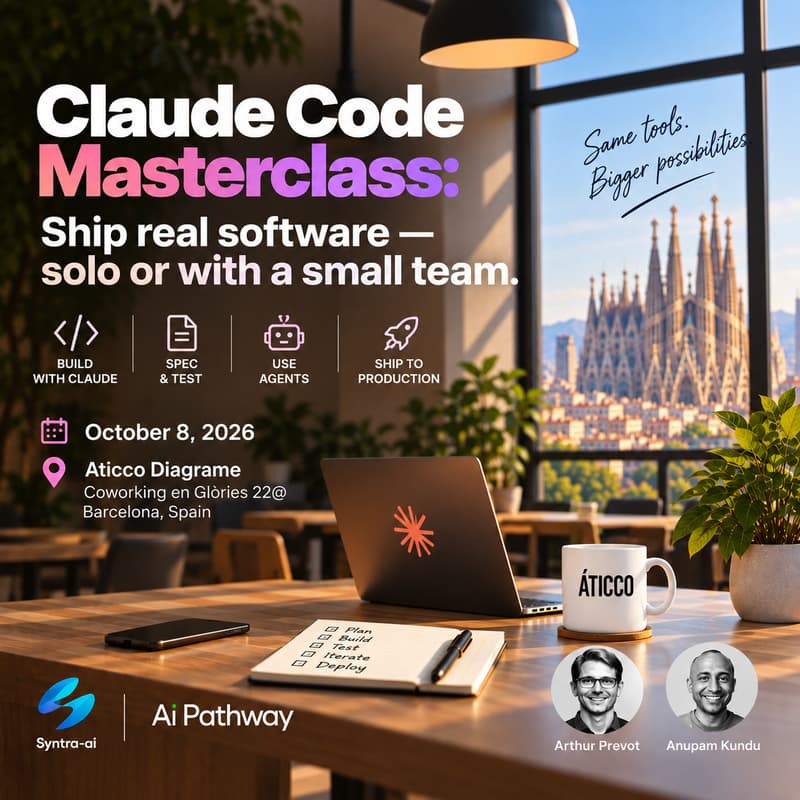
Claude Code Masterclass: Ship real software - Solo or with a small team.
Claude Code Masterclass: Ship real software - Solo or with a small team.
Prompting can get you to a demo. It doesn't get you to a system.
A one-day, hands-on workshop for developers, technical founders, independent builders and automation-heavy entrepreneurs who want to use Claude Code to build real software — not just prototypes.
Bring your own idea: an internal tool, SaaS product, client portal, dashboard, booking system or application.
By the end of the day, you'll have built and deployed your own project to a live URL and learned a development workflow you can continue using after the workshop.
October 8 · Barcelona · 12 seats · 2 instructors · Your own project.
The discipline behind agent-built software: specs, tests, skills, subagents, permissions, context engineering and release gates.
👥 Who it's for
TPM· Technical minded founders · Developers / Builders · Validators · Automation-heavy entrepreneurs
"I have things I want to build. Until now, building them properly required more engineering capacity and competencies than I have."
If you are someone who have something you want to build, but no / limited engineering capacity to build it - then you belong to this class.
This day is designed for people who are new to agent-assisted coding, or who have already tried it and discovered that generating code is much easier than maintaining a real product.
No Claude Code experience is required.
If you have never written code but are technically fluent and comfortable working with LLMs, you should be able to follow the day.
Already using Claude Code every day?
Tell us when you register. Some of the foundations may be familiar, and we can push you further during the build blocks.
🛠️ What you'll be able to do after this day
You won't just know how to use Claude Code. You'll know how to use it to take software from idea to release.
You'll be able to:
Turn an idea into a specification Claude can reliably build against
Structure a repository so coding agents can work without losing critical context
Use tests and review gates to catch bad agent-generated code
Create reusable skills, commands and subagents instead of starting from scratch every time
Run multiple agents while keeping control of the overall system
Decide what agents can do autonomously and what requires your approval
Build, test and deploy your application through a repeatable release process
The goal: after the workshop, you can sit down with another idea and know how to build and ship it yourself.
This program is not for you, if you're looking for an introduction to AI, or a prompting course, or a no-code automation workshop.
🧠 What you'll learn in one day
Setting up a repository an agent can work in
GitHub, branches, and what needs to be written down before Claude touches anything.
Spec-driven development
Write the contract first, so the agent builds what you meant rather than what it inferred.
An agent starts each new session with only the context you give it. So critical knowledge cannot live only in the conversation, it needs to live in the system around the agent.
That principle underpins much of the day.
Tests that can fail
The thing that begins separating an impressive demo from software you can trust.
Skills and slash commands
Teach Claude your conventions once instead of explaining them again and again.
Subagents in parallel
Split work across agents without losing control of the overall system.
Permissions and human gates
Decide what an agent may do unattended, what requires a human, and where that boundary belongs. No production deployment without the appropriate gate. No user communication without approval.
Context engineering, not just prompt engineering
Why increasingly elaborate prompts stop being enough as a codebase grows — and how to keep hallucinated code away from your main branch.
Proving it works rather than hoping
Define "working" before you ship. Catch regressions, incorrect assumptions and the process that quietly stopped running three weeks ago.
Build and release
Create a repeatable path from accepted code to a known release.
Design that doesn't look AI-generated
Move beyond the visual patterns that make many agent-built products immediately recognisable.
🗓️ The programme
9:00 — ARRIVE
Coffee, introductions & setup check
09:15 — SET UP
The repository an agent can actually work in — GitHub, branches, what lives where
10:00 — SPEC
Write the contract before a line of code exists
11:00 — 🛠️ BUILD BLOCK I
Your project. Spec first. Start building.
12:15 — TEACH CLAUDE YOUR WAY
Skills, commands & reusable instructions
13:00 — 🍽️ LUNCH + NETWORKING
14:00 — TEST & REVIEW
Tests that can fail + how to read an agent's diff properly
15:00 — 🚀 BUILD BLOCK II
Subagents in parallel. Get your project toward a live deployment.
16:15 — SHIP
Build, release & a repeatable path to production
16:45 — SHOW & TELL
What shipped, what failed & what comes next
17:15 — 🍷 DRINKS + NETWORKING
And your next build.
📦 What's included
Full-day hands-on workshop, 09:00–17:00
Maximum 12 participants
2 instructors on the floor
Pre-workshop intake so your project is selected and your machine is ready before 09:00
Coffee and pastries
Lunch
Drinks afterwards
Certificate of completion
Slides and reference material to keep
🔁 It does not end at 17:00
One intense day is a good format for teaching. But the real learning often happens the following Tuesday, alone, when something breaks.
So your ticket includes 30 days of follow-through:
4 weekly follow-on emails — one idea and one thing to try on your own project
Private participant group — deliberately small enough that you know who everyone is
One live office hour approximately two weeks later: bring what broke
Direct email access to us for 30 days, with responses within one business day
You also receive a certificate of completion — but more importantly, you should leave with a real project you can show alongside it.
👨💻 👨💻 Two instructors.
Anupam Kundu
Strategy & Product · 25 years
Twenty-five years building technology across four continents, including work with Google, JPMorgan, UNICEF and startups.
Co-author of AI Pathway: A Strategy Framework for the AI-Powered Enterprise. He founded and runs Kiido, a co-parenting product live on the App Store and Google Play. Its current development workflow is heavily agent-driven: features begin with specifications, move through review and testing gates, and ship through a controlled release process.
Anupam and Arthur have collaborated for several years on AI adoption and education across universities and businesses.
Arthur Prévot
Data & Infrastructure · 20 years
An aerospace engineer turned data scientist. Arthur built robotics that flew on the International Space Station and went on to spend twenty years working in fast-growing technology companies, including Shopify.
He created Yaetos, an open-source data framework, teaches at Barcelona Technology School, and now runs Syntra AI, working with businesses on practical AI adoption.
🎟️ Pricing
⚡ EARLY BIRD — €449
First 6 seats
Full day + lunch + drinks + workshop materials + 30-day follow-through
STANDARD — €539
Remaining seats
Everything above, with company invoicing and certificate.
⭐ VIP — €719
Maximum 3 seats
Everything in Standard, plus:
30-minute call before the workshop
One dedicated hour with an instructor
14 days of direct support on Claude Code blockers
💻 What to bring
Your laptop: Mac (preferred), Windows or Linux
Claude Pro or above
Required software installed — we'll send setup instructions before the workshop
An idea you genuinely want to build
You'll choose and scope the project through the intake form before the day.
❓ FAQ
Can my company pay? Can I get an invoice?
Yes. Company invoicing with VAT details is available. If several people from your company are attending, multiple seats can be purchased together.
Do I need coding experience?
No, but you need to be technically comfortable. We teach the structure and workflow rather than programming syntax.
What if I already use Claude Code every day?
Tell us at registration. Some of the morning foundations may be familiar; the build blocks, subagents, permissions, testing and release workflow are where we can push further.
Is there anything after this?
Yes. We are planning a follow-on workshop about what happens once your product has real users: incidents, migrations, production failures, store review and bugs that only appear in release builds. Participants from this workshop will hear about it first.