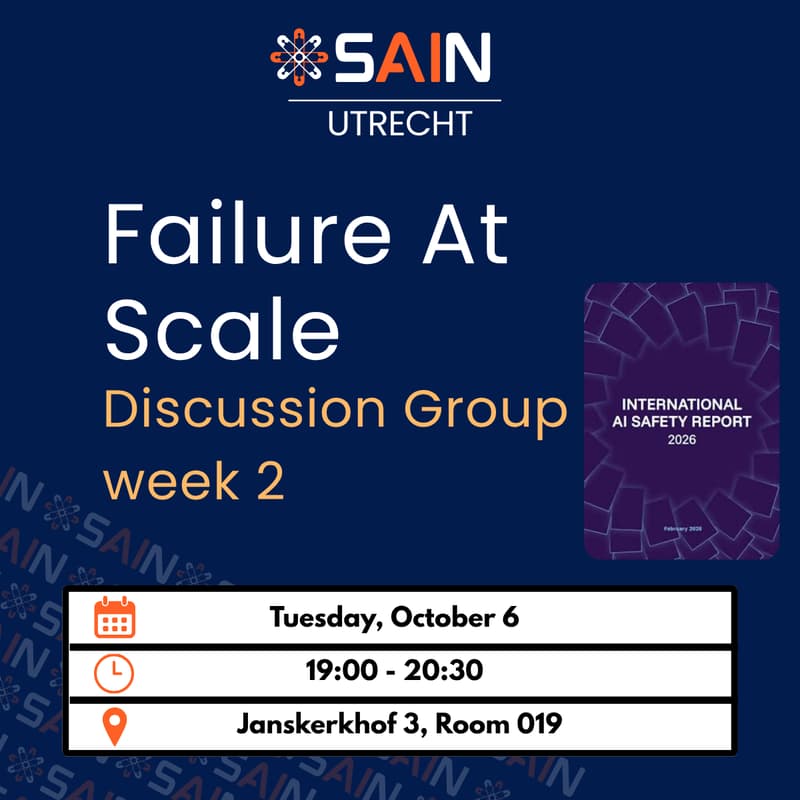

Discussion group - week 2 - What failure could look like at scale
Part two of a four-week AI safety discussion series: Week 1 | Why AI Safety matters · Week 2 | What failure could look like at scale · Week 3 | Why alignment is hard · Week 4 | What's being done about it? Every session stands on its own, so join one or all.
Who it's for: Anyone curious about AI safety and governance, whether you're new to the topic, a healthy skeptic, or already deep in it. No technical background needed, and no need to have joined earlier weeks. You don't need to have answers, just curiosity.
Discussion group curriculum:
https://docs.google.com/document/d/160PpLjFN9SaZja0njeKIQHnD-M1Uy4718dNRDyhaucs/edit?usp=sharing
Last time we looked at one real incident. This week we zoom out. The second International AI Safety Report, chaired by Yoshua Bengio and written by over 100 experts, is a shared scientific assessment of what AI can do today, which risks are emerging, and how well we're managing them.
We'll use it as a map of how things could go wrong at scale, from deliberate misuse to malfunctions to wider effects on society, and talk about which risks feel most real to us.
Questions we'll explore
Which risks feel most real to you, and which feel overhyped or underrated?
What does "jagged" progress in AI capabilities mean for how we prepare?
What evidence would change your mind?
Format (90 min): Open discussion in small groups and plenary. No presentations, and no wrong questions.
Readings:
★ = mandatory (~1.5 hours). The rest is optional.
International AI Safety Report 2026: https://internationalaisafetyreport.org/publication/international-ai-safety-report-2026
★ Executive Summary, pp. 11–13
★ §2.1.3 Cyberattacks, pp. 57–63
★ §2.2 Malfunctions, including loss of control, pp. 71–83
★ §2.3 Systemic risks: labour markets and human autonomy, pp. 84–95
Optional: §1.3 Capabilities by 2030, pp. 32–43
Optional: §2.1.4 Biological and chemical risks, pp. 64–70
Optional: §3.1 Technical and institutional challenges, pp. 97–104