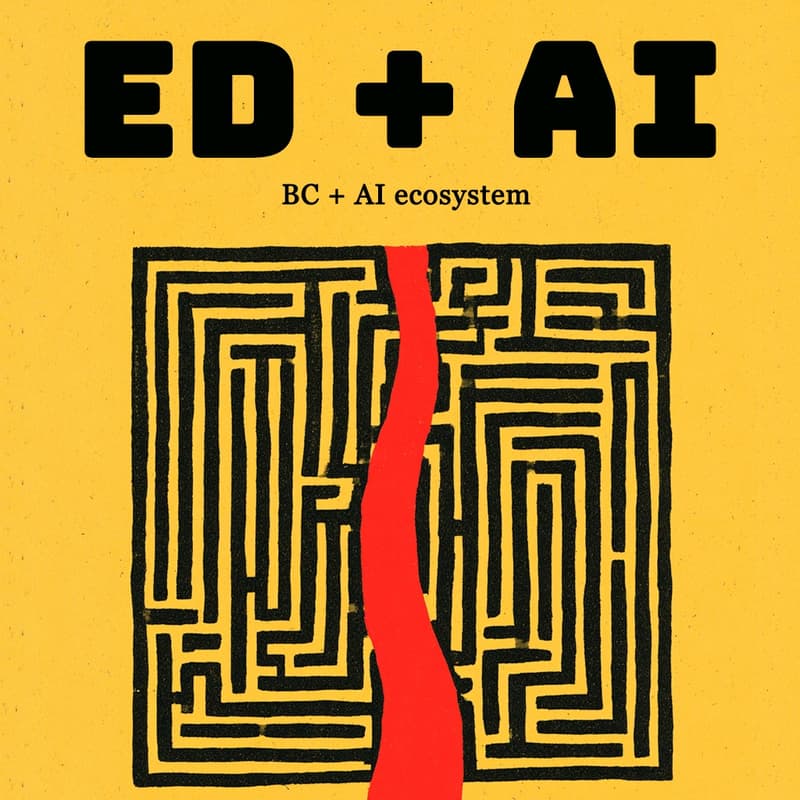

ED + AI #13: Where You Stand on the Future of Learning
Is the future of learning getting better or worse? And do you have a hand in it?
Two questions, one floor, and a room full of people who will answer them differently. That is the whole evening.
Stand where you actually believe.
This month we are borrowing the Polak Game, a futures exercise Nessa Palmer is bringing over from the UBC Master of Educational Technology program, and pointing it at AI and learning.
It works like this. The floor becomes a grid. One direction asks whether you think the future of learning with AI is getting better or worse. The other asks whether you believe people like you can shape it, or whether it is mostly happening to us. You walk to the spot that is true for you today. Not the spot you would defend in a staff meeting. The honest one.
Then we look around. Who is standing near you? Who is in the opposite corner? What does the room look like from where a student stands, or a parent, or a first-year teacher?
From there we build stories. Small groups take a corner and write the future as it looks from that spot: what a classroom is like, what an assignment is, what a young person expects from the adults around them. Then the corners trade.
Bring your gut feeling about where this is going. Bring the moment that moved you from one corner to another. Bring a story about learning you would want to be true in ten years.
We will not agree, and that is the point. The disagreement is where the useful conversation lives.
What to expect
A short introduction to the Polak Game and where it comes from
Everyone on their feet, on the grid, before anyone talks
Small-group story building, one corner at a time
Honest talk about hope, worry, consent, equity, and student agency
A practical community vibe: more kitchen table than conference stage
Who ED + AI is
ED + AI is a monthly AI and education gathering hosted with big love by Ethọ́s Lab × BC + AI.
We are here to weave practical tools with ethical guardrails so classrooms, after-school programs, community labs, and learning spaces can adapt without losing the human core: relationships, curiosity, confidence, care, and agency.
Who belongs
Educators (K to 12 and post-secondary), students, parents and caregivers, youth-program leads, librarians, mentors, researchers, artists, designers, EdTech builders, and all curious neighbours welcome.
If you see learning as public infrastructure and teaching as a creative act, you are home.
Big love to Ethọ́s Lab
Ethọ́s Lab is a youth-powered innovation studio centring Black futures and community imagination. Their space, leadership, and care make ED + AI possible. Thank you for holding the centre and keeping the vibe welcoming and bold.
Who BC + AI is
BC + AI is a grassroots nonprofit network of educators, technologists, artists, researchers, founders, and community builders shaping a uniquely BC approach to AI rooted in accessibility, community, and ethical design.
We host meetups, special interest groups, office hours, and community projects for people who want AI development to stay local, useful, accountable, and human.
Schedule
6:30: Doors open 7:00: We start, right on time 8:00: Formal wrap, mingling and conversation 8:30: Doors close
Ring the doorbell at Ethọ́s Lab for entry.
Poster by Nessa Palmer.
Questions or want to get involved? anthonia@ethoslab.ca or kk@bc-ai.ca.
We look forward to learning and unlearning together.
About the Facilitator
Nessa Palmer is an educator, curriculum designer, Instructional Skills Workshop facilitator, and graduate student in the University of British Columbia's Master of Educational Technology (MET) program. She supports community-building and learning in UBC's MET program as a Graduate Academic Assistant and teaches at Emily Carr University of Art+Design, where she works with first-year international students navigating language, culture, creativity, and university life.
Nessa's practice is grounded in the belief that healthy learning spaces are built through relationships of care, thoughtful design, and structures that give students more voice in their learning.