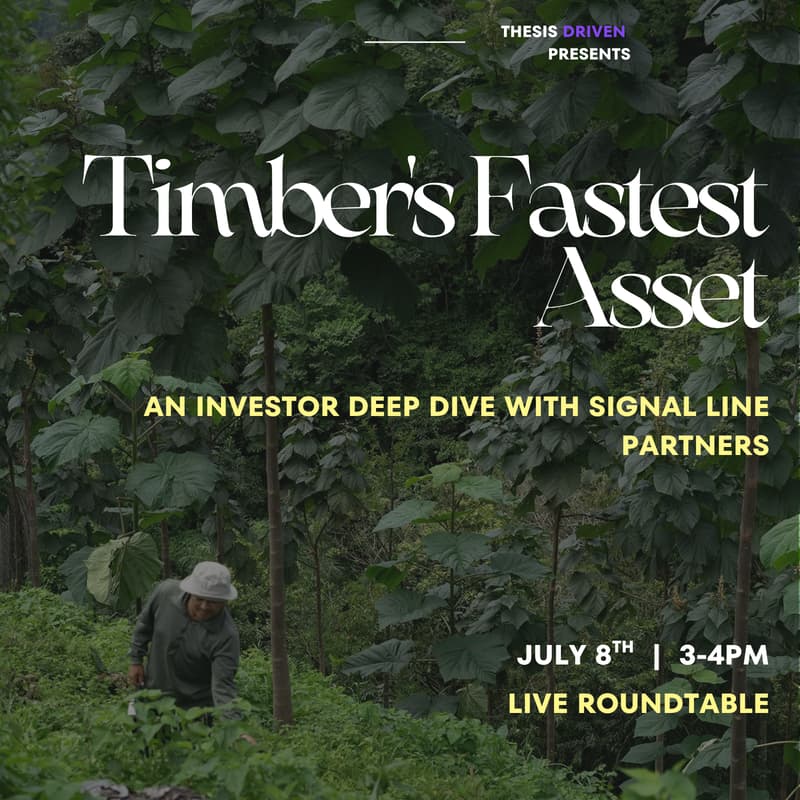

Timber's Fastest Asset: A Deep Dive on Signal Line Partners
Date & Time: Wednesday, July 8th | 3PM - 4PM EDT
Hosted by: Thesis Driven
Timber has quietly been one of the best real-asset trades in institutional finance. Over the past three decades, the NCREIF Timberland Index has delivered annualized returns above 8 percent with low correlation to equities, bonds, and conventional real estate. Endowments and pension funds have allocated to it for years. Family offices and high-net-worth investors, for the most part, have not.
The reason is time. Traditional hardwood rotations run 25 to 40 years for oak, walnut, and cherry; even commercial softwoods take 15 to 25. That timeline locks up capital across generational horizons and concentrates biological risk across decades before a single board foot gets sold. Timber has been the perfect institutional asset and a nearly impossible one for everyone else.
Paulownia changes the math. The hardwood genus, cultivated in East Asia for over two thousand years, compresses the cycle to 8 to 12 years, grows 10 to 20 feet in a single year, and regenerates from the stump for five to seven additional harvest cycles without replanting. The wood carries a Class A fire rating without chemical treatment, weighs a third as much as oak, and is dimensionally stable and naturally water-resistant. World Tree Technologies has spent the past decade building the platform to deliver it at scale: 8,000 acres across 375 farms in five countries, 25 to 30 proprietary genetic varieties, and a commercial sales pipeline now delivering its first large-scale harvests.
Signal Line Partners is leading a capital formation effort to bring institutional and family-office capital into the platform.
Join us for a 60-minute conversation with Signal Line partner and former Invesco CIO Darin Turner on how a 2,000-year-old species is reshaping the investability of timber, and why fast-rotation sustainable hardwood is becoming one of the most compelling real-asset opportunities for family office and private wealth capital.
In this session, we'll cover:
How timber generates returns, why institutional allocators love it, and why the 25-to-40-year rotation cycle has kept private investors out
How paulownia's 8-to-12-year rotation and coppicing biology fundamentally flip the cost-yield equation of hardwood timber
What World Tree has built in practice: $300 million in tree portfolio value, 9+ years of proprietary genetics research, and a signed commercial buyer pipeline
The two ways investors access the opportunity: platform equity in the operating company, and direct planting participation through the Reg D Eco-Tree Program targeting 6 to 7x on invested capital
The tax structure: passive loss deductions estimated at roughly 55 percent of investment over 10 years, with DAF and Self-Directed IRA eligibility
The structural supply crisis in North American lumber, why global demand is projected to quadruple by 2050, and why the long-term case for sustainable hardwood is accelerating
Speakers Include:
The Team
Darin Turner – Partner, Signal Line Partners (former CIO, Invesco)
The Interviewers
Paul Stanton – Thesis Driven
Brad Hargreaves – Thesis Driven
Register now to hear how Signal Line and World Tree are using fast-rotation genetics, a proven operating platform, and an institutional structure to turn timber into an asset family offices can actually own, and why a 2,000-year-old species is becoming a new category of real-asset return.