
From Repertoire to Lineage: SHM trees you can check
After an immunization or infection study you can see that a lineage matured. The harder question is which member to take forward, and which inferred ancestor is worth expressing and testing. A lineage tree is how teams answer that, and most of the time nothing tells you whether the tree is right.
This masterclass is for immunologists and discovery scientists who use somatic hypermutation and lineage structure to understand how a response matured, and who want to know whether the tree can be trusted.
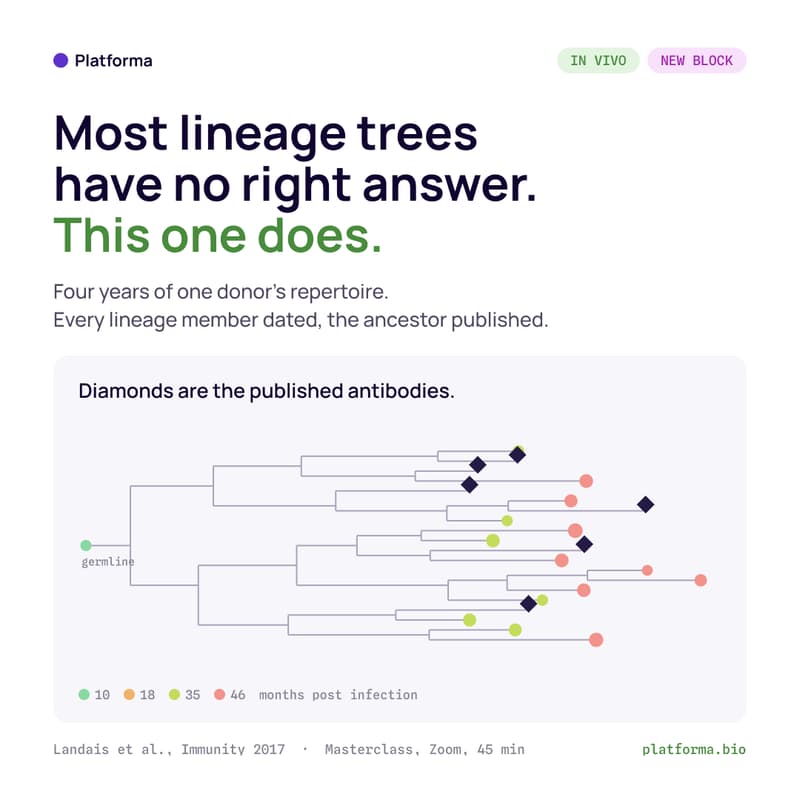
The dataset follows one donor's antibody repertoire across four years, sampled repeatedly, while a broadly neutralizing lineage developed. The paper gives the date each member of the lineage was isolated, and the inferred germline ancestor. So both the root of the tree and the order of its branches can be checked against the paper.
What you'll learn:
Finding clonal families in a bulk repertoire: group millions of sequences into lineages that hold together
Inferring the ancestor: reconstruct the unmutated common ancestor a lineage started from, and understand what that inference rests on
Building the tree: order members by mutation rather than by similarity alone, and read maturation trajectory from the structure
Layering evidence onto the tree: overlay abundance, timepoint, isotype and assay results to interpret the lineage
Scoring the result: compare the reconstruction against dated lineage members and the published ancestor, and see how close it lands
Who should attend:
Immunologists and vaccine scientists studying affinity maturation and response development
Antibody discovery teams who want each selected clone linked to its maturation history
Bioinformaticians building or evaluating lineage reconstruction
Project leads who need to show how a lead emerged, as well as its score