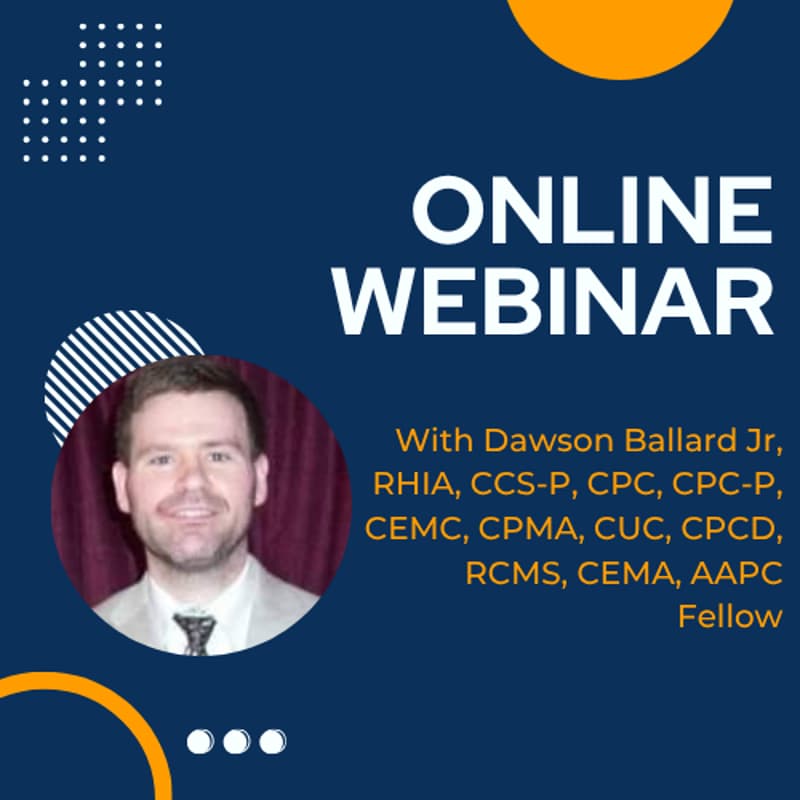

Incident To vs Split Shared Services Explained for Stronger 2026 Billing
Navigating the complexities of healthcare billing is essential for maximizing revenue and maintaining compliance. This intermediate-level webinar, led by Dawson Ballard Jr, RHIA, CCS-P, CPC, CEMC, CEMA, AAPC Fellow, provides a comprehensive exploration of incident-to and split/shared services—two critical concepts in medical billing and coding. Attendees will gain a clear understanding of the definitions, requirements, and distinctions between incident-to and split/shared services, with a focus on the latest CMS rules and regulatory updates. The session will cover eligible providers and settings, supervision requirements, and the importance of accurate documentation, including tracking time and medical decision making (MDM).
Through real-world scenarios and practical examples, participants will learn how to determine the “substantive portion” for split/shared services and apply appropriate modifiers (FS, FT) to optimize billing. The webinar will also address common compliance mistakes, audit risks, and strategies to avoid denials, ensuring attendees are equipped to maximize reimbursement and operational efficiency. Designed for coders, billers, CDI professionals, revenue cycle specialists, and providers, this training delivers actionable insights and best practices to support compliant, effective billing in today’s evolving healthcare landscape.
Learning Objectives:
Define and distinguish between incident-to and split/shared services, including their unique requirements and billing implications
Interpret the latest CMS rules and updates for incident-to and split/shared services, focusing on compliance and regulatory changes
Identify eligible providers and settings for each billing type, such as physicians, non-physician practitioners (NPPs), and various healthcare environments
Explain supervision requirements for incident-to billing versus split/shared services, and how these impact workflow and compliance
Demonstrate proper documentation practices to support compliant billing, including tracking time, medical decision making (MDM), and provider roles
Apply the concept of the “substantive portion” in split/shared services, using time or MDM to determine billing responsibility
Recognize common compliance mistakes and audit risks and implement strategies to avoid denials and maximize reimbursement
Utilize real-world scenarios and modifiers (FS, FT) to accurately bill incident-to and split/shared services, optimizing revenue and operational efficiency
Areas Covered in the Session:
Incident-To
CMS Definition
Source
The Basics of “Incident To” Billing
Documentation
Incident-To Clinical Scenarios
Split/Shared E/M Services
Code is Determined Via Two Options:
Total time on date of service
Substantial portion of MDM
Substantive Portion – Critical Care
Additional Guidance
Split Shared Services – Scenario #1
Visit note is documented in its entirety by the non-physician provider
Attestation statement
Which Provider Should Bill The Service?
The case for the physician:
The case for the non-physician provider
The verdict
The reasons
Split Shared Services – Scenario #2
Physician documentation:
Which Provider Should Bill The Service?
The case for the physician
The case for the non-physician provider
The verdict
The reasons
Suggested Attendees:
Physicians
Physician Assistants
Nurse Practitioners
Certified Nurse Midwives
Providers
Medical Coders
Medical Billers
CDI Professionals
Compliance Officers
Revenue Cycle Professionals
Revenue Cycle Staff
Practice Managers
Hospital Administrators
About the Presenter:
Dawson Ballard Jr. is a healthcare coding expert and educator with over 20 years of experience in medical coding, auditing, and education. He specializes in CPT, ICD-10-CM, and HCPCS coding across a variety of specialties, including OBGYN, family practice, and internal medicine. Dawson has held positions such as Coding Auditor & Educator at Rush University Medical Center, Audit & Compliance Specialist at LMH Health, and Risk Adjustment Coding Auditor at Blue Cross and Blue Shield of Kansas City. He holds multiple industry credentials, including Registered Health Information Administrator (RHIA), Certified Coding Specialist – Physician Based (CCS-P), Certified Professional Coder (CPC), and Certified Professional Medical Auditor (CPMA). Dawson is recognized as an AAPC Fellow and actively contributes to professional associations, having served as a local chapter officer, speaker, and published author on medical coding topics.
Additional Information
System Requirement:
Internet Speed: Preferably above 1 MBPS
Headset: Any decent headset and microphone which can be used to hear clearly
For more information, you can reach out to the below contact:
Toll-Free No: 1-302-444-0162
Email: [email protected]