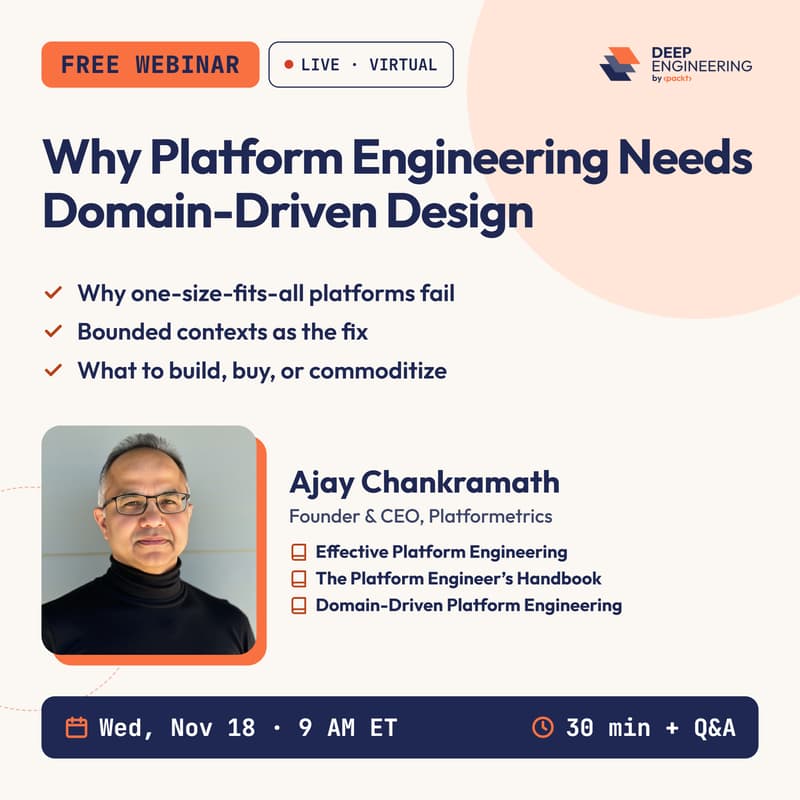

Why Platform Engineering Needs Domain-Driven Design
A framework for deciding what your platform should own, and what it shouldn’t.
Most internal platforms are built as one-size-fits-all: a single set of services, standards, and abstractions applied to every team. It looks efficient on paper. In practice, domain teams fight the platform, ownership blurs, and platform teams end up building things nobody asked for while neglecting what teams actually need.
In this 30-minute session, Ajay Chankramath explains why that keeps happening, and why Domain-Driven Design, usually applied to application code, is the missing structure for platform engineering.
What we’ll cover
Why one-size-fits-all platforms fail: the hidden cost of treating every team and service the same.
Bounded contexts as the fix: using domain boundaries to decide what the platform should own, and where its responsibility ends.
The four-layer service taxonomy: Foundational → Common Enterprise → Domain Backbone → Unique Domain, a practical way to classify every platform service.
Ubiquitous language: closing the translation gap between infrastructure and the business domains it serves.
Conway’s Law alignment: shaping platform boundaries and team structures so they reinforce each other instead of fighting.
What you’ll take away
A framework for applying DDD to platform engineering’s three hardest problems: ownership, interfaces, and investment.
A clear way to decide what to build, what to buy, and what to commoditize.
A preview of the method Ajay teaches hands-on in the full workshop.
Who should attend
Software and platform architects, platform engineers, SREs, DevOps engineers, and engineering managers running shared platforms, at organizations of any size. No prior DDD knowledge needed.
Your Instructor
Ajay Chankramath is the founder and CEO of Platformetrics and heads the Advisory & Training practice at PlatformEngineering.org. He has written three books on platform engineering: The Platform Engineer’s Handbook (Packt), Domain-Driven Platform Engineering (Apress), and Effective Platform Engineering (Manning). His teaching is exercise-first. You spend the day producing real configurations, not watching slides.