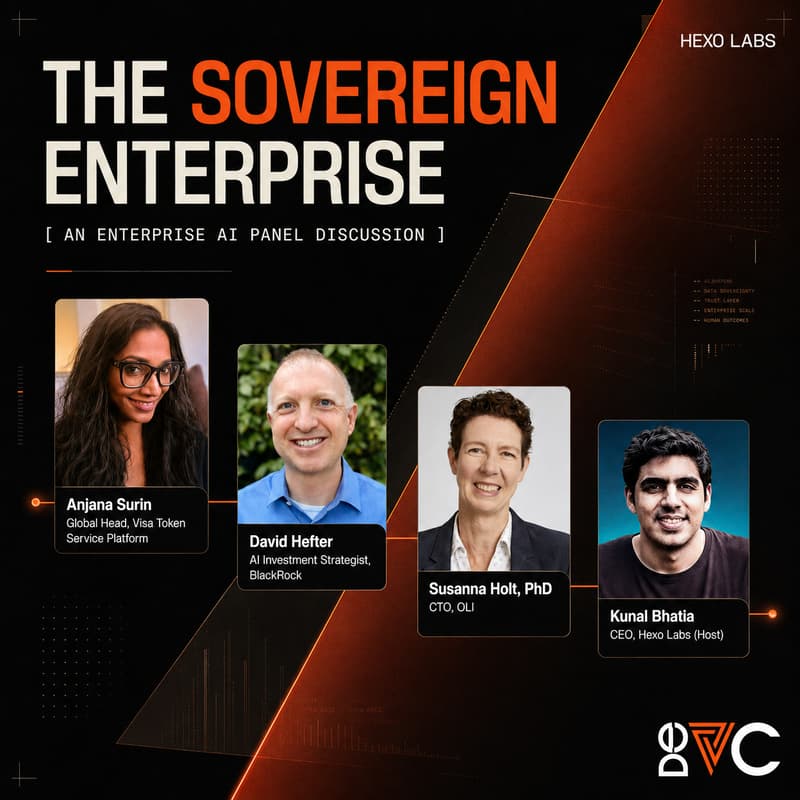

The Sovereign Enterprise: AI, Risk & Control
Enterprise AI is no longer just a question of which model or vendor to choose. It's a question of control.
Where does your data live? Who can inspect and reproduce system behavior? Can you change models without rebuilding the product? What happens when a vendor changes its pricing, policies, or performance—and what changes when the AI itself can adapt after deployment?
Open models and increasingly capable agent systems give enterprises more leverage. They also move more responsibility in-house: security, reliability, evaluation, governance, and cost.
The question is not whether to own everything. It is which control points are too important to rent.
The conversation
What it actually means to “own” your AI stack
Which parts are worth bringing in-house—and which are not
Where security, compliance, and data-residency requirements change the answer
What tends to break when companies move beyond managed platforms
How to evaluate the economics of building, buying, and renting
We’ll begin with one candid panel, followed by dinner, drinks and continued discussion.
Panelists
Anjana Surin — Global Head, Visa Token Service Platform
Anjana leads the platform behind Visa Token Service, helping secure digital payments across wallets and e-commerce. She brings a global product perspective on identity, authentication, delegated authority, fraud, reliability, and introducing new technology into a trust network at scale.
David Hefter — AI Investment Strategist, BlackRock
David leads work across AI strategy, adoption, and governance at BlackRock, with a view into how a global institution evaluates platform dependence, operating risk, and the economics of enterprise AI.
Susanna Holt, PhD — CTO, OLI
A longtime enterprise technology leader and former Autodesk VP of Engineering, Susanna now leads technology at OLI, whose modeling and simulation systems support high-consequence decisions across chemicals, energy, mining, and industrial water. She brings an operator’s view of where probabilistic AI can—and cannot—be trusted.
Kunal Bhatia — Co-founder, Hexo Labs
Kunal co-founded Hexo Labs, the open-source lab behind SIA, a self-improving AI framework designed to run and adapt inside an organization's own environment. He brings the builder's perspective on what owning your intelligence actually takes—running, securing, and improving models in-house, and where open, self-hosted systems are ready for production and where they are not.
Moderated by Aakash Kumar, Managing Director at Z47 and the builder behind DeVC.
The room
Attendance is curated and capped. The room will include CIOs, CISOs, chief AI and risk officers, and the platform leaders directly responsible for enterprise AI decisions, along with a small number of founders and investors building the underlying stack.
This is intended to be a working conversation among peers.
Schedule
5:30 PM — Arrival and drinks
6:30 PM — Panel discussion
7:15 PM — Dinner and continued conversation
8:30 PM — Close
Hosted by
Hexo Labs, the neolab behind SIA — an open-source framework for AI systems that improve through structured feedback. Hexo’s work raises one of the evening’s central questions: as AI systems become more adaptive, how do enterprises preserve auditability, rollback, and control?
DevC is a founder-led venture fund and global collective of founders, operators, and early-stage GPs backing companies at the pre-seed and seed stages. DevC has invested in more than 150 companies over the past three years, including Hexo Labs.
The Frontier Syndicate is a private venture network where frontier signal becomes conviction. Through high-trust rooms and conviction-led capital, it connects the researchers, builders, enterprise leaders, and investors shaping the next generation of technology.