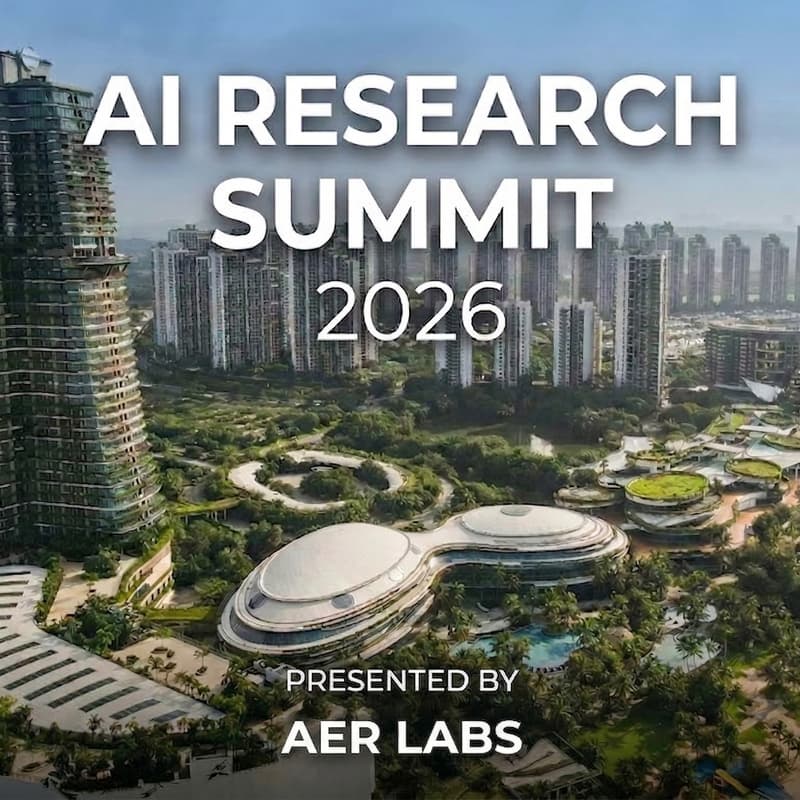
AI Research Summit 2026
AI Research Summit 2026
A one-day, research summit for researchers, engineers, and founders working in frontier AI.
Hosted by AER Labs — Accelerating Efficient & Effective Research
Speakers
Philip S. Yu — University of Illinois Chicago
UIC Distinguished Professor · Wexler Chair in Information Technology · ACM Fellow · IEEE Fellow
Title: Beyond Words: Riemannian Geometry for Next-Generation Graph Foundation Models
Abstract: Riemannian Graph Foundation Models leverage intrinsic graph geometry to enable native structural inference and generation, advancing next-generation graph intelligence beyond conventional representation learning.
Matthew Finlayson — USC / AI2
NLP researcher; formerly Meta Research and Allen Institute for AI
Title: The search for unforgeable language model signatures.
Abstract: All language models impose geometric constraints on their outputs. This talk will show how we can use these to construct secure model verification systems and develop forensic methods for auditing closed models.
Taishi Nakamura — Institute of Science Tokyo / Sakana AI
ICLR 2026 Oral · NeurIPS 2025 Spotlight
Title: Scaling Sparse Mixture-of-Experts Language Models
Abstract: I will discuss recent work on sparse Mixture-of-Experts language models, including optimal sparsity for reasoning tasks, Drop-Upcycling, and related developments in the LLM-jp MoE models.
Niki Amini-Naieni — Oxford VGG
AAAI’2026 · Qualcomm Fellow · Google DeepMind
Title: CountVid: Open-World Object Counting in Videos
Abstract: We present CountVid, the first method for open-world object counting in videos, and VideoCount, the first dataset for our novel task. Given a video, a text description, and any number of visual examples, CountVid automatically identifies the number of unique objects matching the prompt across the whole video. Counting in videos has many possible applications across diverse fields including conservation, medicine, and agriculture.
Piyush Bagad — Oxford VGG
NeurIPS 2025 · CVPR 2023
Title: How to develop time-sensitive video embeddings?
Abstract: Much of contemporary video understanding suffers from "static bias", i.e., questions/tasks in contemporary benchmarks can be solved with a single frame or an unordered set of frames. How can we make video models that are more time-aware, i.e., sensitive to what and how things change over time? In this talk, I will introduce the notion of "chiral actions": similar looking temporally opposite actions that demand time-awareness. Then, I will present our approaches to embed such videos in a time-sensitive manner. I will also talk about some other aspects of nuanced video understanding. This enables applications such as text-to-video search especially for queries of temporal nature. Papers: LIFT · TARA
Seungjun Lee — National University of Singapore
CVPR 2026 · ICLR 2026 Spotlight · NeurIPS 2025 Oral
Title: Vision for Embodied Agent: Reconstruct, Understand and Interact the 3D World from 2D Observations.
Abstract: Embodied agents must perceive, reason about, and interact with complex 3D environments from 2D-modality observations in order to perform the human's request. In this three-step pipeline, this talk outlines three main transitions that have recently emerged in embodied AI research and 3D vision community. First, 3D reconstruction has shifted from sensor-dependent pipelines to sensor-free approaches, driven by the emergence of feed-forward 3D reconstruction models such as VGGT. Second, scene understanding has expanded beyond static environments to dynamic scenarios involving temporal changes and moving objects, making it more aligned with real-world settings. Third, the growing interest in VLN, VLA, and world models reflects a transition from passive perception or reconstruction to active interaction, where agents leverage scene understanding to navigate, plan, and act within the environment. By discussing these transitions, this talk highlights a path toward 3D-aware embodied agents for real-world interaction.
Sookwan Han — Seoul National University
CVPR 2025 · ECCV/ICCV Oral
Title: Agentic Design House for Robotic Accelerators
Abstract: Robotic systems demand specialized accelerators for workloads like In-Memory Computing, 6D pose estimation, and online reinforcement learning, but designing them requires exploring a vast space across RTL, synthesis, place-and-route, and tape-out. We present an agentic approach where AI agents on our Agent Runtime (ART) autonomously execute and iterate on the full chip design pipeline in parallel, decoupling design throughput from engineer headcount. We demonstrate this on an IMC SoC tape-out flow and FPGA place-and-route optimization, and discuss extension to broader robotic accelerator targets.