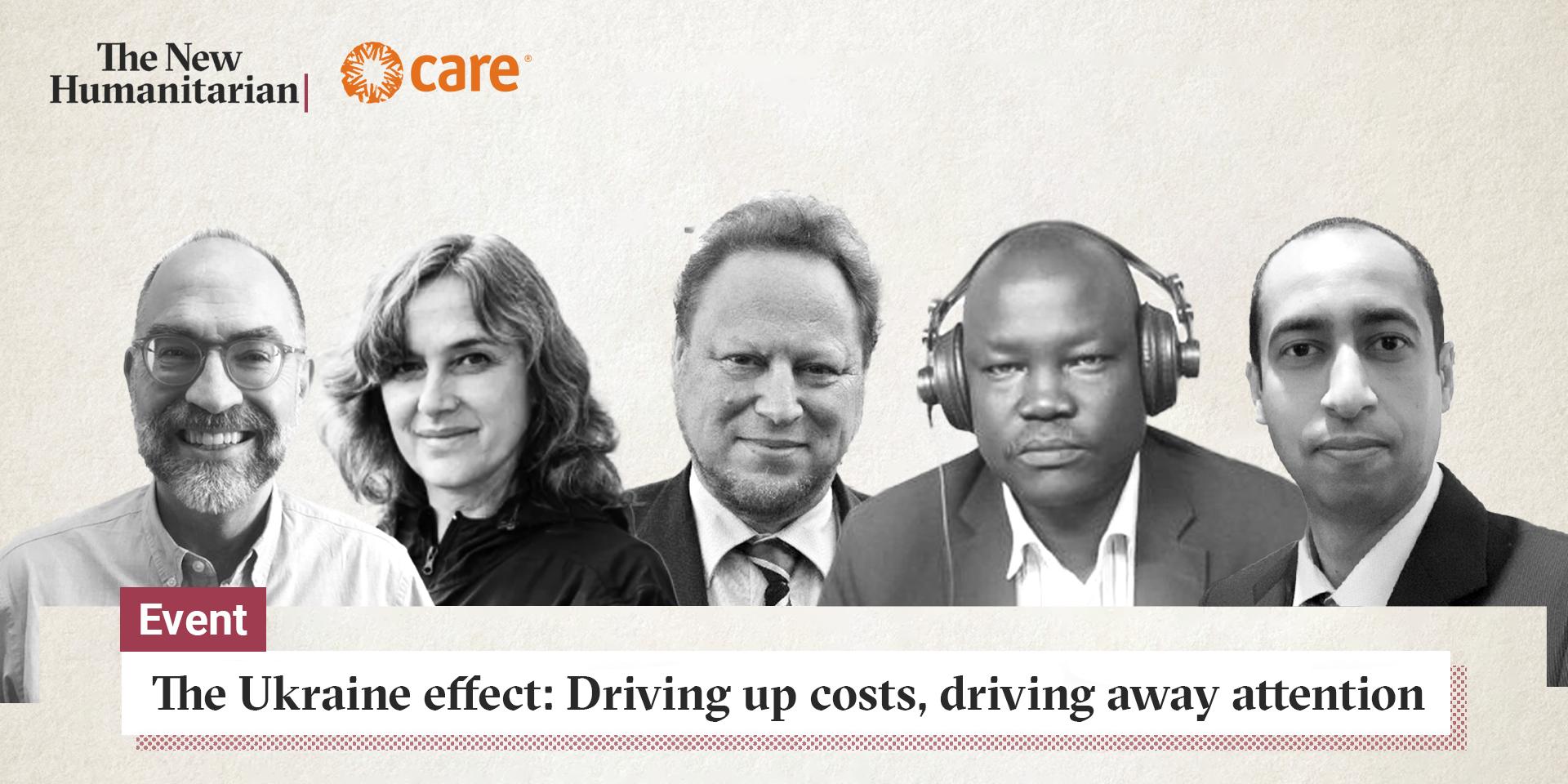
The Ukraine effect: Driving up costs, driving away attention
Tickets for this online event are $10. Members of The New Humanitarian go free. Sign up for membership here: https://www.thenewhumanitarian.org/membership
One year on, what has been the impact on other crises of the focus of funding and attention on Ukraine?
Join us from 3-4.30pm CEST on Wednesday 10 May for an online event presented by The New Humanitarian and CARE International.
We're bringing together a cross-section of the aid sector – including voices from donors, humanitarian response, national government, and civil society – for an open conversation about the challenges faced by responders working on overlooked crises.
Hear from:
Sofía Sprechmann Sineiro, Secretary General, CARE International
Albino Akol Atak, Minister of Humanitarian Affairs, South Sudan
Michael Koehler, Deputy Director-General, European Commission – DG ECHO
Mohanna Eljabaly, General Manager, Yemen Family Care Association
Stephen O’Malley, Deputy Director covering Eastern and Southern Africa, UN OCHA
Eric Reidy (moderator), Staff Editor and Reporter, migration and special coverage, The New Humanitarian.
A myopic media and donor focus on major crises such as the war in Ukraine, the fallout from COVID-19, and the Turkey-Syria earthquakes is diverting attention and funding from a host of other settings where people are in desperate need.
The war in Ukraine is also increasing needs around the world by limiting wheat and fertiliser supplies – leading to rising levels of hunger – and by driving up the prices of food and fuel. That means it’s more expensive for aid agencies to help crisis-affected communities.
How are donors prioritising what to fund when the media spotlight is firmly on Ukraine, but the vast majority of the 230 million people the UN says need help do not live in or around Ukraine?
How are humanitarians and governments in countries in desperate need of funds adapting to the current situation?
How are families in communities where funds have been cut or never materialised coping?
What are frontline humanitarians seeing in countries outside of Ukraine that they think the international community needs to know about?
Sign up now. Members of The New Humanitarian go free. Sign up for membership here: https://www.thenewhumanitarian.org/membership
Got a question? Email [email protected]