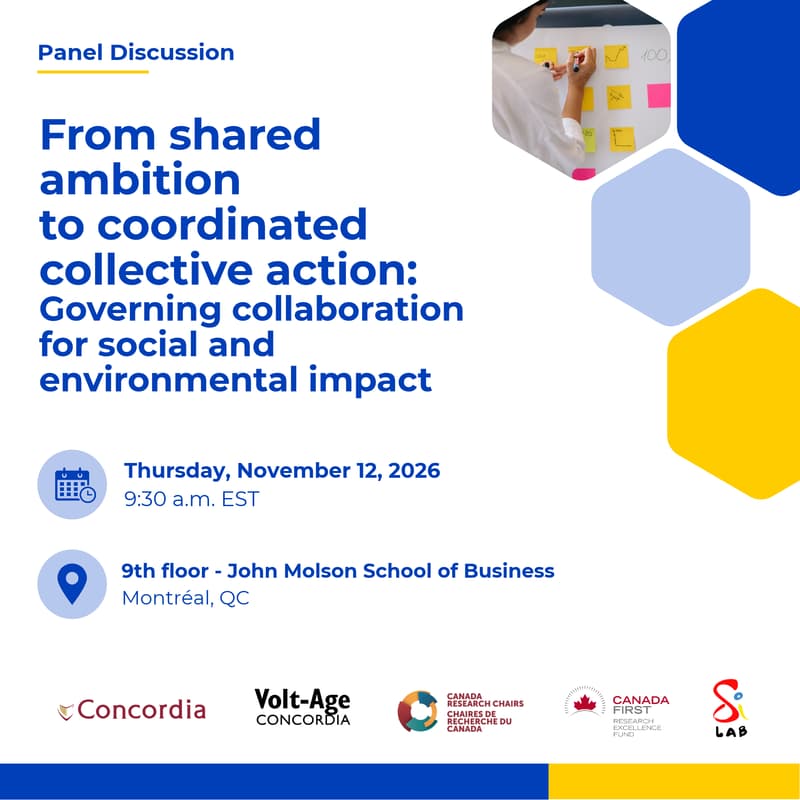
From shared ambition to coordinated collective action: Governing collaboration for social and environmental impact
Join us for a discussion on how governance can support coordinated collective action to transform shared ambitions into social innovation and impact.
Addressing complex societal challenges, like climate change, calls for collaboration across organizational and disciplinary boundaries. From grassroots organizing to cross-sector social partnerships and living labs, these socially-oriented collaborative initiatives have the potential to mobilize diverse knowledge, expertise, and resources. Yet shared ambitions and good intentions do not automatically translate into coordinated action and impact.
Governance plays a critical role in shaping how people and organizations work together. It structures how decisions are made, responsibilities are shared, different perspectives influence priorities, and collaborators communicate, contribute, and hold each other accountable.
This panel discussion brings together social innovators, changemakers, and researchers to explore how governance can support coordinated collective action towards meaningful and lasting societal change. Drawing on practical experience and research insights, speakers will discuss:
Transitioning from shared ambitions to coordinated action
Finding alignment across diverse and sometimes conflicting priorities
Designing inclusive, transparent, and practical decision-making processes
Sustaining commitment and navigating disagreements
Designing evaluation and accountability frameworks that support learning and adjustment as projects and initiatives evolve
This discussion will offer insights for community organizers, living lab practitioners, researchers, non-profit leaders, and anyone working collaboratively to advance social and environmental change.
The panel discussion will be livestreamed (https://concordia-ca.zoom.us/meeting/register/4EW6CZheTZGJlH3xNa096A) and recorded, with the recording available online following the event.
Cet événement se déroulera en anglais, mais les participants.es sont les bienvenu.es à poser leur questions en français et les diapositives seront disponibles en français.
About the speakers
Panelists
Dr. Adriane MacDonald
Dr. Adriane MacDonald is an Associate Professor of Management and Canada Research Chair in Governance and Sustainability at the John Molson School of Business (JMSB). Dr. MacDonald is a multi-disciplinary researcher who focuses on understanding why business, government, and non-profit organizations partner to address sustainability issues; how partners communicate and collaborate; and how partnerships can be structured and managed to achieve tangible sustainability and corporate social responsibility outcomes. She is the principal investigator of the Carbon Governance Living Lab.
David Guimont
David Guimont is a partner at Si Lab and a recognized expert in the deployment of Living Labs. He supports organizations in designing co-creation processes and adopting more collaborative innovation practices. His recent work focuses on strengthening collective resilience to climate change and disasters. Between 2013 and 2024, he co-founded and co-directed the Laboratoire en Innovation Ouverte (LLio), a college centre for applied research, where he led numerous labs and people-centered design projects. A seasoned facilitator, he specializes in co-designing co-creation workshops and setting up innovation cells that foster experimentation in real-world conditions. Holding a master's degree in tourism planning and development from UQAM, he also works as an independent researcher and mentor to managers of social, territorial, and environmental impact projects.
Michael Bossert
Michael Bossert is Manager, Strategy, Innovation and Outreach at the Next-Generation Cities Institute. The development of inter- and transdisciplinary research is his focus, and he builds a global network dedicated to addressing urban challenges through Living Labs and Communities of Practice. He brings together stakeholders from governments, municipalities, the private sector, civic groups and academia to collaborate and boost city transformation. Since 2025 he started his journey as a PhD student in the Individualized PhD program at Concordia University Montreal. His research focuses on Metalabs and networks to collaborate and exchange knowledge based on case studies. His goal is to accelerate urban transformation and create impact in the Global North and South and improve strategies and policies.
Juliette Champoux-Pellegrin
Juliette is the second author on the Roadmap for Designing Living Lab Governance Structures, having spent the last year studying living lab initiatives and carbon governance within the Carbon Governance Living Lab. Her background is interdisciplinary, with eight years of experience working in social and private enterprises, nonprofit organizations, and research teams. With this experience, Juliette recently co-founded the nonprofit organization Montreal Climate Week and now serves as its executive director.
Moderator
Nilufar Sabet-Kassouf
Nilufar Sabet-Kassouf (Nilu) has a multidisciplinary background, having studied in cell and molecular biology and biochemistry, and done research in neurophysiology at the intersection of music and meditation. For the past 7 years, she has shifted her focus to addressing complex socio-ecological challenges through her work at Future Earth and Sustainability in the Digital Age at Concordia University. In this capacity, she has been reflecting on the relationship between local realities and global priorities established through international science policy processes, and the role that technology plays in shaping these realities. More recently, Nilu has been leading the design and facilitation of capacity-building workshops and programs to cultivate ideas and practices of collective leadership and meaningful community engagement.