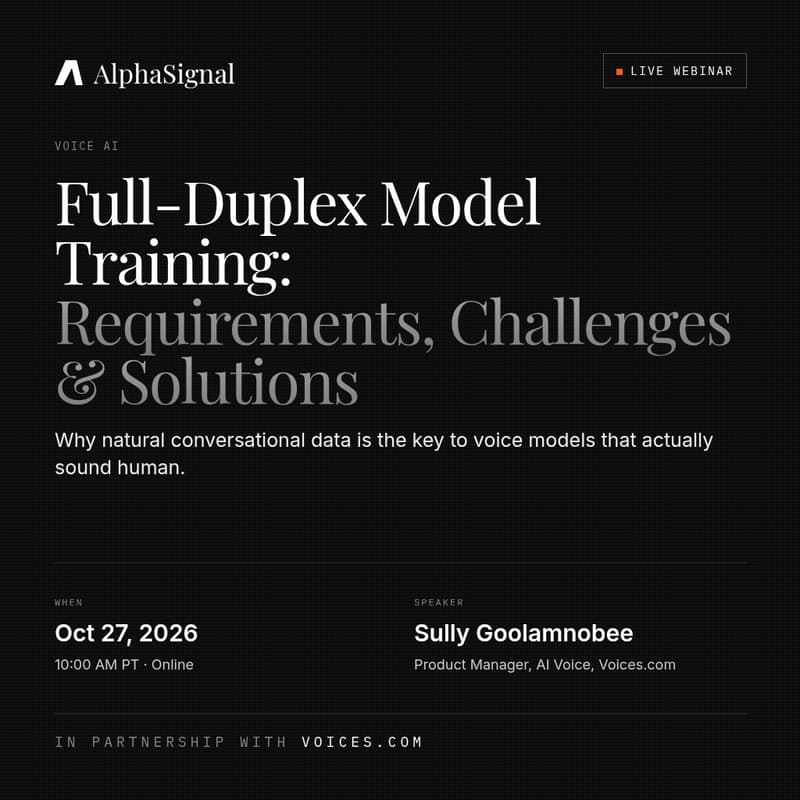
Requirements, Challenges, and Solutions for Full-Duplex Model Training
Full-duplex models produce the most realistic conversational voice experiences. But if they're trained on unnatural data, they learn the exact speech behavior they were built to overcome.
Most open-source conversational datasets are built around rigid turn-taking, with little real overlap between speakers. Adding synthetic interruptions doesn't fix it, because it can't recreate the timing, backchannels, and natural overlap a full-duplex model needs to learn from.
Join AlphaSignal and Voices for a live presentation with Sully Goolamnobee, Product Manager of AI Voice at Voices, covering:
The limits of open-source and synthetic data for training full-duplex models
The three requirements for full-duplex training data: naturalness, zero bleed, and sub-second timing
Voices' research and approach to building custom conversational datasets for full-duplex training
If you want your voice experience to feel natural, your training data has to sound natural too. The session ends with live Q&A.
Speaker: Sully Goolamnobee, Product Manager, AI Voice at Voices.com. Sully works on data QA, evals, and model training in the Voices AI Voice Lab. He's spent his career in conversational AI. At Calabrio and Wysdom AI, he built chatbots in the early days of intent-based corpora and later developed AI-powered QA products for contact centers. He's based in Toronto and has a bachelor's degree from the University of Waterloo.
Who should attend: ML and AI teams building full-duplex conversational voice models.