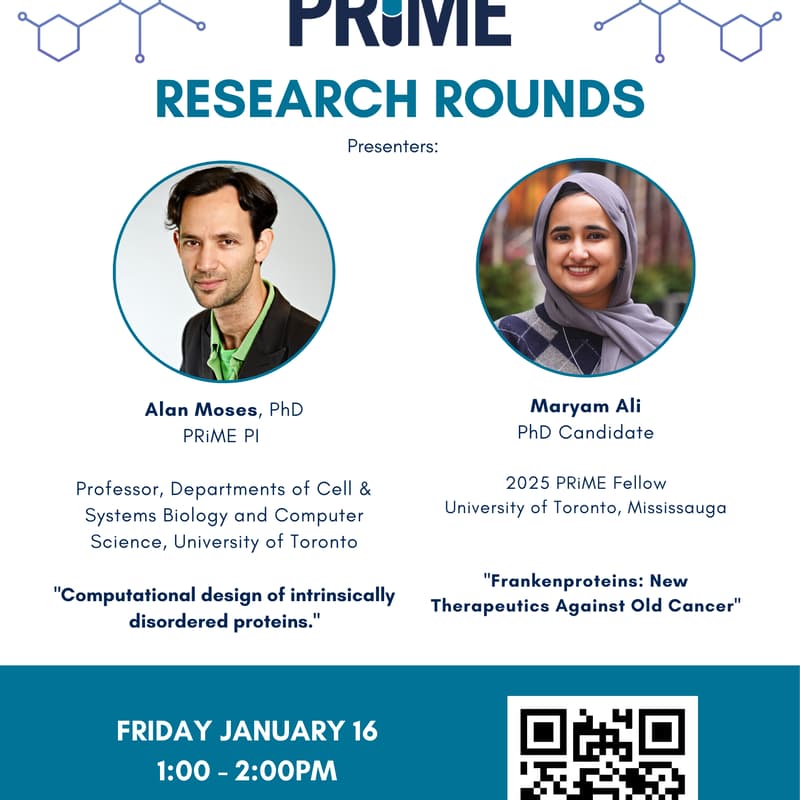
January Research Rounds
PRiME Research Rounds is a monthly research presentation featuring talks from PRiME Principal Investigators and Fellows. The seminar sessions bring the PRiME community together for engaging discussions!
Date: Friday, January 16, 2026, 1:00 - 2:00PM (Light refreshments will be provided)
Location: Red Seminar Room, Terrence Donnelly Centre, 160 College Street
Speakers:
Alan Moses, PhD
PRiME PI
Professor, Departments of Cell & Systems Biology and Computer Science, University of Toronto
"Computational design of intrinsically disordered proteins."
Alan Moses is a Professor of Cell and Systems Biology at the University of Toronto. He earned his Bachelor’s degree from Columbia University (2000) and completed his Ph.D. at the University of California, Berkeley (2005). His research touches on many of the major areas in computational biology, including regulatory sequences in DNA and proteins, microscope image analysis, and population genomics.
Maryam Ali
PhD candidate, 2025 PRiME Fellow
University of Toronto Mississauga (UTM)
"Frankenproteins: New Therapeutics Against Old Cancer"
Maryam Ali is a fifth-year PhD candidate in Prof. Jumi Shin’s laboratory at the University of Toronto Mississauga (UTM). She completed her Honours Chemistry Co-op degree at the University of Waterloo in 2021. Her doctoral research focuses on both rational engineering and non-rational design of DNA-binding proteins, including synthetic modulators developed for applications in biological circuits and protein therapeutics. A major component of her work involves optimizing a directed evolution platform-enhanced mutagenesis phage-assisted evolution - to improve the robustness and functionality of engineered proteins.
Over the past two years, Shin’s lab has collaborated with Dr. Micheline Piquette-Miller’s group at the Leslie Dan Faculty of Pharmacy, University of Toronto, to evaluate anti-cancer protein therapeutics in cell lines and mouse models. Maryam’s 2025 PRiME Fellowship project is titled ‘Designer Protein Drugs for Targeting Breast and Ovarian Cancer.’