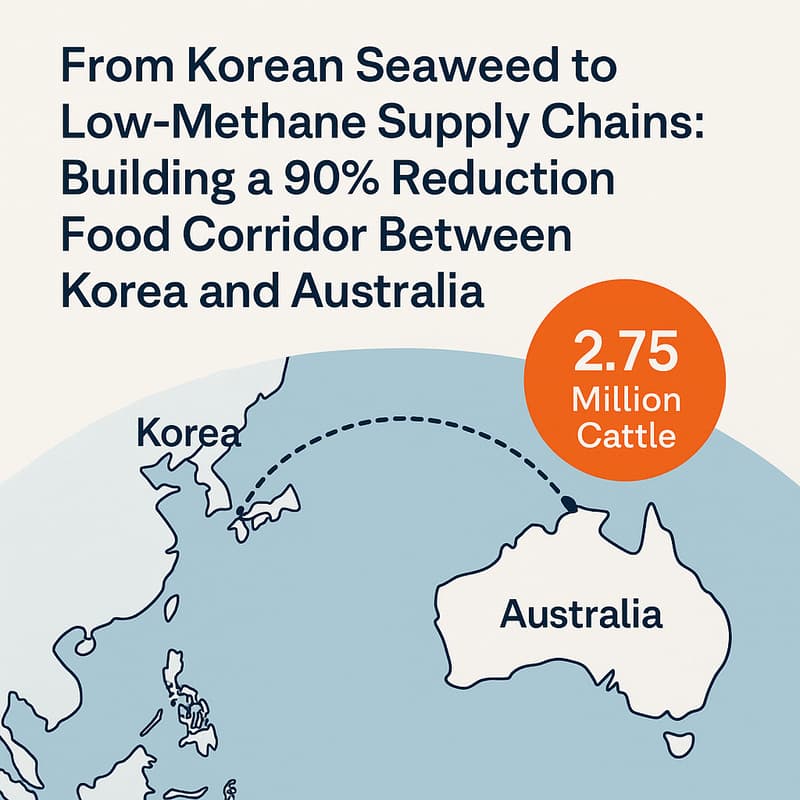
Korean Seaweed Meets Australian Beef: Pathways to 90% Methane Reduction
Breakfast will be served at 10:45 AM.
Join us for a conversation on methane reduction and the future of low-carbon livestock, featuring perspectives from industry, research, and climate innovation.
Livestock methane is one of the biggest hidden climate problems in our food system.
More than $200 million has been invested in Australia into methane-reducing seaweed solutions. And yet, commercial-scale supply still hasn’t properly landed.
The Science Behind It
Over the past decade, researchers at CSIRO (Australia’s national science agency) have shown that adding small amounts of the seaweed Asparagopsis to cattle feed can reduce methane emissions by up to 90%.
That breakthrough, commercialised by FutureFeed, is now supported by a formal national product standard (AS 5404).
The next challenge is execution:
Quality and consistency
Safety and compliance
Supply chain readiness
On-farm adoption
Why South Korea’s Southern Islands Matter
The biggest barrier to scaling Asparagopsis is supply issue.
And this is where South Korea becomes unexpectedly important.
Korea operates more than 100,000 hectares of established seaweed farms, backed by advanced hatchery systems and generations of coastal farming expertise.
Our analysis shows that allocating just 7-10% of that capacity could produce enough Asparagopsis to support Australia’s feedlot cattle industry at scale.
Why Australia Matters
Australia is one of the world’s largest exporters of beef and dairy.
Retailers, food brands and investors are increasingly focused on Scope 3 emissions, meaning livestock methane is now part of global supply chain accountability.
That’s why methane-reducing feed solutions must prove three things:
They work
They’re safe and compliant
They can operate at commercial scale
Australia provides one of the most practical environments in the world to test and implement those solutions across real feedlots and farms.
What Will Happen on the Day
This session is designed as an open, industry-led discussion on methane reduction pathways in commercial cattle systems.
We will examine:
Solutions currently in the market
What appears to be working in commercial settings
Operational and performance constraints
Feed efficiency and ration integration considerations
Cost implications and supply reliability
What realistic adoption in Australia would require
The goal is to have a grounded conversation about market development, and what would need to be true for broader uptake across feedlots and feed manufacturing systems.
We will also explore how methane mitigation intersects with feed efficiency outcomes and emerging procurement signals from processors and retailers.
Refund Policy
Refunds are available up to 2 days before the event.
If the event is cancelled, all ticket holders will receive a full refund.
Location
Greenhouse Tech Hub (Salesforce Tower)
Level 3, 180 George Street
Sydney NSW 2000
Room: Telford Room
Getting There
Greenhouse Tech Hub is located inside Salesforce Tower at Circular Quay.
Public Transport:
Circular Quay Train Station – 3 min walk
Barangaroo Metro – 5 min walk
Light Rail (Bridge Street stop) – 6 min walk
Multiple bus routes stop near Circular Quay & Bridge Street
Parking:
There is no parking on site.
Nearby options:
Wilson Parking – 155 George Street
Secure Parking – 122 Pitt Street
Drop-off / Rideshare:
There is no stopping zone on 180 George Street.
Please use:
33 Pitt Street
Underwood Street