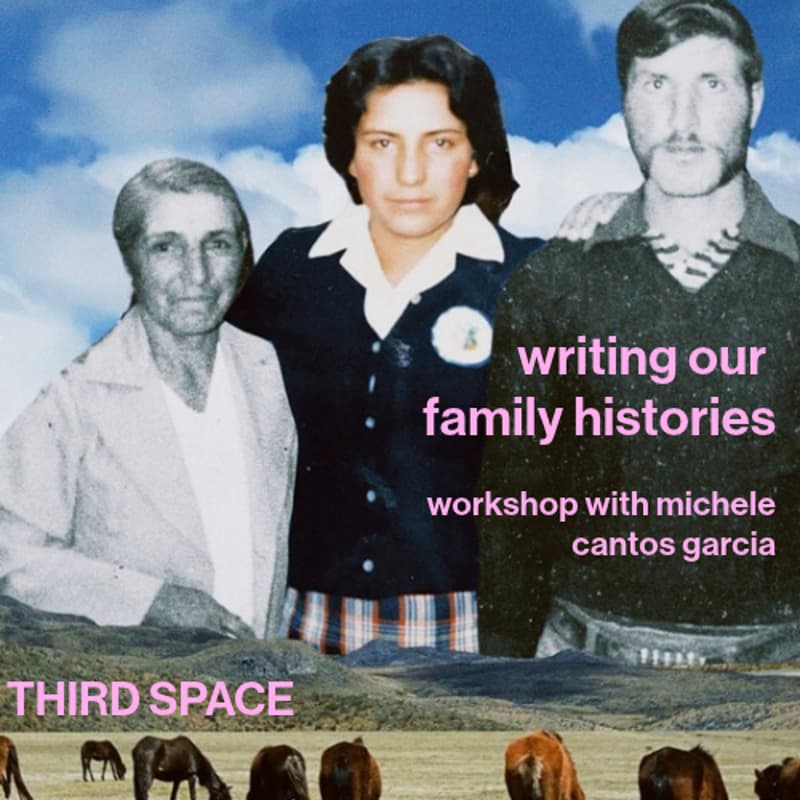

Writing Our Family Histories
Is there a family story you want to save before it’s lost?
In this warm, communal workshop, we gather to remember family stories and learn a simple method for preserving them. We begin with a short reading and a few warm-ups. Then we work through the artist’s process, listening closely to anyone who feels called to share and shaping our own stories into vivid, artful writing. We look for the details that make a person real (what they said, what they did, what they kept) and practice writing about family with intention, reverence, and care. Surrounded by cozy flameless candles, we’ll approach our writing as a space for discovery, self-expression, and preservation.
You’ll leave with
A method you can use again with any photo, object, or relative
Better questions to ask at the family table
A first written portrait of someone in your family, ready to be spoken aloud
A photo of the communal altar we build together
The company of community members who care about preserving their family stories
Adults 18+, no writing experience required
Recommended: Family photos, small keepsakes, notebook, pen, or laptop
About the method:
Most people come to family history overwhelmed, hoping to save their stories for posterity but unsure where to begin, how to capture it all, or what to do with their keepsakes. But what sticks with our families for generations is rarely the official record (the census data, genealogy, the DNA tests). It is often a few curated items passed down intentionally, and the memorable, powerful stories that get told around the dinner table.
Michele’s approach, Building Altars, Not MuseumsTM, gives families an intentional framework and process to design those stories and commit to honoring them. She observed that most people take a museum-style approach to preserving a family (neverending documentation of facts, names, dates, places, lineage with little context), and she encourages them to rethink their mission as building an altar instead, one that honors a family: what they taught us, what they believed, what we want to keep alive. It is a more embodied way to remember, drawing on time-tested Andean traditions Michele inherited, where remembering our families is communal, light-hearted, and a part of everyday life.
Michele Cantos Garcia
Michele is a writer and process artist who explores communal ritual as a way to process our lives, express ourselves, and release what we no longer need. She draws on memoir writing, oral history, and the communal traditions she inherited from her Ecuadorian ancestry to witness and preserve our lives. Her process is slow, imperfect, and mindful. Her work asks: What is worth keeping and passing down? What must we release? And what becomes possible, more embodied, when we ask these questions together?