
Bay Area Frontier Research Club #9 | Pebblebed (dinner + paper discussion)
Research-Grounded Agents, Self-Evolving Systems & Strategic Self-Play. Three Frontier Research Talks + Rigorous Q&A.
Three frontier research talks, one argument — the research loop is becoming agentic. Kalpit Dixit (Paper Lantern, ex-AWS Bedrock) on Research-Grounded AI Agents. Dastin Huang (Sentient Foundation) returns to our stage with new, unpublished results on self-evolving agents. And Jonathan Li (Caltech / RPI) closes with STRATEGIST — the ICLR paper featured in the State of AI Report on agents that learn high-level strategy through self-play and tree search.
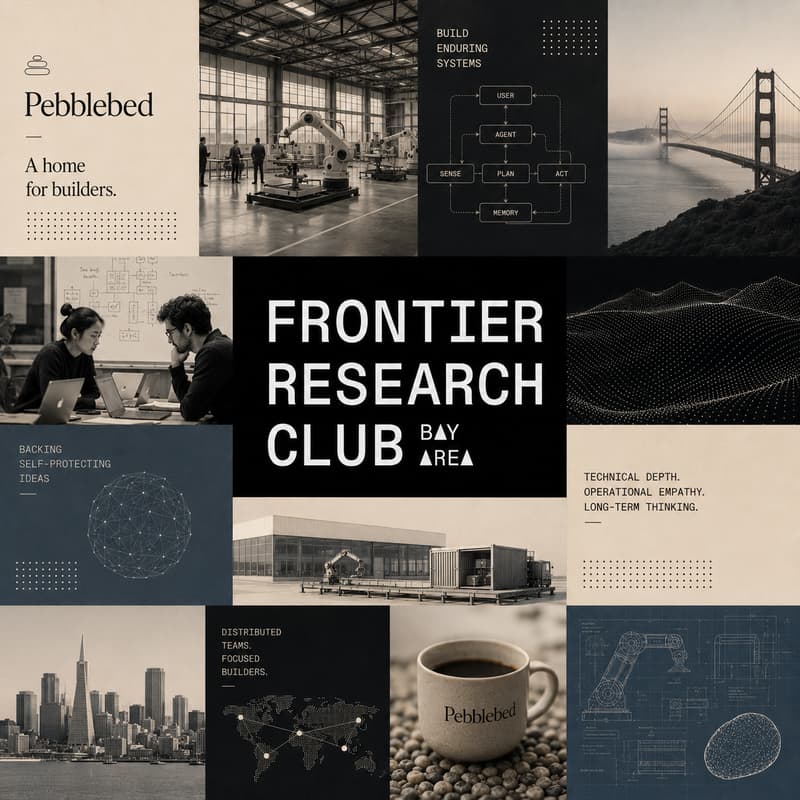
The Bay Area Frontier Research Club is a curated forum for rigorous discussion on how AI is reshaping the scientific research process. We convene experimental researchers, computational scientists, and research engineers across domains to examine concrete work—papers, methods, and workflows—covering literature synthesis, hypothesis generation, experimental design, simulation, analysis, and reproducibility.
For each session, we curate 2–3 papers selected for rigor and discussion value. Presentations are intentionally brief so the majority of time is reserved for questions and critique: assumptions, evaluation methodology, failure modes, and what would constitute convincing evidence. Papers and supporting materials are shared in advance to ensure a high-baseline conversation.
🕒 Agenda
5:30pm: Doors open
5:30pm – 6:30pm: Networking + snacks
6:30pm – 8:00pm: Research presentations + discussion
8:00pm – 8:30pm: Networking
🎙️ Presenters & topics
Talk #1: Research-Grounded AI Agents
Kalpit Dixit is the founder of Paper Lantern. Previously, he was a Senior Applied Scientist at AWS Bedrock, where he led teams delivering trillions of pretraining tokens, RAG capabilities, and multiple AI products into GA. Earlier, he was a high-frequency options trader at Optiver. MS Stanford, BS+MS IIT Bombay.
Paper Lantern tackles a deceptively simple question: what changes when an AI agent can actually use the world's research literature? Today's coding and chat agents are stuck at the state of their training data — even with web search, they default to the standard playbook. Paper Lantern's MCP server distills 2M+ research papers into structured, agent-readable form, surfacing methods, tradeoffs, benchmarks, and implementation guidance directly into the reasoning loop of any coding or chat agent. In a head-to-head case study with Karpathy's autoresearch framework, the Paper Lantern-equipped agent reached 3.2% lower validation loss than the same agent without it (gap still widening at the 2-hour mark), achieved 10% lower training cost, and showed the same gains continuing at 100x pretraining compute.
Talk #2: Self-Evolving Agents — New Results
Dastin Huang is an AI researcher at Sentient Foundation, the open-source AGI research organization, where he works on agent systems. Before Sentient, he spent five years as a Machine Learning Applied Scientist at Fiserv, shipping production ML in one of the world's largest payments infrastructures. MS UC San Diego, BS University of Science and Technology of China. Through his independent research practice he builds self-evolving agent systems — including Athanor, the architecture he presented at our AGI House session, and approaches targeting the ARC-AGI-2 reasoning benchmark.
Dastin returns to the Frontier Research Club stage with new, unpublished results on self-evolving agents: systems that modify their own scaffolding, tooling, and behavior as they run. His slot is the in-the-wild middle of tonight's argument — between agents grounded in the research literature and agents whose self-improvement is provable in simulation sits the engineering question of what self-modification actually survives contact with real tasks.
Talk #3: STRATEGIST — Learning Strategic Skills via Self-Play and Tree Search
Jonathan Li is a visiting researcher at Caltech, a PhD student at Rensselaer Polytechnic Institute, and a part-time researcher at NEC Laboratories America. His research focuses on scaling self-improvement in LLMs and AI agents through reinforcement learning, search, and adaptive inference. His work has appeared at ICLR, NeurIPS, and ICML, and was featured in the State of AI Report.
Can LLM agents learn effective strategies for complex, long-horizon tasks involving planning, competition, cooperation, and hidden information? STRATEGIST is a framework that lets agents autonomously learn and refine high-level strategies through self-play — no human demonstrations, no extensive RL. It combines language-based strategy generation with tree search, iteratively improving decision-making in multi-agent environments like social deduction games and strategic planning tasks, with implications for agents that rapidly acquire strategic skill in negotiation, customer support, and autonomous software engineering.
📝 Want to present your work?
If you have a research paper you’d like to discuss with a cross-disciplinary room, submit it for consideration.
SUBMIT YOUR PAPER HERE.
👥 Who should attend
Experimental researchers
Computational scientists across domains (bio/chem/materials/climate/neuro/physics)
Research engineers + lab automation people
Those building tools for literature review, experiment planning, robotics, simulation, or scientific data
If you’ve ever wished research moved faster, you belong here.
Capacity is limited.
We will take photos and short video clips for event recap and promotion. By attending, you consent to being photographed and recorded, and to the use of those images and clips by the organizers on social media and other event marketing channels.
🌐 Connect with Frontier Research Club
• Luma Calendar: luma.com/frontiersyndicate
• Youtube: FrontierResearchClub
• LinkedIn: frontier-research-club
• Instagram: @frontierresearchclub
• Email: kristopher@frontiersyndicate.vc
🤝 Hosted by
Frontier Syndicate is a venture community connecting frontier tech researchers, builders, and investors through curated convenings and early-stage capital. Across the Bay Area, we host a recurring series of research forums, builder nights, and intimate investor dinners — and back exceptional companies emerging from the labs, communities, and technical networks we convene.
Hexo Labs is a neolab for recursive self-improving AI. Their open-source SIA framework is the first to update both the harness AND the model weights of a task-specific agent in the same self-improvement loop — clearing state-of-the-art results across multiple domain benchmarks. Hexo backs the broader research community through grants and direct collaboration on hard problems in science and engineering.
Pebblebed is a technical early stage VC founded by Pam Vagata (cofounder of OpenAI, ran AI for Stripe, inventor of FBLearner Flow); Keith Adams (founded Facebook AI Research, was chief architect at Slack, 20th engineer at VMWare) and Tammie Siew (former Sequoia Southeast Asia investor, former Sequoia & Notable Capital backed founder)