
Nanobody and VHH discovery, end to end
Camelid antibodies differ from human ones in ways that matter for analysis. The germlines are different. The hallmark framework residues that make a VHH soluble are the positions an aligner built for human antibodies would correct. CDR3 loops are long enough to break standard clustering. There is no light chain to pair, so much of the usual logic does not apply.
This masterclass is for scientists working with single-domain binders, from llama, alpaca or Bactrian camel immunization, or from a synthetic VHH library.
We run a published VHH campaign live, from raw reads to a selected panel, using settings built for single-domain data rather than adapted from human IgG.
What you'll learn:
Annotating camelid sequences correctly: the right germline reference, hallmark framework residues preserved rather than silently corrected, and long CDR3s handled as signal instead of error
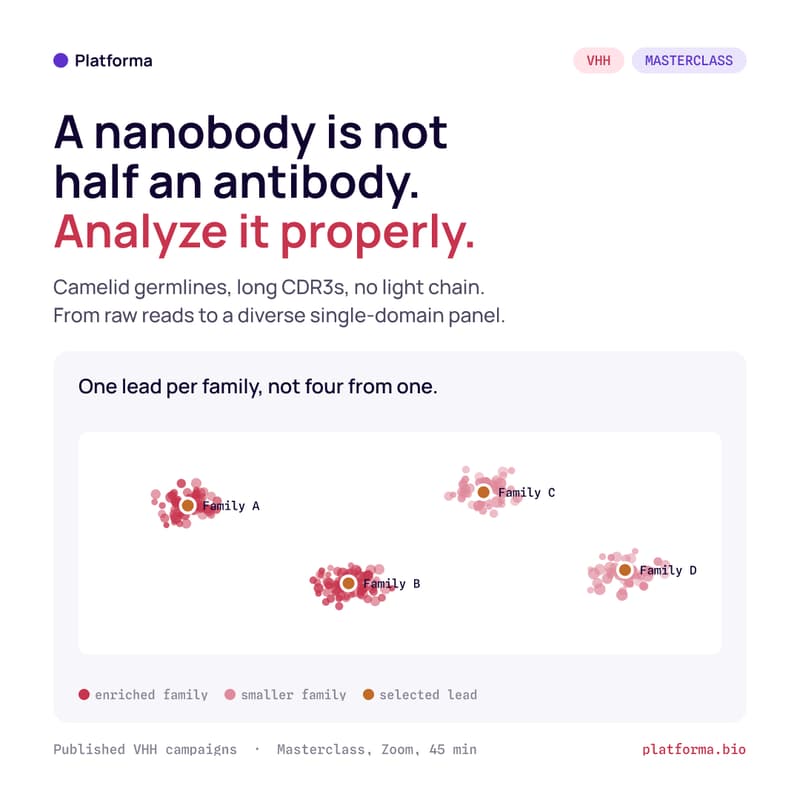
Grouping single-domain binders into families: cluster on the loop that does the binding, so a family of variants is treated as one candidate
Reading enrichment on single domains: track which families survived selection, with the controls that separate binding from display
Screening single-domain liabilities: the developability motifs that matter for VHH, scored before anything reaches synthesis
Selecting a diverse panel: spread the final picks across distinct families so the shortlist covers more than one epitope
Who should attend:
Scientists running camelid immunization campaigns or synthetic VHH libraries
Bioinformaticians who have had to patch human-antibody tools to make camelid data work
Discovery and project leads building single-domain pipelines, including shark VNAR and other heavy-chain-only formats