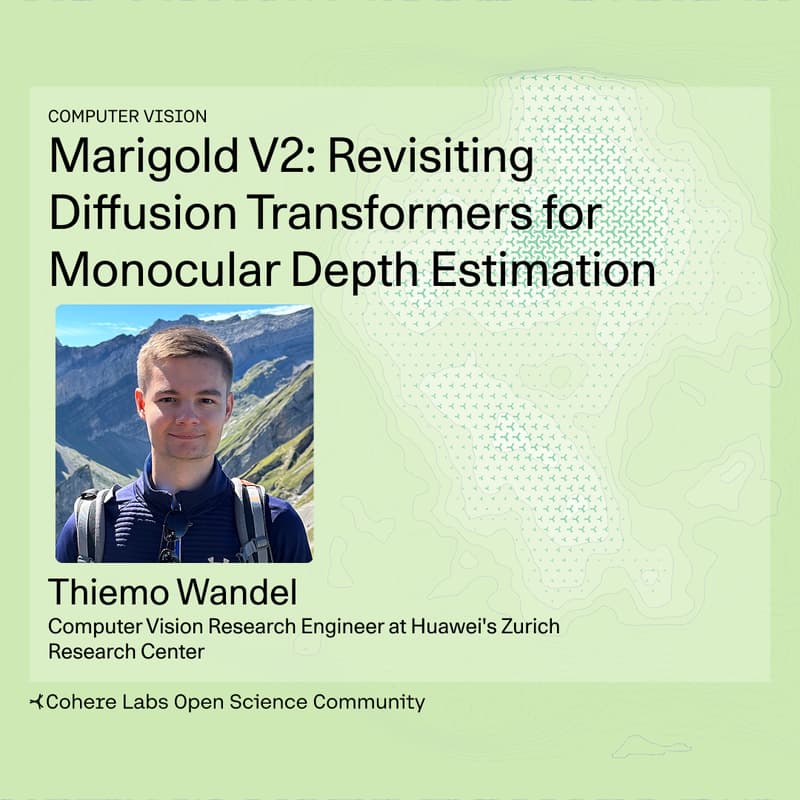

Thiemo Wandel - Marigold V2: Revisiting Diffusion Transformers for Monocular Depth Estimation
Monocular depth estimation is a ubiquitous yet highly ill-posed computer vision task, with downstream applications in scene reconstruction, computational photography, and robotics, among others. Despite the field's maturity, recent models still struggle to generalize to out-of-distribution inputs and to produce sharp and detailed depth maps. In this talk, we revisit Marigold, a set of techniques for repurposing modern image generation and editing models, powered by the diffusion transformer (DiT) architecture, into state-of-the-art monocular depth estimators. Our recipes target single-step inference from pretrained multi-step flow-matching models, with quantization where needed, preserving model capacity while remaining cheap to run. We analyze the artifacts of naive training and adopt a 2-stage fine-tuning protocol built around a novel Sinkhorn-based loss. The results are crisper, cleaner depth maps that generalize well out-of-distribution, with 16-26% improvement in AbsRel over the previous best on KITTI and ETH3D. Qualitatively, the model resolves fur, foliage, and hair-thin edges that have eluded prior models. Furthermore, Marigold V2 achieves state-of-the-art results when applied to other dense regression tasks, such as surface normals estimation and intrinsic image decomposition.
Bio: Thiemo Wandel is a Computer Vision Research Engineer at Huawei's Zurich Research Center, where he develops computational photography algorithms for Huawei's latest phones. He graduated with an MSc in Electrical Engineering and Information Technology from ETH Zurich in 2024, joined Huawei as a research intern in 2025, and won the Best Newcomer Award in 2026. His research interests include depth estimation, computational photography, and more broadly generative AI and 3D vision.