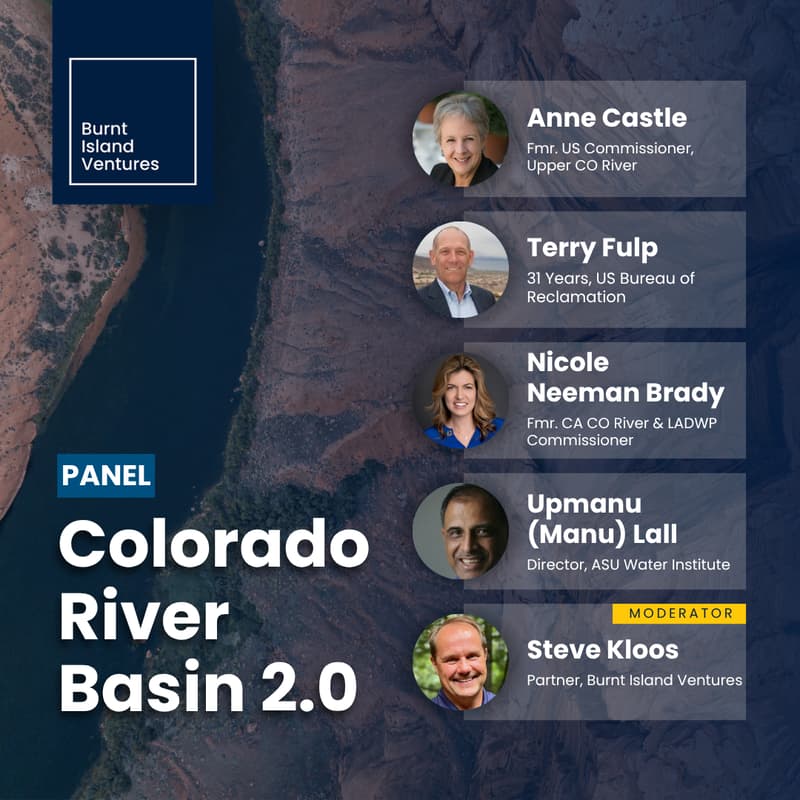

Colorado River Basin 2.0 Webinar
The Colorado River Basin was engineered for a different hydrological reality. It's time for Basin 2.0.
The basin's operating rules expire at the end of 2026, but the new framework will deliver incremental fixes. The redesign to a durable operating system, what we're calling Basin 2.0, is what has to come next.
This webinar is about what Basin 2.0 could look like and what it will take to get there. The basin's assets and the toolkit already exist. What's missing is leadership, capital, and the political will to use them.
Stabilizing the basin might require only $1-2B/yr, against a $1.5T annual basin economy: an "insurance premium" of only about 0.1% to create a durable operating system for one of the most important watersheds in North America. A hard problem, but a solvable one.
What we'll cover
The Situation: What the current reality is and why a full reset is needed
Upgrading to Basin 2.0: The real toolkit, from agriculture to urban reuse and the water-energy nexus
Who Pays? The cost of stabilization and the mechanisms to fund it
The Panelists
Anne Castle: Upper Basin policy, federal Interior background, and tribal water access
Nicole Neeman Brady: California and Lower Basin; urban utility, agriculture, and investor lens
Terry Fulp: Retired U.S. Bureau of Reclamation; Lower Basin operations and basin negotiation
Upmanu (Manu) Lall: Academic and structural critique; water-energy systems
Moderated by Steve Kloos, Burnt Island Ventures