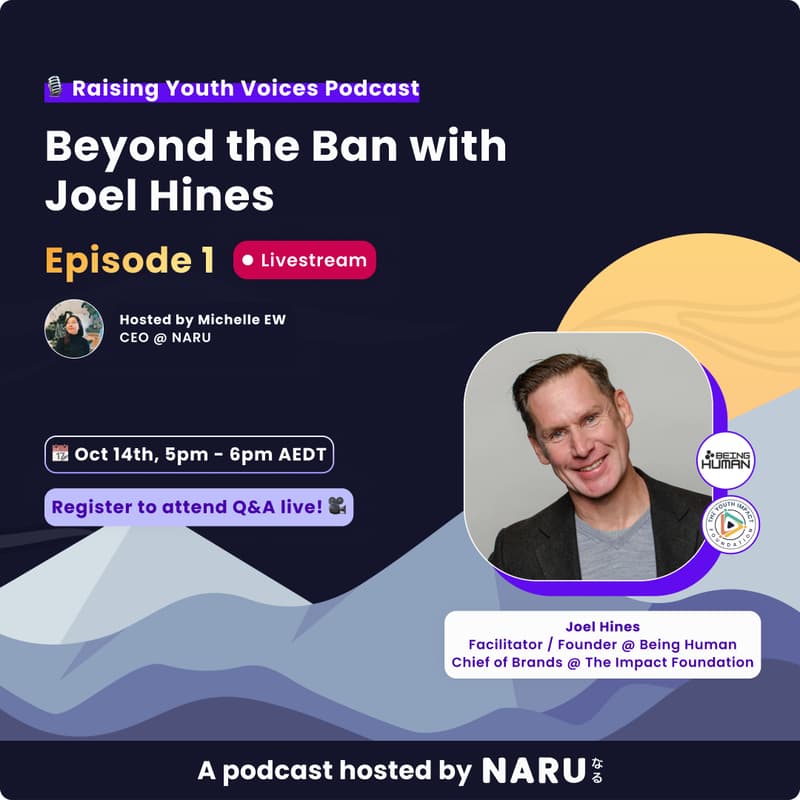

Beyond the Ban - Episode 1 with Joel Hines & Mark Ong
Register to receive a link to the podcast recording after the session. 🎥
Taking social media away doesn't take away the need for connection.
The conversation around Australia's social media age restrictions often focuses on what young people will no longer be able to access.
But there is another question worth asking:
What will they turn to instead?
Young people don't go online simply because they have access to an app.
They go looking for friendship, belonging, identity, status, validation, entertainment and direction.
For boys especially, the search for direction can take them into places adults may not see until the influence has already taken hold.
So what happens when one of the places where young people were finding those things is removed?
Does the need disappear?
Or does it simply move somewhere else?
Meet the Guests
Joel Hines is the founder of Being Human and a youth development practitioner working at the intersection of connection, wellbeing, education and human development.
A former occupational therapist, school principal and facilitator, Joel has spent more than two decades working with young people, educators, parents and community organisations.
His work has included programs with organisations such as The Man Cave, Rites of Passage Institute and Movember, helping young people develop emotional literacy, resilience, relationships and a stronger sense of self.
He is also the author of Holding Space and Holding Space for Your Son, and the creator of the THRIVE framework.
His work gives him a particularly useful perspective on a question that is often missing from the social media debate: What are young people actually looking for when they go online?
We will be joined by our youth guest, Mark Ong, a 2nd year student at the University of Melbourne. Together, we’ll uncover how the ban has really changed young people’s lives.
What we'll explore
What happens when the platform disappears?
Does removing social media remove the harm — or simply move young people's needs somewhere else
Where do boys go looking for a map?
Boys don't always encounter harmful online figures because they're inherently bad. Sometimes they're looking for answers, identity and direction.
What happens when those searches move into less visible corners of the internet?
What are young people missing in the first place?
The debate often focuses on what young people are losing. But what if the bigger question is what they needed before they went online?
Will boys experience the restrictions differently?
The under-16 restrictions treat young people as one broad group. But boys and girls can experience online culture, belonging and social pressure differently.
Is anyone planning for that?
What should replace what we're taking away?
If governments restrict access to social media, what needs to exist alongside those restrictions?
More programs? Better communities? New forms of belonging?
And what's coming next?
If young people are moving away from social media, where will their attention and need for connection go next?
Could AI become part of that picture?
Who should attend?
This conversation is for people who work with, care about or design for young people:
Parents and carers
Educators and school leaders
Youth organisations and youth workers
Community builders
Researchers and policymakers
People working in youth wellbeing and digital safety
Anyone trying to understand how young people will build connection in a changing digital world
You don't need to work in technology to join the conversation.
If young people are part of your work, this conversation is for you.
About NARU
NARU is exploring what safe digital community can look like for young people in a world where the way they connect online is changing.
We believe young people still need places to build friendships, find belonging, learn from their peers and participate in communities.
The question is what those spaces should look like.
That means listening to the people closest to the issue, young people, parents, educators, youth organisations, researchers and community leaders.
This conversation is part of that work.