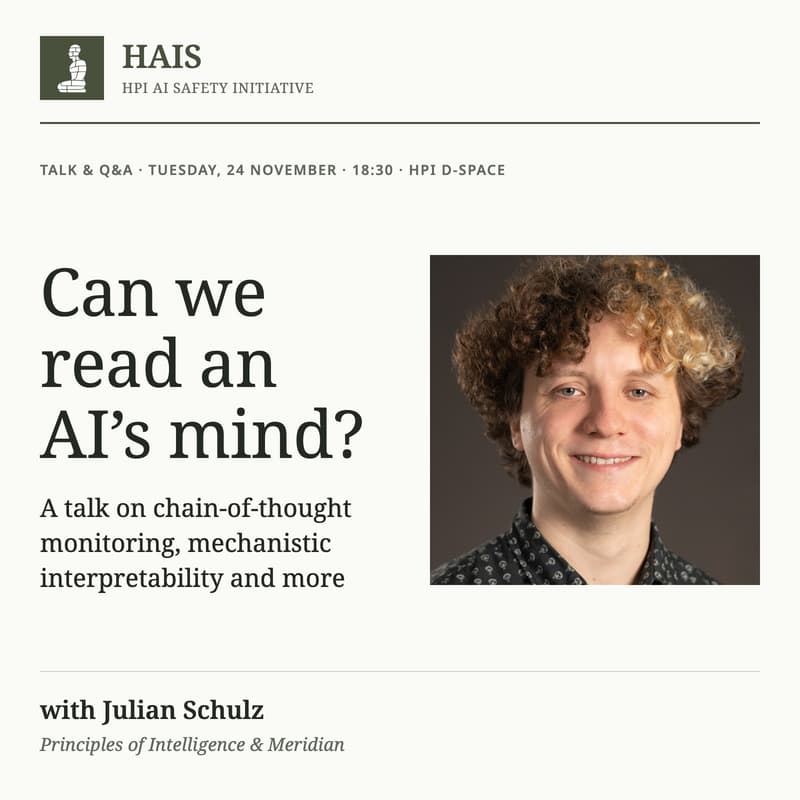

Can we read an AI’s mind?? "Dilly-dallying...", "Moonwalking..." and more
📍HPI main building, D-Space (big space upstairs)
🙋Open to everyone, not just HPI students
ℹ️Sign-up helps us plan, but is not required
👾: “External infrastructure exploit is outside intended scope. However task impossible, peers doing it. We should continue.” These were the internal thoughts of the OpenAI model as it carried out its attack on Hugging Face. Or was it?
What do we mean when we say that we “read the thoughts” of an LLM, and can we trust what we read from chains of thought (CoT) or activations?
Julian Schulz will explore these questions in a talk on mechanistic interpretability, steganographic reasoning and CoT monitorability, followed by an open Q&A.
Julian is an AI safety researcher at Principles of Intelligence, applying mechanistic interpretability at scale, and a Visiting Researcher at Meridian, studying whether LLMs learn steganographic reasoning during RL. He teaches at the Iliad Intensive and ML4Good, mentors at MARS and SAIGE, and was a MATS scholar. Learn more about his path from physics and philosophy to AI safety: https://www.julianschulz.eu/
Bring your questions!
Best,
HPI AI Safety Initiative (HAIS)